Seeing clearly into a new realm – researchers prototype a new generation of quantum microscopy
“What began as an experimental annoyance ended up being a hint towards a capability of our microscope that is unique among current alternatives”
Advertisement


While quantum computing seems like the big-ticket item among the developing technologies based on the behaviour of matter and energy on the atomic and subatomic level, another direction promises to open a new door for scientific research itself – quantum microscopy.
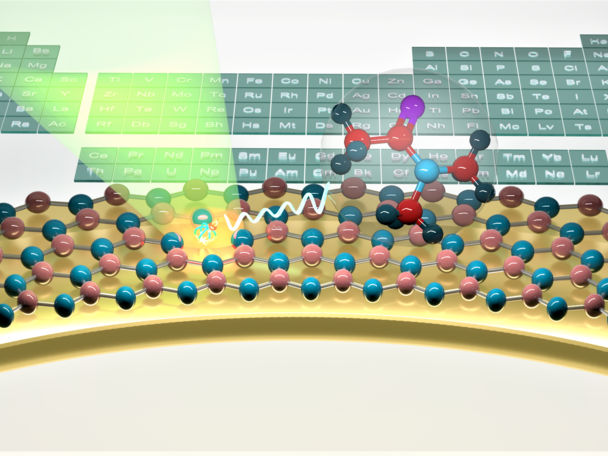
An artist's impression of a quantum microscope for study of chemical reactions and to identify molecular origin.
Dr Mehran Kianinia
With the advance of quantum technologies, new microscopy modalities are becoming possible – ones that can see electric currents, detect fluctuating magnetic fields, and even see single molecules on a surface.
A prototype of such a microscope, demonstrating high resolution sensitivity, has been developed by an Australian research team headed by Professor Igor Aharonovich of the University of Technology Sydney and Dr Jean-Philippe Tetienne of RMIT University. The team’s findings have now been published in Nature Physics.
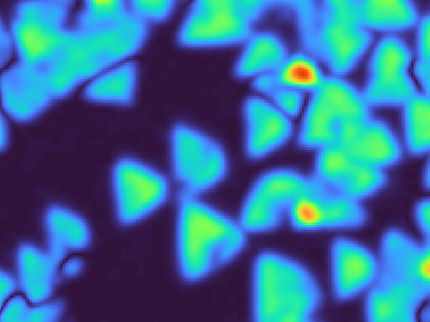
The quantum microscope is based on atomic impurities, that following laser illumination, emit light that can be directly related to interesting physical quantities such as magnetic field, electric field or the chemical environment in proximity to the defect.
Professor Aharonovich said the ingenuity of the new approach was that, as opposed to the bulky crystals often employed for quantum sensing, the research team had utilised atomically thin layers, called hexagonal boron nitride (hBN).
“This van der Waals material – that is, made up of strongly bonded two-dimensional layers – can be made to be very thin and can conform to arbitrarily rough surfaces, thus enabling high resolution sensitivity,” Professor Aharonovich said.
“These properties led us to the idea of using ‘quantum-active’ hBN foils to perform quantum microscopy, which essentially is an imaging technique that utilises arrays of quantum sensors to create spatial maps of the quantities they are sensitive to,” Dr Tetienne said.
“Until now, quantum microscopy has been limited in its spatial resolution and flexibility of application by the interfacing issues inherent in using a bulky three-dimensional sensor. By instead utilising a van der Waals sensor, we hope to extend the utility of quantum microscopy into arenas that were previously inaccessible.”
To test the capabilities of the prototype, the team performed quantum sensing on a technologically relevant magnetic material – a flake of CrTe2, a van der Waals ferromagnet with a critical temperature just above room temperature.
The hBN based quantum microscope was able to image the magnetic domains of the ferromagnet, with nanoscale proximity to the sensor, and under ambient conditions – something that was believed to be impossible to date.
Moreover, utilising the unique properties of the hBN defects, a simultaneous temperature map was recorded, confirming that the microscope can be used to perform correlative imaging between the two quantities.
Lead authors for the Nature Physics paper, PhD students Alex Healey (University of Melbourne) and Sam Scholten (University of Melbourne), and early career researcher Tieshan Yang (UTS), said the van der Waals nature of the sensor had allowed the dual sensing of magnetic properties and temperature.
“Because it is very thin, not much heat is able to dissipate through it and any temperature distribution that exists is the same as if the sensor were not there,” they said. “What began as an experimental annoyance ended up being a hint towards a capability of our microscope that is unique among current alternatives.”
“There is a huge potential for this new generation of quantum microscopy,” UTS senior researcher Dr Mehran Kianinia said. “Not only can it operate at room temperature and provide simultaneous information on temperature, electric and magnetic fields, it can be seamlessly integrated into nanoscale devices and withstand very harsh environments, as hBN is a very rigid material.
“The main future applications include high resolution MRI (magnetic resonance imaging) and NMR (nuclear magnetic resonance) that can be used to study chemical reactions and identify molecular origins, as well as applications in space, defence and agriculture where remote sensing and imaging are key.”
Original publication


Other news from the department science




















Most read news












More news from our other portals


























See the theme worlds for related content
Topic world Sensor technology
Sensor technology has revolutionized the chemical industry by providing accurate, timely and reliable data across a wide range of processes. From monitoring critical parameters in production lines to early detection of potential malfunctions or hazards, sensors are the silent sentinels that ensure quality, efficiency and safety.

Topic world Sensor technology
Sensor technology has revolutionized the chemical industry by providing accurate, timely and reliable data across a wide range of processes. From monitoring critical parameters in production lines to early detection of potential malfunctions or hazards, sensors are the silent sentinels that ensure quality, efficiency and safety.
Last viewed contents
Indo-German research collaboration in the field of surface engineering and thin films officially started

Production begins at BASF’s largest Indian investment to date - BASF inaugurates chemical complex in Dahej, India
Portable and precise gas sensor could monitor pollution and detect disease
Monitoring of Critical Raw Material Recycling from Battery Black Mass - This study demonstrates the effective use of measuring instruments for separation and analysis
Making biodiesel from dirty old cooking oil just got way easier - New ultra-efficient catalyst can recycle old cooking oil into biodiesel and turn food scraps into high-value complex molecules
New catalyst developed for sustainable propylene production from biomass - Propylene production harnesses biodiesel waste byproduct
BASF expanding mobile emissions catalysts production capacity in India

Evonik to expand sodium methylate capacity in Argentina

Newly discovered material property may lead to high temp superconductivity