‘Lab-on-a-drone’ sends science skyward to keep track of smelly air pollution
A low-cost 3D printed analytical IoT platform for vertical monitoring of gaseous hydrogen sulphide
Advertisement


Polluted air can contribute to the development of asthma and other conditions, and the first step toward combating its effects is continuous, accurate monitoring. Most measurement devices are stationary, placed just feet above the ground, but contaminants can drift away. Now, researchers publishing in ACS’ Analytical Chemistry have developed a “lab-on-a-drone” system that, unlike similar gadgets, can detect and analyze levels of pollutants, such as smelly hydrogen sulfide gas, all while still floating in mid-air.
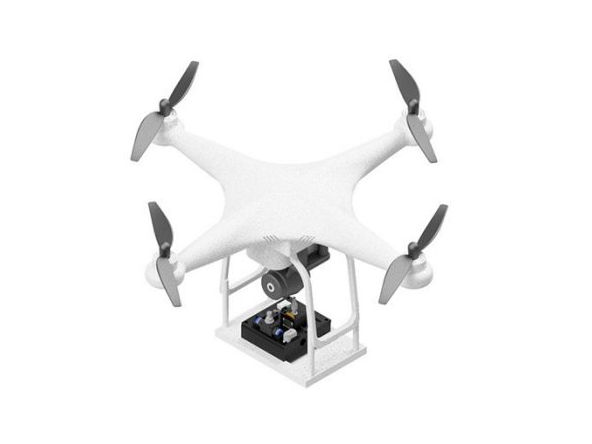
This modified quadcopter drone can detect and analyze hydrogen sulfide gas while in the air.
Adapted from Analytical Chemistry, 2023, DOI: 10.1021/acs.analchem.3c02719
Hydrogen sulfide (H2S) is one of the stinkiest air pollutants, well known for its putrid, rotten-egg odor. Though it’s naturally found in well water and volcanic emissions, it’s also a common byproduct of petroleum refineries and wastewater treatment plants. The gas is an irritant, and in high enough amounts, it can be toxic. Most methods to quantify H2S and other pollutants rely on ground-based instruments, and expensive devices such as satellites are required to collect measurements at higher altitudes. Unmanned drones have been used by researchers to gather samples in mid-air, but analyses still had to be performed on the ground with traditional instruments. So, João Flávio da Silveira Petruci and colleagues wanted to create an inexpensive “lab-on-a-drone” that could sample and analyze H2S gas while in the air and report the results in real time — a first for devices of its kind.
Using a 3D printer, the team manufactured a custom device that was mounted to the bottom of a commercially available quadcopter drone. It took advantage of a unique chemical reaction between H2S and a green-glowing fluorescein mercuric acetate molecule. When excited by an onboard blue LED light, the interaction caused a decrease in the green fluorescence intensity, which was detected and quantified. This reaction is highly selective and was not affected by other, interfering gaseous air pollutants.
The team took their drone to a wastewater treatment plant, where it sampled air on the ground, then at around 30 and 65 feet in the air at three different times throughout the day. The detection device transmitted its results via Bluetooth to a smartphone, allowing for real-time monitoring. In the evening, there was a clear increase in H2S concentration as the drone increased altitude, though it never exceeded the acceptable ambient level. The researchers say that this system could be adapted to detect other pollutants in the future.
Original publication


Other news from the department science





















Most read news












More news from our other portals

























Last viewed contents

Molecular catalysts could help unlock the promise of lithium–sulfur batteries - New review explains how catalysts working at battery surfaces or within electrolytes can accelerate sulfur conversion and guide the design of next-generation energy storage
The power of going small: Copper oxide subnanoparticle catalysts prove most superior
Unique X-ray Topography Based Defect Characterization for SiC Wafers Honored with Georg Waeber Innovation Award 2023

Bodo Möller Chemie Group enters exclusive acquisition talks with Rocktin - Strengthen adhesives distribution in Asia
Researchers develop procedure to interpret x-ray emission spectra of liquid water - Study helping to advance the understanding of the structure of water

How can life emerge in a world of minerals? - The European Research Council (ERC) has awarded an ERC Synergy Grant to the project “The role of silica at the dawn of life on our planet” (PROTOS)

New reactor could save millions when making ingredients for plastics and rubber from natural gas - With oil production dropping, a process using natural gas is needed to avert a shortage of a workhorse chemical used for automotive parts, cleaning products and more

Manganese could make luminescent materials and the conversion of sunlight more sustainable
Fibers from old tires can improve fire resistance of concrete

Consortium develops evolutionary concept for recycling of end-of-life polyurethane mattress foams - Ecomaison, Covestro, Secondly and Federal Eco Foam launch research project

Controversial Mass Products: Ceresana Analyzes the Global Market for Plasticizers