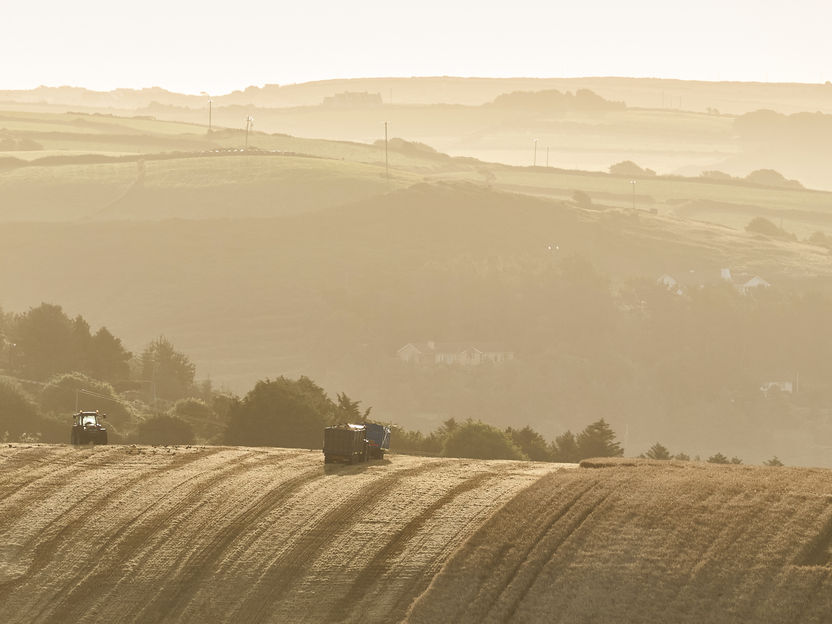
Non-exhaust emissions from trains are not negligible
Trains cause particulate matter pollution along railway lines

Advertisement


One of the first major studies on abrasion emissions from rail vehicles shows that a lot of particulate matter contaminated with heavy metals is produced especially along railway lines.
In addition to exhaust emissions, abrasion emissions from tyres and brakes have become increasingly important when assessing the environmental impact of traffic. However, the focus here was on road vehicles; rail was hardly considered. In a study commissioned by the German Centre for Rail Transport Research (DZSF), researchers from the Institute of Thermodynamics and Sustainable Propulsion Systems at Graz University of Technology (TU Graz) have now been able to prove that so-called non-exhaust emissions from rail transport also have a relevant influence on air quality and soil pollution.
Half of the daily particulate matter limit due to trains alone
This applies especially to areas along railway line sections where there is increased braking; this includes station approaches and sections with speed limits. The abrasion emissions from rail vehicles alone reached values of up to 25 micrograms of particulate matter in the PM10 category (particles with a diameter of less than ten micrometres) per cubic metre as a daily average in Augsburg along the railway lines investigated for the study. This already corresponds to half of the permissible limit of 50 micrograms per cubic metre.
With increasing distance from the railway lines – from about ten metres – the pollution from the abrasion of the rail vehicles decreases rapidly, but the fine particulate matter also enters the soil and water and is deposited there. The proportion of heavy metals in railway emissions is significantly higher than in other modes of transport, which is reflected in more heavily polluted deposits. DZSF chemists involved in the project were able to detect these residues in bodies of water.
Contribution to closing the data gap
In order to determine the composition and source of the abrasion particles, the components involved were analysed in various laboratories. Daniel Fruhwirt and his team tested several brake pads in the new brake test rig for rail vehicles at TU Graz. At the Politecnico di Milano, researchers analysed the abrasion of the contact wire and the pantograph in order to be able to classify the fine dust emissions from trains on overhead lines. And at DB Systemtechnik in Berlin, the team scrutinised the wheel-rail contact. The resulting data made it possible to allocate the emissions to air, soil and water to the rail vehicles.
“Based on our study, we can clearly say that non-exhaust emissions from rail are not negligible,” explains Daniel Fruhwirt from the Institute of Thermodynamics and Sustainable Propulsion Systems at TU Graz. “Before we did this study, there was a huge gap in the data on abrasion emissions from rail vehicles and we were able to make a significant contribution to closing it. Although emissions do not single-handedly cause pollutant limits to be exceeded, they certainly play a role in the overall mix. It is therefore important that efforts are made to also assess emissions behaviour in the future when certifying brakes.”



Other news from the department science





















Most read news












More news from our other portals

























Last viewed contents
Controversial Mass Products: Ceresana Analyzes the Global Market for Plasticizers
New metal-free, recyclable polypeptide battery that degrades on demand - Breakthrough could lead to battery production moving away from cobalt
Shedding light on mechanisms of electrochemical energy storage - UV-visible spectroscopy gives researchers a tool to study battery materials - a breakthrough that could speed the design of higher performing energy storage devices
Researchers discover new ultra strong material for microchip sensors - A material that doesn't just rival the strength of diamonds and graphene, but boasts a yield strength 10 times greater than Kevlar

Brown chemists report promising advance in fuel-cell technology

Climate pioneers cooperate to produce solar fuels - INERATEC joins forces with Synhelion

Micro- and nanoplastics in the body are passed on during cell division - That plastic may increase metastasis of tumors
Search for new semiconductors heats up with gallium oxide
Smoltek Hydrogen and Heraeus Precious Metals advance next-generation ultra-low iridium electrolysis technology
Chemistry without detours: Researchers introduce a two-step process for producing phosphorus-containing chemicals - This promising innovation not only contributes to environmental protection but also saves significant time and costs

Evidence stacks up for poisonous books containing toxic dyes