Synthetic mini-motor with enormous power developed: Hope for use in the organism
Bacteria as a role model: Conversion of chemical energy into rotational energy at the supramolecular level for the first time

Advertisement


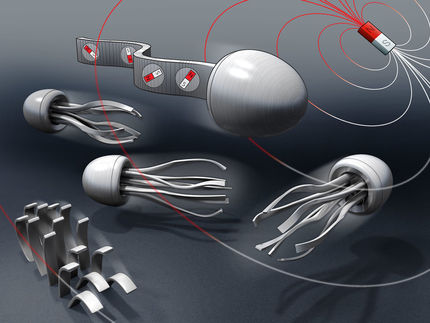
Researchers at the Technical University of Munich (TUM) have developed an artificial motor at the supramolecular level that can develop impressive power. This wind-up motor is a tiny ribbon made of special molecules. When energy is applied, this ribbon aligns itself, moves like a small fin and can thus push objects. For the first time, the energy for this comes from a chemical fuel.
Until now, the conversion of chemical energy into rotational energy on a supramolecular level, i.e. for small objects consisting of more than one molecule, was only known from biology. Primitive bacteria, known as archaea, use the chemical fuel ATP to rotate their tiny fin-like locomotion organs, the flagella, and thus move around. Synthetic replicas of this process have not existed until now. In the future, the new development could be used in nanorobots that swim through blood vessels to detect tumor cells, for example.
Chemical fuel drives the rotation
The peptide ribbons developed by a team led by Brigitte and Christine Kriebisch and Job Boekhoven, Professor of Supramolecular Chemistry, are a few micrometers long and just a few nanometers wide. When chemical fuel is added, they gain structure and the ribbons curl up into small tubes, causing them to begin to rotate. This process can even be observed live under the microscope.
The researchers discovered that they can control the rotation speed of the ribbons by the amount of fuel added. In addition, the direction of rotation - clockwise or anti-clockwise - can be influenced by the structure of the molecular building blocks of the ribbons. The research results were published in the journal Chem.
Crawling on surfaces
Together with Prof. Matthias Rief, TUM Professor of Molecular Biophysics, who works on state-of-the-art optical measurement methods, the researchers found that the ribbons exert enough force on their surroundings to move micrometer-sized objects. Determining the force is one of the most important results for practical use.
If several rotating ribbons are brought together at a central point, for example, small “micro-walkers” are created that can crawl along surfaces. In the future, after further improvements, these micro-walkers could possibly be used for medical applications such as transporting drugs in the body. The fuel used is not yet suitable for this, as it would be harmful to the organism.
Original publication


Other news from the department science





















Most read news












More news from our other portals

























Last viewed contents
Siemens and CAPHENIA accelerate scale-up of Sustainable Aviation Fuel - Siemens supports CAPHENIA from pilot plant to commercial scale-up

Thianthrenium chemistry allows for reactivity switch of a nucleophilic amino acid into a versatile intermediate - Useful and broadly applicable tool in the field of chemical biology

BASF inaugurates new $1 billion MDI production facility at its Geismar Verbund site - BASF’s largest single investment made to date in the U.S.

Akeno receives 4.5 million euros for real-time production planning - From BASF project to international rollout
Pitt researchers harness carbon nanomaterials for drug delivery systems, oxygen sensors - Researchers describe carbon nanocapsules for drug and energy storage in Advanced Materials, creation of highly sensitive oxygen sensors in Nature Chemistry
How to produce fluorescent nanoparticles for medical applications in a nuclear reactor
Water, Clay and Carbon: A New Route to Sustainable Energy Storage - Researchers demonstrate an all-water supercapacitor stable over 60,000 charging cycles
Don't Give the Slightest Chance to Toxic Elements in Medicinal Products - New high-accuracy reference solutions for the SI-traceable measurement

Bodo Möller Chemie Group enters exclusive acquisition talks with Rocktin - Strengthen adhesives distribution in Asia
Researchers develop procedure to interpret x-ray emission spectra of liquid water - Study helping to advance the understanding of the structure of water

How can life emerge in a world of minerals? - The European Research Council (ERC) has awarded an ERC Synergy Grant to the project “The role of silica at the dawn of life on our planet” (PROTOS)