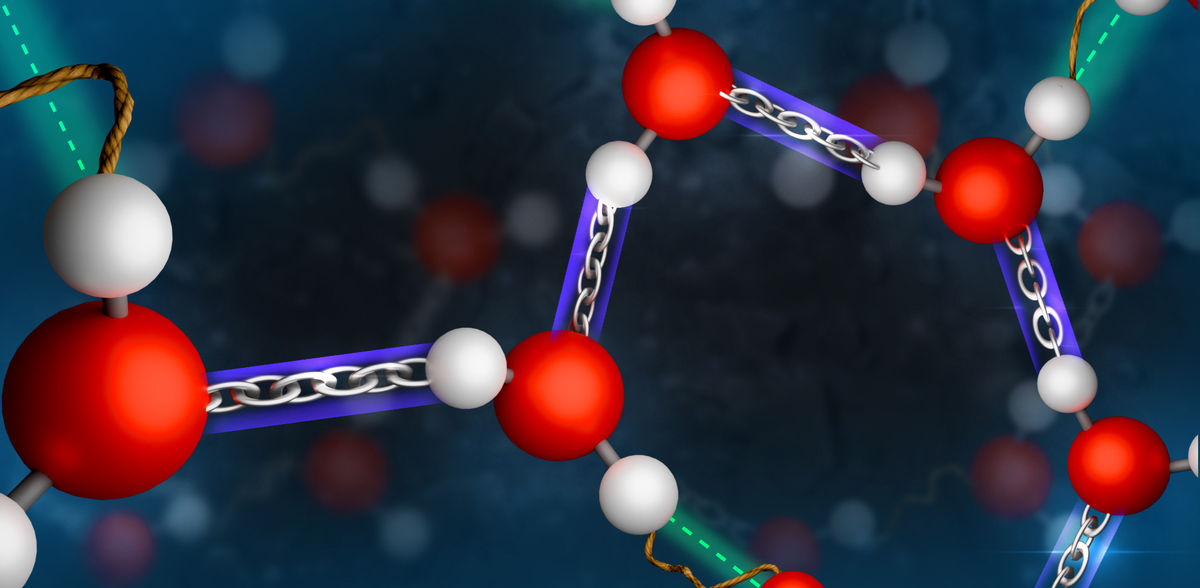
Liquid water molecules are inherently asymmetric
New insight into the bonds between water molecule
Advertisement


Icebergs float on water because the underlying liquid water has a higher density than the iceberg. Liquid water itself has its highest density at 4°C - one of the so-called anomalies of water, i.e. properties of liquids that are rarely observed for other liquids.
The origins of these anomalies have long been the subject of scientific research. Researchers at the Max Planck Institute for Polymer Research have now discovered another piece to the puzzle to explain the special behavior of water.
Many of the anomalous properties of water can be traced to the special interactions between the individual water molecules - the so-called hydrogen bonds. Each water molecule can donate two of these bonds – one from each hydrogen atom – and accept two of them from other, neighboring molecules. Unlike in ice, these bonds are broken and re-formed on average 1 trillion times per second in liquid water, so that the water molecules can be packed closer together and move very quickly. Due to the rapid movement of the water molecules in the liquid, one might assume that the strength of the individual bonds to its neighbors is purely random.
However, the team led by group leader Johannes Hunger has discovered that the hydrogen bond distances are not simply random, but that two bonds of a molecule have different strengths: If one bond is very strong - i.e. the first neighboring water molecule is very close - the second hydrogen bond is weak - i.e. the second neighboring water molecule is further away.
These alternating bond distances lead to structuring of the nominally disordered liquid: if you move from one water molecule to the next and to the one after that, there is always a strongly bonded neighboring molecule. As a result, structures such as rings or chains of water molecules can form in the liquid. The structure of liquid water is therefore not just a random arrangement of individual water molecules but follows certain rules.
To obtain these results, the scientists diluted water with a solvent so that they could examine isolated water molecules. They made individual atoms of the water molecules vibrate with the help of lasers and investigated how the vibrations influence each other. This allowed them to measure the strength of individual hydrogen bonds and the strength of the neighboring bond at the same time.
The study, which has now been published in the journal “Nature Communications”, contributes to a comprehensive understanding of the anomalies of water at a molecular level.
Original publication


Other news from the department science





















Most read news












More news from our other portals

























Last viewed contents

Green steel from toxic red mud - An economical process with green hydrogen can be used to extract CO2-free iron from the red mud generated in aluminium production
Team tracks real-time molecular motions - Important new insights into a key process for the development of more efficient solar cells
Researchers turn coffee and plastic waste into climate solution - “What begins with a Starbucks coffee cup and a discarded plastic water bottle can become a powerful tool in the fight against climate change...”

Team develops bioprocess for converting plant materials into valuable chemicals

Wonder material graphene claims yet another superlative
Magnets trump metallics - Magnetic fields can block conductivity of carbon nanotubes

Cellphone converts into powerful chemical detector - With only $50 worth of components, an ordinary cellphone transforms into a sophisticated scientific instrument, capable of identifying chemicals, drugs, and pathogens
Dual-function organic molecule may advance display technologies and medical imaging - Researchers overcome a long-standing molecular design challenge by realizing efficient light emission and photon absorption in the same compound.

Cylib selected as Strategic Project under EU Critical Raw Materials Act - cylib is building a facility in Dormagen designed to process up to 140,000 EV batteries per year