Lithium-sulphur pouch cells investigated at BESSY II
Degradation processes examined
Advertisement


A team from HZB and the Fraunhofer Institute for Material and Beam Technology (IWS) in Dresden has gained new insights into lithium-sulphur pouch cells at the BAMline of BESSY II. Supplemented by analyses in the HZB imaging laboratory and further measurements, a new picture emerges of processes that limit the performance and lifespan of this industrially relevant battery type. The study has been published in the journal Advanced Energy Materials.
Lithium-sulphur batteries have a number of advantages over conventional lithium batteries: they use the abundant raw material sulphur, do not require the critical elements cobalt or nickel, and can achieve extremely high specific energy densities. Prototype cells are already achieving up to 500 Wh/kg, almost twice as much as current lithium-ion batteries.
Degradation processes examined
However, lithium-sulphur batteries have so far been much more susceptible to degradation processes: during charging and discharging, dissolved polysulphides and sulphur phases form on the lithium electrode, gradually reducing the performance and lifetime of the battery. ‘Our research aims to elucidate these processes in order to improve this type of battery,’ says HZB physicist Dr. Sebastian Risse, who leads a team at HZB working on operando analysis of batteries.

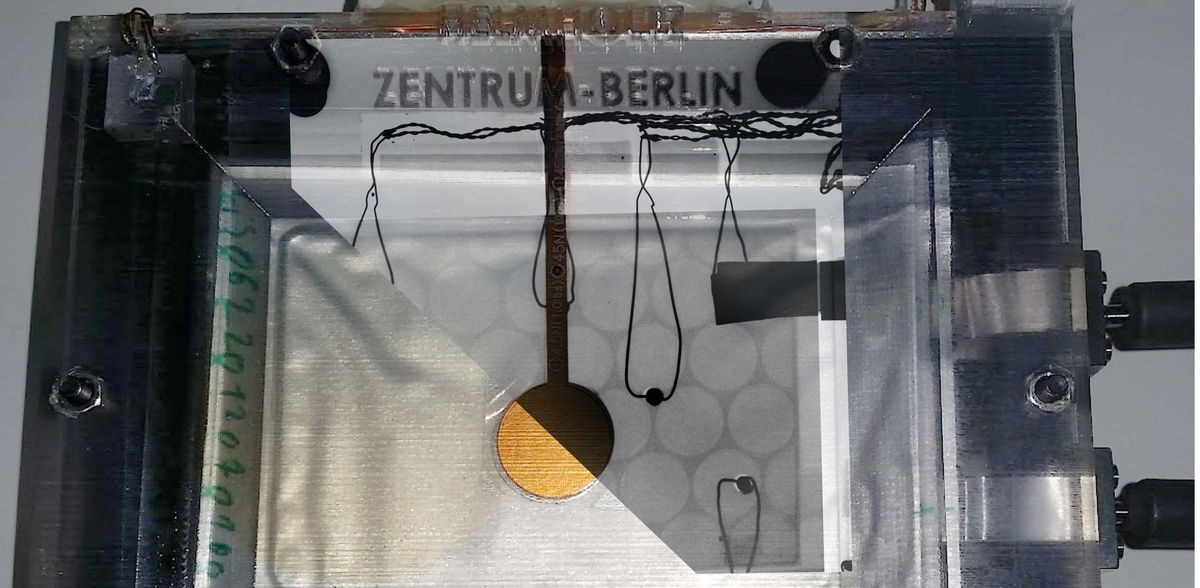
The pouch cell lab at HZB
He is focusing on pouch cells, a battery format widely used in industry. HZB's Institute for Electrochemical Energy Storage (CE-IEES), headed by Prof. Yan Lu, has therefore set up a laboratory specialising in the production of lithium-sulphur batteries in the required pocket format. Here, scientists can produce and investigate a wide variety of lithium-sulphur pouch cells. As part of the BMBF-funded 'SkaLiS' project, coordinated by Sebastian Risse, a team from the Fraunhofer Institute for Material and Beam Technology (IWS) in Dresden has now published a comprehensive study of lithium-sulphur pouch cells in the prestigious journal Advanced Energy Materials.
Multimodal setup
The battery cells were studied in a setup developed at HZB using various methods such as impedance spectroscopy, temperature distribution, force measurement and X-ray imaging (synchrotron and laboratory source) during charging and discharging. For the first time, we were able to observe and document both the formation of lithium dendrites and the dissolution and formation of sulphur crystallites during multi-layer battery operation,' says Dr Rafael Müller, HZB chemist and first author of the study.
Phase-contrast radiography at BESSY II
In particular, phase-contrast radiography with coherent synchrotron light at the BAM beamline at BESSY II allowed us to follow the morphology of the only weakly absorbing lithium metal and to correlate it with other measurement data, giving us a comprehensive picture. X-ray analyses in the imaging laboratory at HZB, carried out in collaboration with the imaging group of Dr Ingo Manke, also allowed the formation of strongly absorbing sulphur crystals to be analysed during battery operation.
Outlook: High-energy battery systems
‘Our results bridge the gap between basic research and technology transfer, and in particular allow conclusions to be drawn about the scalability of this battery technology and the further development of high-energy battery systems,’ says Risse. Among other things, the team showed that a new design approach by the IWS Dresden is promising: a perforated and thus significantly lighter cathode current collector does not impair the performance of the cell.
The results of this study will help to optimise the performance and lifetime of lithium-sulphur batteries, so that this promising battery type can meet the requirements of mobile and stationary energy storage systems.
Original publication
Rafael Müller, Tom Boenke, Susanne Dörfler, Thomas Abendroth, Paul Härtel, Holger Althues, Stefan Kaskel, Nikolay Kardjilov, Henning Markötter, Michael Sintschuk, André Hilger, Ingo Manke, Sebastian Risse; "Multimodal Operando Analysis of Lithium Sulfur Multilayer Pouch Cells: An In‐Depth Investigation on Cell Component Design and Performance"; Advanced Energy Materials, 2025-1-7


Other news from the department science





















Most read news












More news from our other portals

























See the theme worlds for related content
Topic World Spectroscopy
Investigation with spectroscopy gives us unique insights into the composition and structure of materials. From UV-Vis spectroscopy to infrared and Raman spectroscopy to fluorescence and atomic absorption spectroscopy, spectroscopy offers us a wide range of analytical techniques to precisely characterize substances. Immerse yourself in the fascinating world of spectroscopy!

Topic World Spectroscopy
Investigation with spectroscopy gives us unique insights into the composition and structure of materials. From UV-Vis spectroscopy to infrared and Raman spectroscopy to fluorescence and atomic absorption spectroscopy, spectroscopy offers us a wide range of analytical techniques to precisely characterize substances. Immerse yourself in the fascinating world of spectroscopy!
Topic World Battery Technology
The topic world Battery Technology combines relevant knowledge in a unique way. Here you will find everything about suppliers and their products, webinars, white papers, catalogs and brochures.

Topic World Battery Technology
The topic world Battery Technology combines relevant knowledge in a unique way. Here you will find everything about suppliers and their products, webinars, white papers, catalogs and brochures.
Last viewed contents
Shedding light on mechanisms of electrochemical energy storage - UV-visible spectroscopy gives researchers a tool to study battery materials - a breakthrough that could speed the design of higher performing energy storage devices

Researchers discover new ultra strong material for microchip sensors - A material that doesn't just rival the strength of diamonds and graphene, but boasts a yield strength 10 times greater than Kevlar

Brown chemists report promising advance in fuel-cell technology

Climate pioneers cooperate to produce solar fuels - INERATEC joins forces with Synhelion

Micro- and nanoplastics in the body are passed on during cell division - That plastic may increase metastasis of tumors

Search for new semiconductors heats up with gallium oxide
Smoltek Hydrogen and Heraeus Precious Metals advance next-generation ultra-low iridium electrolysis technology

Chemistry without detours: Researchers introduce a two-step process for producing phosphorus-containing chemicals - This promising innovation not only contributes to environmental protection but also saves significant time and costs

Evidence stacks up for poisonous books containing toxic dyes

Adhesives from waste wood, biofuel from straw - EU research project on the potential of agroforestry waste as environmentally friendly raw materials completed
Computational trick enables better understanding of exotic state of matter - New process relevant for fusion and materials research