New process for polarity inversion of chemical compounds for precise drug synthesis
“With this research, we believe we have made a significant contribution to selective, sustainable and targeted chemical synthesis”
Advertisement


Researchers at Leipzig University have developed a new process for reversing the polarity of chemical compounds, also known as umpolung, for the precise synthesis of pharmaceuticals. This innovative method, developed by a team of scientists led by Professor Christoph Schneider at the Institute of organic chemistry, provides a solution-oriented approach to a long-standing challenge in organic and medicinal chemistry,” says Till Friedmann, lead author of the study funded by the German Research Foundation. It has just been published in the Journal of the American Chemical Society.

Professor Christoph Schneider (right) and Till Friedmann
Michael Laue
“For the first time, this strategy allows us to efficiently and precisely create a structural motif that was previously difficult to access,” says Friedmann. Specifically, the chemists have discovered how a process can be used to reverse the polarity of chemical compounds in such a way as to achieve the highly unusual placement of two carbonyl groups along a carbon chain.
Hydrazones as the key to success
The carbonyl group, characterised by a double bond between a carbon and an oxygen atom, is the central functional unit in organic chemistry. Due to their natural polarity – where the carbon carries a partial positive charge and the oxygen carries a partial negative charge – synthesising compounds with two carbonyl groups at a very specific distance from each other has been difficult. This is because it requires the targeted reversal of the polarity of one of the two carbonyl groups. The key to this new success was the use of a special functional group called a hydrazone, which can reverse the natural polarity of the carbonyl group. By employing a particularly effective and precisely tailored catalyst, the researchers were able to produce the desired molecules very efficiently in reactions with another reaction partner. In addition to detailed mechanistic studies of the reaction process, this new strategy has already been applied to synthesise several medical agents, including the antiepileptic drug pregabalin.
Chirality as the key to functionality
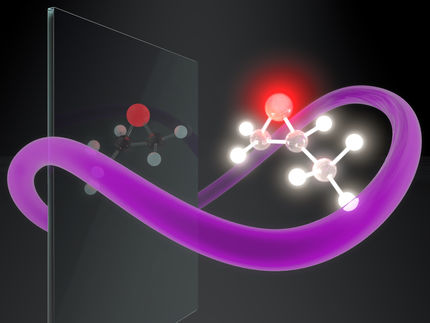
Chirality, or the asymmetric arrangement of atoms in a molecule, plays a crucial role in chemistry and biology. Enantiomers, which are mirror-image and at the same time non-superimposable forms of a molecule, can have completely different effects in the human body. In some cases, the other enantiomer is even toxic. A major challenge in chemistry is the targeted synthesis of these compounds in the laboratory. The silylium ACDC (asymmetric counterion-directed catalysis) concept used by the research group solves this problem. “Two charged particles combine to form an ion pair: a negatively charged particle from the catalyst and a positively charged particle from the hydrazone. The chiral catalyst ensures that effectively only one of the two possible mirror images of the product is formed,” explains study leader Professor Schneider. The term ‘silylium’ refers to a positively charged silicon particle that acts as an active component of the catalyst.
Drug development potential
Compounds produced using this strategy have many potential applications. They can serve as starting materials for the synthesis of a wide range of drugs, the production of which has traditionally relied on toxic heavy metal catalysts. These compounds are also valuable building blocks for chemical transformations that are inaccessible with natural polarity. “With this research, we believe we have made a significant contribution to selective, sustainable and targeted chemical synthesis,” says Professor Schneider. This method will provide the basis for further developments and innovative applications, particularly in medicinal chemistry.
Original publication


Other news from the department science





















Most read news











More news from our other portals



























See the theme worlds for related content
Topic world Synthesis
Chemical synthesis is at the heart of modern chemistry and enables the targeted production of molecules with specific properties. By combining starting materials in defined reaction conditions, chemists can create a wide range of compounds, from simple molecules to complex active ingredients.

Topic world Synthesis
Chemical synthesis is at the heart of modern chemistry and enables the targeted production of molecules with specific properties. By combining starting materials in defined reaction conditions, chemists can create a wide range of compounds, from simple molecules to complex active ingredients.
Last viewed contents
An Enzyme That Offers Hope: Novel Plastic-Degrading Enzyme Discovered in Bacteria - "Pac-Man Enzyme" breaks down polyester plastic while simultaneously splitting penicillin

Chemistry On Four Paws: How Dogs Change Our Indoor Environment - Surprising effect: Petting releases many pollutants, as skin oils react with ozone to produce ultrafine particles
Wastewater treatment plants as drivers for the energy transition - Technical add-on module can, in principle, turn any wastewater treatment plant into a CO2 sink and decentralized methane production plant

FUST Lab Receives Investment from Asia2G Capital - The Korean deep-tech company plans to use the capital to expand into the U.S., European, and Japanese markets

ACHEMA Middle East: Debut in Saudi Arabia not until 2027 - Messe Frankfurt Saudi Arabia and DECHEMA are responding to regional uncertainties and are also changing the venue

New core-shell design for anodes significantly increases performance of sodium-ion batteries - Researchers coat porous carbon with a filter-like layer that allows sodium ions to pass through while keeping disruptive electrolyte molecules out

New "chemical armor" could unlock the holy grail of solid-state battery technology - A simple one-step coating builds a silicon-indium hybrid shield on lithium metal, quadrupling current density and extending battery cycle life
Scientists unveil mechanism behind greener ammonia production
Siemens to digitalize one of Europe's largest renewable hydrogen projects - Physics-based digital twin and real-time optimization
Collaboration between University of Bristol and Malvern Panalytical - Bringing academia and business together to solve global challenges

Digital lab day 2025 celebrates international success - virtual battery day 2025 follows in November