Insects as mini molecule-making factories, marking a breakthrough in chemical engineering
Caterpillar factories produce fluorescent nanocarbons
Advertisement


Researchers led by Kenichiro Itami at the RIKEN Pioneering Research Institute (PRI) / RIKEN Center for Sustainable Resource Science (CSRS) have successfully used insects as mini molecule-making factories, marking a breakthrough in chemical engineering. Referred to as “in-insect synthesis,” this technique offers a new way to create and modify complex molecules, which will generate new opportunities for the discovery, development, and application of non-natural molecules, such as nanocarbons.
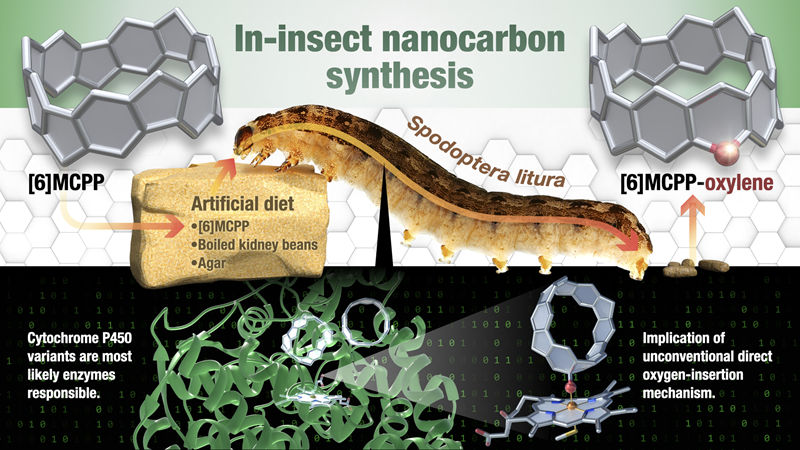
Tobacco cutworm caterpillars can convert [6]MCPP to [6]MCPP-oxylene far more effectively than laboratory setting
RIKEN
Molecular nanocarbons are super tiny structures made entirely of carbon atoms. Despite their minuscule size, they can be mechanically strong, conduct electricity, and even emit fluorescent light. These properties make them ideal for use in applications like aerospace components, lightweight batteries, and advanced electronics. However, the precision required to manufacture these tiny structures remains a major obstacle to their widespread use. Conventional laboratory techniques struggle with the fine manipulation needed to put these complex molecules together atom by atom, and their defined shapes make it especially difficult to modify them without disrupting their integrity.
“Our team has been conducting research on molecular nanocarbons, but along with that, we've also developed molecules that act on mammals and plants,” says Itami. “Through those experiences, we suddenly wondered — what would happen if we fed nanocarbons to insects?”
As strange as the idea may sound, it’s rooted in biology. Insects, particularly plant-eating insects like grasshoppers and caterpillars, have evolved sophisticated systems in the gut for breaking down foreign substances like plant toxins and pesticides. These metabolic processes rely on enzymes capable of complex chemical transformations. The RIKEN researchers hypothesized that insects could serve as living chemical factories, performing the types of chemical modifications to nanocarbons that are difficult to replicate in the laboratory.
To test their concept, the team fed tobacco cutworm caterpillars—common agricultural pests with well-mapped metabolic pathways—a diet containing a belt-shaped molecular nanocarbon known as [6]MCPP. Two days later, analysis of the caterpillar poo revealed a new molecule, [6]MCPP-oxylene, which is [6]MCPP that has incorporated an oxygen atom. This subtle change caused the molecule to become fluorescent.
Using techniques such as mass spectrometry, NMR, and X-ray crystallography, the researchers determined [6]MCPP-oxylene’s structure. Experiments using molecular biology pinpointed two enzymes, CYP X2 and X3, as being responsible for the transformation. Further genetic analyses confirmed that these enzymes are essential for the reaction to occur.
Computer simulations found that these enzymes could simultaneously bind two [6]MCPP-oxylene molecules and directly insert an oxygen atom into a carbon–carbon bond—a rare and previously unobserved phenomenon. “It is extremely difficult to reproduce the chemical reactions occurring inside insects in a laboratory setting,” Itami explains. “Lab-based attempts at this oxidation reaction failed or had very low yields.”
True to the philosophy of the PRI, this work pioneers a new direction in materials science: making functional molecules using insects. The shift from traditional test tubes to biological systems—enzymes, microbes, or insects—will allow the construction of complex nanomolecules. Beyond glowing molecular nanocarbons, with tools like genome editing and directed evolution, in-insect synthesis could be applied to a wide range of molecules and functions, forging links between organic chemistry and synthetic biology.
“The tobacco cutworm is a notorious agricultural pest because of its rapid life cycle and exceptional ability to metabolize pesticides, earning them a reputation as global villains in the crop protection industry,” says Itami. “And yet, what we find truly fascinating, is that in our project, these very moths took on an unexpected role—not as adversaries, but as unlikely heroes.”
Original publication


Other news from the department science





















Most read news












More news from our other portals

























See the theme worlds for related content
Topic world Synthesis
Chemical synthesis is at the heart of modern chemistry and enables the targeted production of molecules with specific properties. By combining starting materials in defined reaction conditions, chemists can create a wide range of compounds, from simple molecules to complex active ingredients.
Topic world Synthesis
Chemical synthesis is at the heart of modern chemistry and enables the targeted production of molecules with specific properties. By combining starting materials in defined reaction conditions, chemists can create a wide range of compounds, from simple molecules to complex active ingredients.
Last viewed contents
Metal powder: zero-carbon fuel for the future? - How iron can be used to store and transport energy
A touch of gold and silver - For the first time, it is possible to produce crystalline layers of precious metals that consist of a single atomic layer and which are semiconducting
Nanoparticle supersoap creates 'bijel' with potential as sculptable fluid

Inspired by nature: Scientists have developed a nanopore-microchip

Reinforcement of structures with Memory Steel
Ultra-thin lenses that make infrared light visible - Researchers have achieved this using a special metal-oxide lens material called lithium niobate and through nanoscale pattern, stamped into the material

Team develops bioprocess for converting plant materials into valuable chemicals

Wonder material graphene claims yet another superlative
Magnets trump metallics - Magnetic fields can block conductivity of carbon nanotubes

Cellphone converts into powerful chemical detector - With only $50 worth of components, an ordinary cellphone transforms into a sophisticated scientific instrument, capable of identifying chemicals, drugs, and pathogens
Dual-function organic molecule may advance display technologies and medical imaging - Researchers overcome a long-standing molecular design challenge by realizing efficient light emission and photon absorption in the same compound.