Engineered enzyme to precisely build complex molecules
This breakthrough paves the way for a more sustainable and efficient production of a variety of complex chemicals
Advertisement


Researchers at the University of Basel have repurposed a natural enzyme so that it catalyzes a highly challenging chemical reaction. Their approach opens new possibilities for synthesizing complex molecules—such as pharmaceuticals and fine chemicals—in a more environmentally friendly and efficient way.
Catalysts are among the most important tools for achieving more sustainable green chemistry. They accelerate chemical reactions, making them more efficient and easier to control. As a result, energy, waste and costs can be saved when manufacturing a wide variety of products. The search for new catalysts has kept the field of chemistry busy since the 20th century.
As nature’s catalysts, enzymes have garnered increasing attention for their exceptional ability to enhance both the reactivity and selectivity of chemical reactions, as well as for their environmentally benign properties.

Promising method with a catch
Recently, metal hydride hydrogen atom transfer (MHAT) has emerged as a promising catalytic method to efficiently build complex molecules. A compound consisting of metal hydride – a metal atom bonded with a hydrogen atom – transfers a hydrogen atom to a double bond within the organic compound, producing a reactive intermediate that triggers the subsequent bond formation.
MHAT can convert a flat, two-dimensional substrate into a complex molecule with a three-dimensional architecture. However, achieving precise control over the three-dimensional arrangement of the atoms within the molecule—particularly the mirror-image configurations of the molecule, akin to left and right hands—remains challenging.
In pharmaceutical and fine chemicals manufacturing, however, it is crucial that a single-handed configuration is created. This is because the two mirror-image molecules can exhibit different biological properties—one may be therapeutically beneficial while the mirror-image counterpart can be inactive or even toxic.
Enzyme produces single-handed configuration
Researchers at the University of Basel have now succeeded in combining MHAT chemistry with enzymatic catalysis to produce three-dimensional molecules with single-handed configuration. The groundbreaking research is part of the National Center of Competence in Research “Molecular Systems Engineering”, which is led by Prof. Dr. Thomas R. Ward at the University of Basel. He and his team have published their results in the journal Nature.
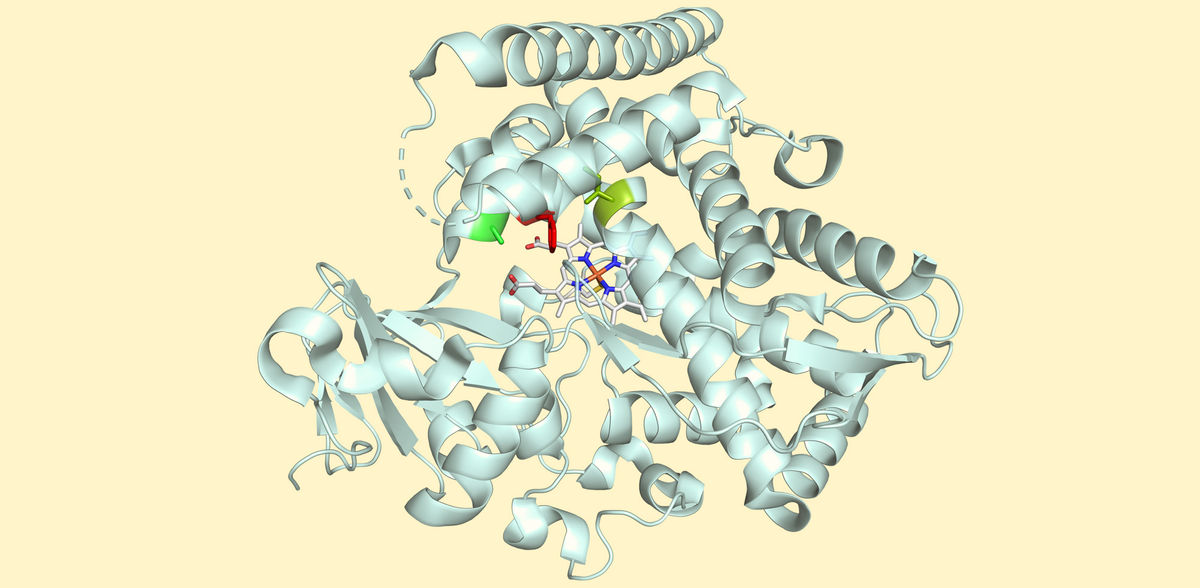
The research team has managed to repurpose a haemoprotein – an enzyme that is widely present in nature – to carry out MHAT reactions within its catalytic site. Thanks to the sophisticated enzyme scaffold, it produces almost exclusively the desired single-handed form of the molecule (up to a 98 to 2 ratio of left- and right-handed molecules). Notably, such transformations are very challenging to achieve with conventional chemical tools. “Until now, no enzyme that could carry out such a MHAT reaction was known,” explains first author Dr. Xiang Zhang.
Specificity – both a curse and a blessing
This breakthrough paves the way for a more sustainable and efficient production of a variety of complex chemicals. By repurposing a natural enzyme to catalyze this versatile chemical transformation, the researchers aim to streamline the synthesis of pharmaceuticals and other high-added value chemicals.
However, the specificity of the enzyme is both a curse and a blessing: if using a structurally different starting material, the enzyme scaffold might require further engineering to achieve high specificity. Additionally, in order to make this transformation even more useful, the researchers are looking for a more sustainable way for metal hydride formation.
Original publication


Other news from the department science




















Most read news












More news from our other portals


























Last viewed contents
Phosphorus Rubber - Poly-(1-phospha-isoprene): phosphorus-containing natural rubber analogue

Abrasinter, S.L. - Barcelona, Spain

Advanced magnesium-based hydrogen storage materials and their applications

How a persistent chemical enters our surface waters - Modeling the formation and distribution of trifluoroacetic acid (TFA) in the atmosphere

Simple process extracts valuable magnesium salt from seawater - This method plays a new trick with an old process

Team develops bioprocess for converting plant materials into valuable chemicals
Ytterbium thin-disk lasers pave the way for sensitive detection of atmospheric pollutants - The laser's capacity to generate high-power, stable pulses in the SWIR range is a game-changer for field-resolved spectroscopy and femtosecond fieldoscopy

Golden Ball Mills as Green Catalysts - A gold-coated grinding bowl proves to be a real marvel

Researchers discover new ultra strong material for microchip sensors - A material that doesn't just rival the strength of diamonds and graphene, but boasts a yield strength 10 times greater than Kevlar

Researchers are improving technology to generate high harmonics in nanostructured metasurfaces

“Dictionaries” make fluorescence-based data for integrative structure models and their dynamics accessible - 3D structures of biomolecules
