Researchers at European XFEL create a novel gold compound
Advertisement


gold is considered chemically extremely inert. Researchers at European XFEL have now demonstrated that, under extreme conditions, this arguably the most precious of all metals becomes chemically active. Using the world's largest X-ray laser, they have now created a completely new compound of gold and hydrogen: solid gold hydride.
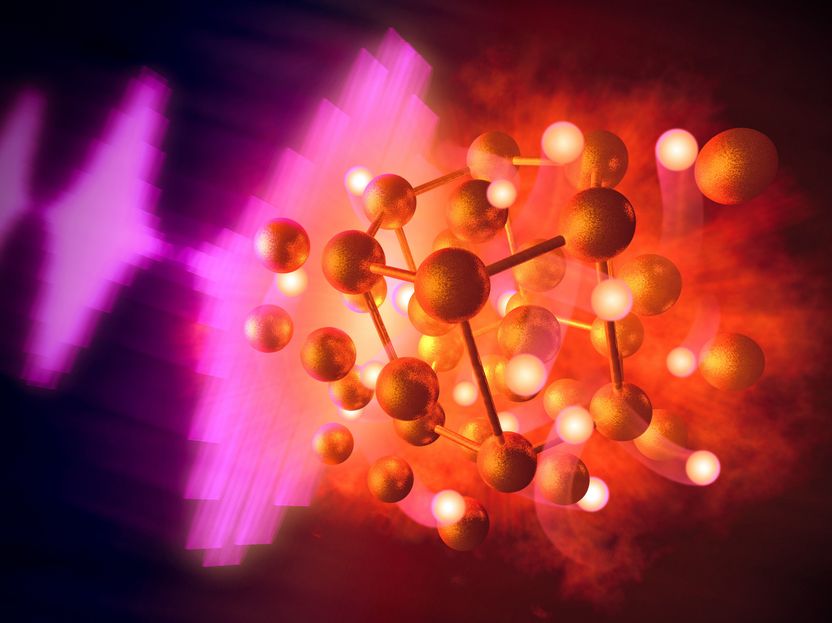
Artist's impression: Using X-ray pulses, an international team of researchers at European investigated how gold reacts with hydrogen and forms what is called gold hydride.
Copyright: Greg Stewart/SLAC
An international team of researchers has produced the first solid chemical compound of gold and hydrogen: Under extremely high pressure and temperatures, a so-called gold hydride was formed in experiments at European XFEL in Schenefeld near Hamburg, Germany. This discovery contradicts the previous assumption that gold hardly reacts with hydrogen and opens up new perspectives for chemistry under extreme conditions.
Gold is considered one of the most inert metals. But at pressures such as those found in the Earth's interior, the precious metal exhibits new qualities. Researchers at European XFEL's High-Energy Density (HED) Instrument compressed gold to over 40 gigapascals (GPa) using a diamond anvil cell and heated it to approximately 2,500 degrees Celsius using ultrashort flashes from the European XFEL X-ray laser. Under these conditions, the gold reacted with hydrogen released from embedded hydrocarbons, forming a novel gold-hydrogen compound.
"We were able to demonstrate that above 40 GPa, the lattice of gold atoms forms a hexagonal close-packed arrangement with disordered hydrogen atoms in the interstices," explains Mungo Frost of the SLAC National Accelerator Laboratory. The compound, called gold hydride, has the chemical formula Au₂Hx, where the hydrogen content x increases with increasing pressure and ranges from zero to nearly one.
Particularly remarkable is that the hydrogen in the newly discovered compound moves very easily through the rigid lattice of the gold atoms. Scientists refer to this state as a superionic state. This property has previously been observed primarily in hydrogen-rich materials, but is completely new in this form for gold-containing compounds.
Upon cooling, the gold hydride decomposes back into normal, face-centered, cubic gold. Therefore, the researchers suspect that the gold hydride only remains stable under high-temperature conditions. Because samples were previously cooled to room temperature before analysis, past experiments have apparently overlooked the compound.
"Our results show that even elements as unreactive as gold can exhibit entirely new chemical properties under extreme pressure and temperature conditions," says Ulf Zastrau, head of the HED Instrument at European XFEL, where the experiment was conducted. The team perceives this as an indication that many other unexpected compounds may exist that have so far remained undiscovered only due to a lack of suitable methods.
This discovery is not only a novelty in gold chemistry, but has also far-reaching implications for high-pressure experiments, in which gold has previously been used as a completely inert material. Future research will clarify whether similar effects also occur with other precious metals.
Original publication



Other news from the department science





















Most read news












More news from our other portals

























Last viewed contents

RUDN University chemist created a catalyst from orange peel for organic compounds production

Shedding light on mechanisms of electrochemical energy storage - UV-visible spectroscopy gives researchers a tool to study battery materials - a breakthrough that could speed the design of higher performing energy storage devices

Researchers discover new ultra strong material for microchip sensors - A material that doesn't just rival the strength of diamonds and graphene, but boasts a yield strength 10 times greater than Kevlar

Brown chemists report promising advance in fuel-cell technology

Climate pioneers cooperate to produce solar fuels - INERATEC joins forces with Synhelion

Micro- and nanoplastics in the body are passed on during cell division - That plastic may increase metastasis of tumors

Search for new semiconductors heats up with gallium oxide
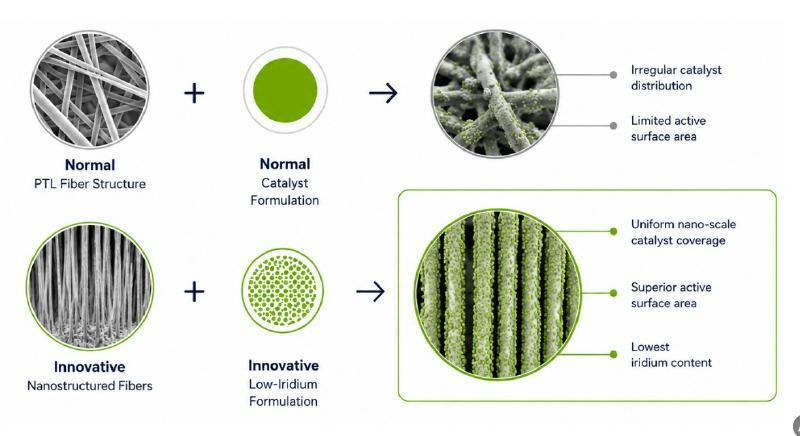
Smoltek Hydrogen and Heraeus Precious Metals advance next-generation ultra-low iridium electrolysis technology

Chemistry without detours: Researchers introduce a two-step process for producing phosphorus-containing chemicals - This promising innovation not only contributes to environmental protection but also saves significant time and costs

Evidence stacks up for poisonous books containing toxic dyes

Adhesives from waste wood, biofuel from straw - EU research project on the potential of agroforestry waste as environmentally friendly raw materials completed