Direct Recycling: Europe's Answer to China's Raw-Mate-rial Dominance
How ReUse Makes Home Storage Sys-tems Sustainable
Advertisement


To reduce dependence on rising electricity prices, German households are increasingly turning to stationary battery storage systems combined with photovoltaic systems. These systems provide solar energy around the clock, relieving the burden on power grids. But what happens in ten to fifteen years when these storage systems reach the end of their service life? The answer is direct recycling.
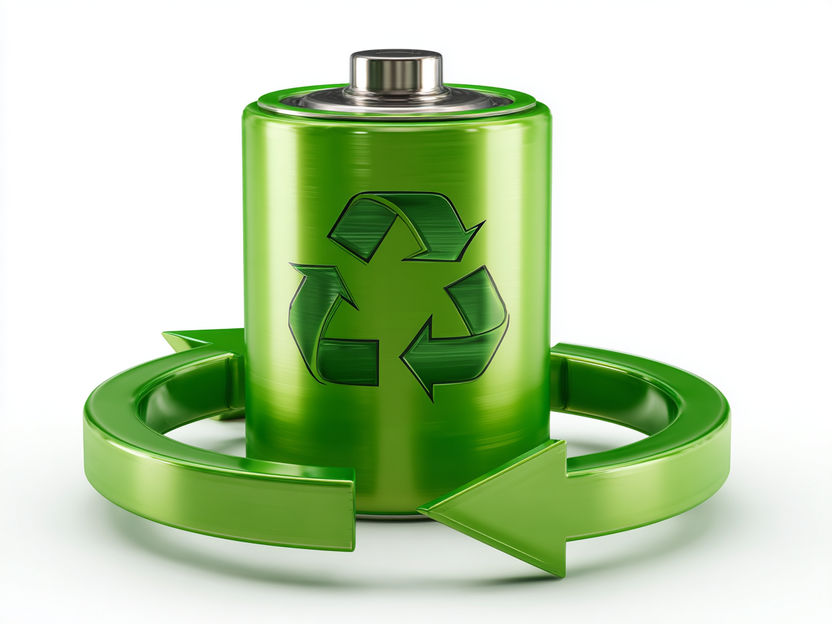
Symbolic image
AI-generated image
Today, most stationary battery storage systems are based on lithium-ion technology, primarily lithium iron phosphate (LFP) cells. They are considered safe and durable and do not require critical raw materials such as cobalt and nickel. Nevertheless, they do use valuable materials such as lithium, copper, and graphite—and this is precisely where the challenge lies. Around 70 percent of the world’s graphite comes from China and demand continues to rise. Since 2025, additional export restrictions have been in place for graphite, LFP cathode materials and their precursors. Companies must apply for permits, delaying deliveries and driving up prices.
Independence through smart battery recycling
The good news for Europe is that existing recycling strategies can reduce this dependence. By 2030, millions of tons of batteries from electric vehicles and stationary storage systems will accumulate in Europe and present an enormous opportunity: through intelligent recycling, they can become a valuable source of raw materials for the future. Traditional recycling processes such as pyrometallurgy and hydrometallurgy are energy-intensive and particularly suitable for batteries with a high proportion of valuable materials such as nickel, manganese, and cobalt (NMC). However, they are often less attractive for the widely used lithium iron phosphate (LFP) batteries, which have a significantly lower material value. This calls for efficient, sustainable, yet economical solutions.
From waste to raw material source: energy and CO₂ savings
The EU project ReUse picks up where traditional recycling processes for LFP leave off. Instead of converting materials from old batteries into intermediate products such as metal salts, ReUse pursues an innovative approach: through direct recycling, the battery materials—including cathode and anode materials—are separated and retained in their original structure. This allows them to be reused directly in new batteries. Not only does this save energy and reduce CO₂ emissions, but it also preserves the material functionality. A further advantage is that it eliminates the need for costly new production of active material—a crucial point, since there are hardly any active-material manufacturers in Europe; most are located in Asia. ReUse thus enables Europe to secure its strategic independence. Batteries are driving the energy transition, and ReUse ensures that they become an opportunity for a sustainable future rather than a burden.
AI, robotics, and green solvents: new technologies in the recycling process
The project is supported by a consortium of 13 partners from research and industry across seven European countries and is coordinated by the Fraunhofer Institute for Silicate Research ISC in Würzburg. The aim is to develop automated processes for dismantling, material separation and sorting, reprocessing, and reintegration. These include AI-supported sorting, optimized unloading processes, robot-assisted dismantling and precise electrode separation without damaging functional materials. Innovative processes, such as the use of “supercritical” CO₂, are used for the removal of binding agents. Because this is considered a “green” solvent, it enables environmentally friendly and efficient extraction. After a regeneration step, these technologies make it possible to reuse active materials directly in new batteries. This saves energy, reduces costs, and makes recycling economically attractive.
Benefits for consumers and security of supply
For consumers, this means that battery storage will not only contribute to the energy transition but will also become part of a growing circular economy. Every storage unit installed today will become a raw-material source for tomorrow. This will increase long-term supply security and reduce dependence on imports. However, to tap these resources, the battery industry must adapt to new recycling processes. Direct recycling, as developed in the EU ReUse project, is becoming the key to reducing costs, cutting CO₂ emissions and maintaining material quality. Companies will need to invest in automated dismantling and reprocessing methods to remain competitive. At the same time, new business opportunities and jobs are emerging in the recycling sector. Given geopolitical risks, such as current and future Chinese export restrictions, the ability to recover battery materials efficiently is becoming a strategic advantage for Europe. In short, consumers stand to benefit from more stable prices and sustainable products, while industry is facing a profound shift towards a truly sustainable circular economy.


Other news from the department science





















Most read news











More news from our other portals



























See the theme worlds for related content
Topic World Battery Technology
The topic world Battery Technology combines relevant knowledge in a unique way. Here you will find everything about suppliers and their products, webinars, white papers, catalogs and brochures.

Topic World Battery Technology
The topic world Battery Technology combines relevant knowledge in a unique way. Here you will find everything about suppliers and their products, webinars, white papers, catalogs and brochures.
Last viewed contents
Baden-Württemberg has potential for its own sustainable fuel production - DME-based e-fuels could become cheaper than methanol
From Flue Gas to Raw Material: Extracting Carbon from CO₂ Produced by Waste Incineration - KIT and EEW Energy from Waste (EEW) plan to use CO₂ from flue gases in the NECOC process

KAIST identifies a route to faster-charging, longer-lasting EV batteries - Research team uses a 3D digital twin to reveal localized degradation mechanisms during fast charging

Matthews Engineering and start-up hs-tumbler partner on dry battery electrode manufacturing - Companies aim to enable dry electrode manufacturing through trajectory mixing

Winter-ready lithium batteries: scientists use "polarity-contras" electrolyte strategy to outsmart extreme cold - Lithium metal batteries retain 80% capacity after 150 cycles at -40 °C

The competitiveness of low-carbon fuels depends on location - New infrastructure could boost European production
Deep tech startup Reduciner introduces novel technology to turn captured carbon into sustainable fuels - Raising 3.6 million euros in its initial funding round, the Finnish startup plans to build its first industrial-scale pilot
Bruker announces strategic collaboration with Atinary Technologies to advance self-driving laboratories
FUST Lab Receives Investment from Asia2G Capital - The Korean deep-tech company plans to use the capital to expand into the U.S., European, and Japanese markets

ACHEMA Middle East: Debut in Saudi Arabia not until 2027 - Messe Frankfurt Saudi Arabia and DECHEMA are responding to regional uncertainties and are also changing the venue
New core-shell design for anodes significantly increases performance of sodium-ion batteries - Researchers coat porous carbon with a filter-like layer that allows sodium ions to pass through while keeping disruptive electrolyte molecules out
