Researchers turn recovered car battery acid and plastic waste into clean hydrogen
The photoreforming method targets hard-to-recycle plastics like nylon and polyurethane, which current upcycling technologies cannot process
Advertisement


Researchers have developed a solar-powered reactor to break down hard-to-recycle forms of plastic waste – such as drinks bottles, nylon textiles and polyurethane foams – using acid recovered from old car batteries, and converting it into clean hydrogen fuel and valuable industrial chemicals.
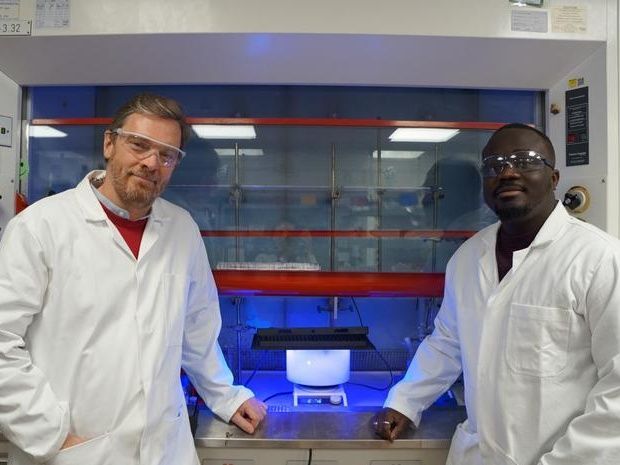
Erwin Reisner and Kay Kwarteng
Beverly Low
The reactor, developed by researchers from the University of Cambridge, is powered by the energy from the sun, and could be a cheaper, more sustainable alternative to current chemical-based recycling methods. The team say their method could create a circular system where one waste stream solves another. Their results are reported in the journal Joule.
Global plastic production is more than 400 million tonnes per year, yet only 18% is recycled. The rest is burned, landfilled, or leaks into ecosystems. The researchers say that their method, known as solar‑powered acid photoreforming, could become part of the solution to the global mountain of plastic waste.
The researchers engineered a photocatalyst that is robust enough to withstand the highly corrosive effects of acid, while making productive use of the acid inside spent car batteries, which is normally neutralised and discarded.
“The discovery was almost accidental,” said Professor Erwin Reisner from Cambridge’s Yusuf Hamied Department of Chemistry, who led the research. “We used to think acid was completely off limits in these solar-powered systems, because it would simply dissolve everything. But our catalyst developed didn’t – and suddenly a whole new world of reactions opened up.”
“Acids have long been used to break plastics apart, but we never had a cheap and scalable photocatalyst that could withstand them,” said lead author Kay Kwarteng, a PhD candidate in Reisner’s research group, who developed the photocatalyst. “Once we solved that problem, the advantages of this type of system became obvious.”
The method developed by Kwarteng, Reisner and their colleagues first treats waste plastics with the car battery waste acid, breaking the long polymer chains into chemical building blocks such as ethylene glycol, which the photocatalyst then converts into hydrogen and acetic acid (the main ingredient in vinegar) when exposed to sunlight.
In laboratory tests, the reactor generated high hydrogen yields and produced acetic acid with high selectivity. It also ran for more than 260 hours without any loss in performance.
The approach works for multiple types of plastic waste, even those that are currently tough to recycle, such as nylon and polyurethane. This offers a real advancement to current upcycling technologies that do not cover plastics beyond PET.
The approach works not just with new, laboratory-grade acid, but with the acid recovered from car batteries. These batteries contain between 20-40% acid by volume, and are replaced worldwide in huge numbers every year. The lead in these batteries is typically extracted for resale, but the acid creates extra waste once it is safely neutralised.
“It’s an untapped resource,” said Kwarteng. “If we can collect the acid before it’s neutralised, we can use it again and again to break down plastics: it’s a real win-win, avoiding the environmental cost of neutralising the acid, while putting it to work generating clean hydrogen.”
The researchers say their method offers a potential order‑of‑magnitude cost reduction compared with other photoreforming approaches, largely because the acid enables increased hydrogen production rates and can be reused rather than consumed or wasted.
Kwarteng says that although challenges remain – such as ensuring reactors can withstand corrosive conditions – the fundamental chemistry is sound. “These acids are already handled safely in industry,” he said. “The question now is engineering: how do we build reactors that can run continuously and handle real‑world waste?”
The researchers say that their approach won’t replace conventional recycling, but it could complement it by handling contaminated or mixed plastics that currently have no viable route to reuse.
“We’re not promising to fix the global plastics problem,” said Reisner. “But this shows how waste can become a resource. The fact we can create value from plastic waste using sunlight and discarded battery acid makes this a really promising process.”
The team plans to commercialise this process with the support of Cambridge Enterprise, the University’s innovation arm, and with a UKRI Impact Acceleration Account. The research was supported in part by the Cambridge Trust, the Royal Academy of Engineering, the Leverhulme Trust, the Isaac Newton Trust, and the Engineering and Physical Sciences Research Council (EPSRC), part of UK Research and Innovation (UKRI). Erwin Reisner is a Fellow of St John’s College, Cambridge. Kay Kwarteng is a Member of Churchill College, Cambridge.
Original publication



Other news from the department science





















Most read news











More news from our other portals



























See the theme worlds for related content
Topic World Battery Technology
The topic world Battery Technology combines relevant knowledge in a unique way. Here you will find everything about suppliers and their products, webinars, white papers, catalogs and brochures.

Topic World Battery Technology
The topic world Battery Technology combines relevant knowledge in a unique way. Here you will find everything about suppliers and their products, webinars, white papers, catalogs and brochures.
Last viewed contents
A new route to safe and sustainable synthetic chemistry - CO₂ as a source of oxygen: University of Bayreuth revolutionises oxidation chemistry

Velaris acquires Markes International to expand its automated sample preparation capabilities - The company joins the Velaris family of existing brands – Skalar Analytical, LCTech, PromoChrom, EST Analytical, GERSTEL and TE Instruments
Using individual atoms to achieve fossil-free chemistry - Chemists have achieved a breakthrough in catalysis research on multiple levels

Research guides future of plastic waste chemical recycling

The competitiveness of low-carbon fuels depends on location - New infrastructure could boost European production

Deep tech startup Reduciner introduces novel technology to turn captured carbon into sustainable fuels - Raising 3.6 million euros in its initial funding round, the Finnish startup plans to build its first industrial-scale pilot
Bruker announces strategic collaboration with Atinary Technologies to advance self-driving laboratories

FUST Lab Receives Investment from Asia2G Capital - The Korean deep-tech company plans to use the capital to expand into the U.S., European, and Japanese markets

ACHEMA Middle East: Debut in Saudi Arabia not until 2027 - Messe Frankfurt Saudi Arabia and DECHEMA are responding to regional uncertainties and are also changing the venue

New core-shell design for anodes significantly increases performance of sodium-ion batteries - Researchers coat porous carbon with a filter-like layer that allows sodium ions to pass through while keeping disruptive electrolyte molecules out

New "chemical armor" could unlock the holy grail of solid-state battery technology - A simple one-step coating builds a silicon-indium hybrid shield on lithium metal, quadrupling current density and extending battery cycle life