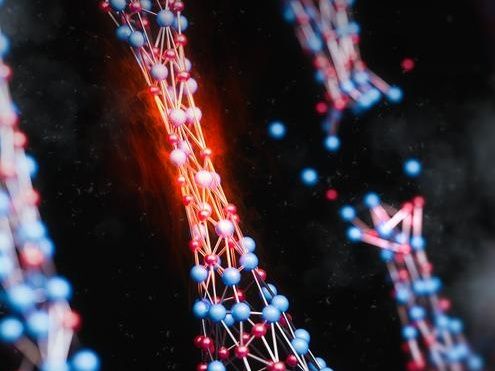
Water, Clay and Carbon: A New Route to Sustainable Energy Storage
Researchers demonstrate an all-water supercapacitor stable over 60,000 charging cycles
Advertisement


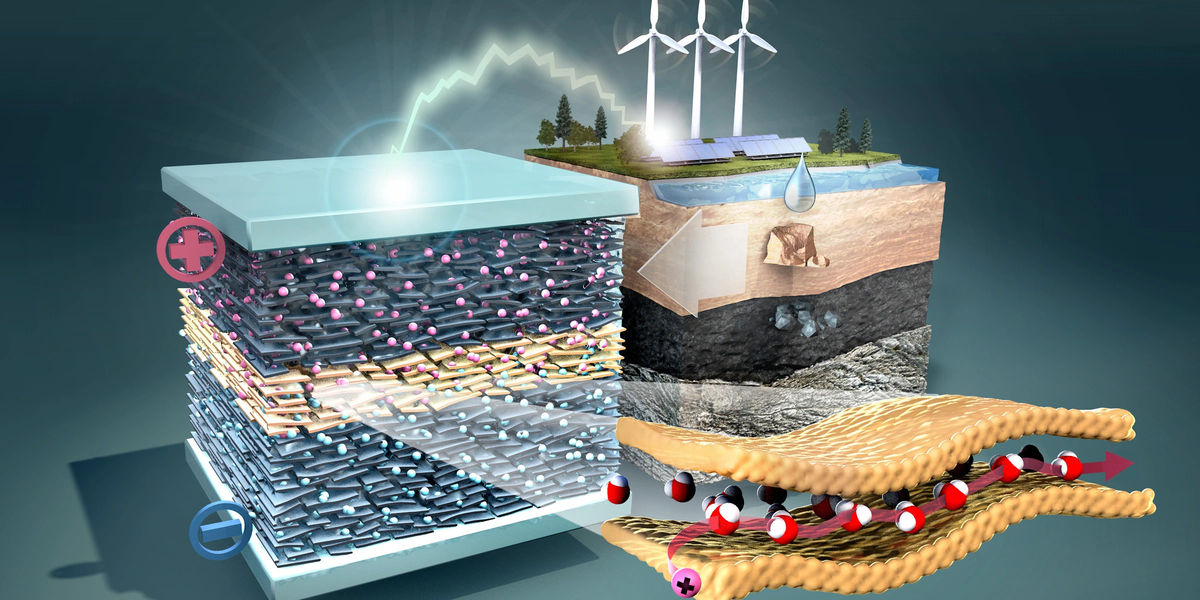
Can pure water store electrical energy? A research team led by Dr. Vasily Artemov within the Cluster of Excellence “BlueMat – Water-Driven Materials” at Hamburg University of Technology has now shown that it can. By confining water within nanometer-sized channels in clay minerals, the researchers created a supercapacitor capable of efficiently storing and transporting electrical charge.
What makes the finding unusual is that it uses pure water as its electrolyte — the medium that transports electrical charge. Today’s batteries and supercapacitors typically rely on added salts, acids, or other chemical electrolytes. In contrast, the new system works without such additives and is based solely on abundant, naturally occurring materials: water, clay, and carbon.
“Our goal is to develop safer and more sustainable energy-storage technologies based on abundant materials rather than complex chemical compounds”, says Vasily Artemov, lead author of the paper: “The device stores and releases energy efficiently, operates at a comparatively high voltage for a water-based system, and remains stable over tens of thousands of charging cycles.”
Water on the Nanoscale
The new device belongs to a class of energy-storage technologies known as supercapacitors. Unlike batteries, which store energy through chemical reactions, supercapacitors store energy by separating electrical charges. As a result, they can be charged and discharged very quickly and often have exceptionally long lifetimes.
The researchers call their system the “Blue Capacitor”. The key to the technology lies in channels about one nanometer wide, which is roughly 100,000 times thinner than a human hair. Inside these tiny spaces, water exhibits properties not found in ordinary bulk water, allowing charge to move efficiently. To harness this effect, the researchers combined clay minerals with graphene, a highly conductive form of carbon. Together, the layers form millions of tiny channels that fill with water. “Our results show that nanoconfined water can serve as the active electrolyte in a practical energy-storage device”, says Artemov.
Stable and Durable
In laboratory tests, the Blue Capacitor maintained stable performance over more than 60,000 charge-discharge cycles. The device also operated at voltages of up to 1.6 volts, a comparatively high value for a water-based energy-storage system. The researchers see this as evidence that the unique properties of nanoconfined water can be harnessed for practical applications. The tests were conducted at the facilities of PETRA III at DESY, one of the world’s leading centres for research on and with particle accelerators. “Only with DESY's brilliant X-ray source PETRA III, we were able to visualize the ultra-thin sheets of individual water films within the clay structures“, adds Prof. Patrick Huber, co-author of the paper.
Potential Applications
The technology is still at an early stage of development, and further research will be needed before commercial applications become possible. However, the researchers believe the concept could offer a practical route toward future energy-storage technologies. Possible future applications include storing renewable energy from solar and wind power, supporting electrical grids, and powering devices that require frequent charging and discharging. Beyond energy storage, the findings could inspire new technologies that take advantage of the unusual properties of water at the nanoscale, including advanced sensors, bio-inspired systems, and neuromorphic computing. “Our work shows that even a familiar substance like water can reveal unexpected properties when viewed at the nanoscale“, says Artemov. “By understanding these properties, we may be able to develop entirely new technological applications.”
Original publication
Vasily Artemov, Svetlana Babiy, Yunfei Teng, Jiaming Ma, Alexander Ryzhov, Tzu-Heng Chen, Lucie Navratilova, Victor Boureau, Pascal Schouwink, Mariia Liseanskaia, Patrick Huber, Fikile Brushett, Lyesse Laloui, Giulia Tagliabue, Aleksandra Radenovic; "All-water supercapacitor enabled by 1-nm clay channels"; Nature Communications, Volume 17, 2026-6-5


Other news from the department science





















Most read news












More news from our other portals

























Last viewed contents
Don't Give the Slightest Chance to Toxic Elements in Medicinal Products - New high-accuracy reference solutions for the SI-traceable measurement
Bodo Möller Chemie Group enters exclusive acquisition talks with Rocktin - Strengthen adhesives distribution in Asia
Researchers develop procedure to interpret x-ray emission spectra of liquid water - Study helping to advance the understanding of the structure of water
How can life emerge in a world of minerals? - The European Research Council (ERC) has awarded an ERC Synergy Grant to the project “The role of silica at the dawn of life on our planet” (PROTOS)
New reactor could save millions when making ingredients for plastics and rubber from natural gas - With oil production dropping, a process using natural gas is needed to avert a shortage of a workhorse chemical used for automotive parts, cleaning products and more
Manganese could make luminescent materials and the conversion of sunlight more sustainable
Fibers from old tires can improve fire resistance of concrete

Consortium develops evolutionary concept for recycling of end-of-life polyurethane mattress foams - Ecomaison, Covestro, Secondly and Federal Eco Foam launch research project

Controversial Mass Products: Ceresana Analyzes the Global Market for Plasticizers
New metal-free, recyclable polypeptide battery that degrades on demand - Breakthrough could lead to battery production moving away from cobalt
Shedding light on mechanisms of electrochemical energy storage - UV-visible spectroscopy gives researchers a tool to study battery materials - a breakthrough that could speed the design of higher performing energy storage devices