Molecular catalysts could help unlock the promise of lithium–sulfur batteries
New review explains how catalysts working at battery surfaces or within electrolytes can accelerate sulfur conversion and guide the design of next-generation energy storage

Advertisement


Lithium–sulfur batteries could store substantially more energy than conventional lithium-ion batteries while relying on sulfur, an abundant and relatively inexpensive material. Yet major chemical obstacles continue to limit their efficiency, durability and practical use.
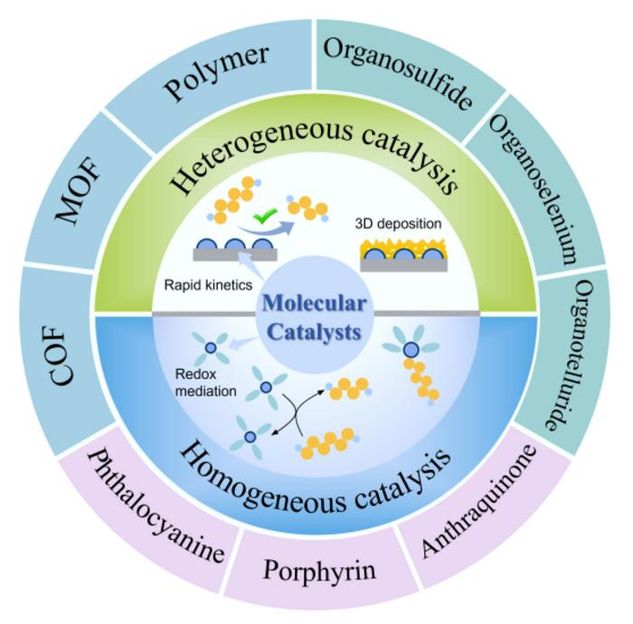
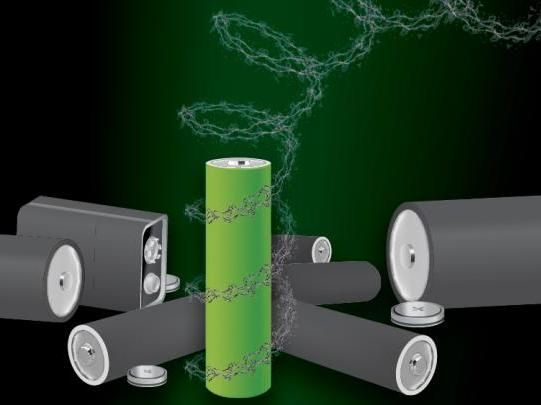
Heterogeneous/homogeneous catalytic role of molecular catalysts in lithium–sulfur batteries
Yi Ke, Can Qian, Zhuang Ji, Yuan Yang, Cai Qi, Xinwei Wang, Jinhai Zhang, Yuping Wu & Yiren Zhong
A new review published in Energy & Environment Nexus examines how precisely designed molecular catalysts could address these challenges. The authors provide a unified framework for understanding how molecular catalysts operate through two distinct modes, heterogeneous catalysis at solid interfaces and homogeneous catalysis within the liquid electrolyte.
"Molecular catalysts give researchers an unusually precise way to control the complex sulfur reactions inside lithium–sulfur batteries," said corresponding author Yiren Zhong. "By clarifying where these catalysts work, how they interact with sulfur species and why they eventually lose activity, we hope this review can guide the development of more efficient and durable battery systems."
Why lithium–sulfur batteries lose performance
Lithium–sulfur batteries have a theoretical specific capacity of 1,672 milliampere-hours per gram and a theoretical energy density of 2,600 watt-hours per kilogram. These characteristics make them attractive for applications where weight is critical, including unmanned aerial vehicles and spacecraft.
However, sulfur does not store and release energy through a simple reaction. During battery operation, it passes through a series of soluble compounds known as lithium polysulfides before forming solid lithium sulfides.
These reactions are often slow. Soluble polysulfides can also migrate between the battery electrodes, producing the damaging polysulfide shuttle effect. This process wastes active material, lowers charging efficiency, promotes unwanted reactions at the lithium metal anode and contributes to capacity loss.
The review highlights the conversion of soluble polysulfides into solid lithium sulfide as a particularly important bottleneck. This liquid-to-solid step accounts for approximately 70% of the theoretical discharge capacity, but it also presents one of the largest kinetic barriers in the battery.
Two catalytic routes for faster sulfur chemistry
Molecular catalysts have clearly defined structures and identifiable active sites. Their metal centers, surrounding ligands and electronic properties can be adjusted with molecular-level precision. They also offer high atomic utilization, low weight, small loading requirements and flexible placement within the cathode, separator or electrolyte.
In heterogeneous catalysis, catalyst molecules are immobilized on conductive surfaces. They can capture polysulfides, accelerate electron transfer, regulate lithium sulfide nucleation and produce more favorable solid deposits. However, the growing layer of electrically insulating discharge products may eventually cover the catalyst and block its active sites.
In homogeneous catalysis, catalyst molecules dissolve in the electrolyte. They can move throughout the battery, transfer electrons through redox mediation or react with polysulfides to form more easily converted intermediates. This broader working region can overcome the limited surface area of solid catalysts, but mobile catalyst species and reactive intermediates may intensify shuttling or trigger unwanted reactions at the lithium anode.
Toward catalysts that combine both advantages
The authors identify semi-confined catalytic architectures as a promising direction. These systems immobilize molecular catalysts while preserving some of the mobility and accessibility associated with homogeneous catalysis.
The review also calls for standardized descriptors that connect molecular structure with catalytic performance, advanced operando techniques that reveal how active sites change during battery operation and high-throughput screening supported by machine learning. Future studies must also evaluate catalysts under practical conditions, including high sulfur loading, limited electrolyte and pouch-cell configurations.
By combining molecular precision with realistic battery engineering, molecular catalysts may provide an important route toward lighter, higher-energy and longer-lasting lithium–sulfur batteries.
Original publication


Other news from the department science





















Most read news












More news from our other portals

























See the theme worlds for related content
Topic World Battery Technology
The topic world Battery Technology combines relevant knowledge in a unique way. Here you will find everything about suppliers and their products, webinars, white papers, catalogs and brochures.

Topic World Battery Technology
The topic world Battery Technology combines relevant knowledge in a unique way. Here you will find everything about suppliers and their products, webinars, white papers, catalogs and brochures.
Last viewed contents
The power of going small: Copper oxide subnanoparticle catalysts prove most superior
Unique X-ray Topography Based Defect Characterization for SiC Wafers Honored with Georg Waeber Innovation Award 2023

Bodo Möller Chemie Group enters exclusive acquisition talks with Rocktin - Strengthen adhesives distribution in Asia
Researchers develop procedure to interpret x-ray emission spectra of liquid water - Study helping to advance the understanding of the structure of water

How can life emerge in a world of minerals? - The European Research Council (ERC) has awarded an ERC Synergy Grant to the project “The role of silica at the dawn of life on our planet” (PROTOS)

New reactor could save millions when making ingredients for plastics and rubber from natural gas - With oil production dropping, a process using natural gas is needed to avert a shortage of a workhorse chemical used for automotive parts, cleaning products and more
Manganese could make luminescent materials and the conversion of sunlight more sustainable

Fibers from old tires can improve fire resistance of concrete

Consortium develops evolutionary concept for recycling of end-of-life polyurethane mattress foams - Ecomaison, Covestro, Secondly and Federal Eco Foam launch research project

Controversial Mass Products: Ceresana Analyzes the Global Market for Plasticizers
New metal-free, recyclable polypeptide battery that degrades on demand - Breakthrough could lead to battery production moving away from cobalt