Inspired by the Cell: Bayreuth Researchers Develop Self-Protecting Synthetic Fibres
Bayreuth chemists use a zinc-containing complex that reversibly aggregates into micrometer-sized structures above 32 °C
Advertisement


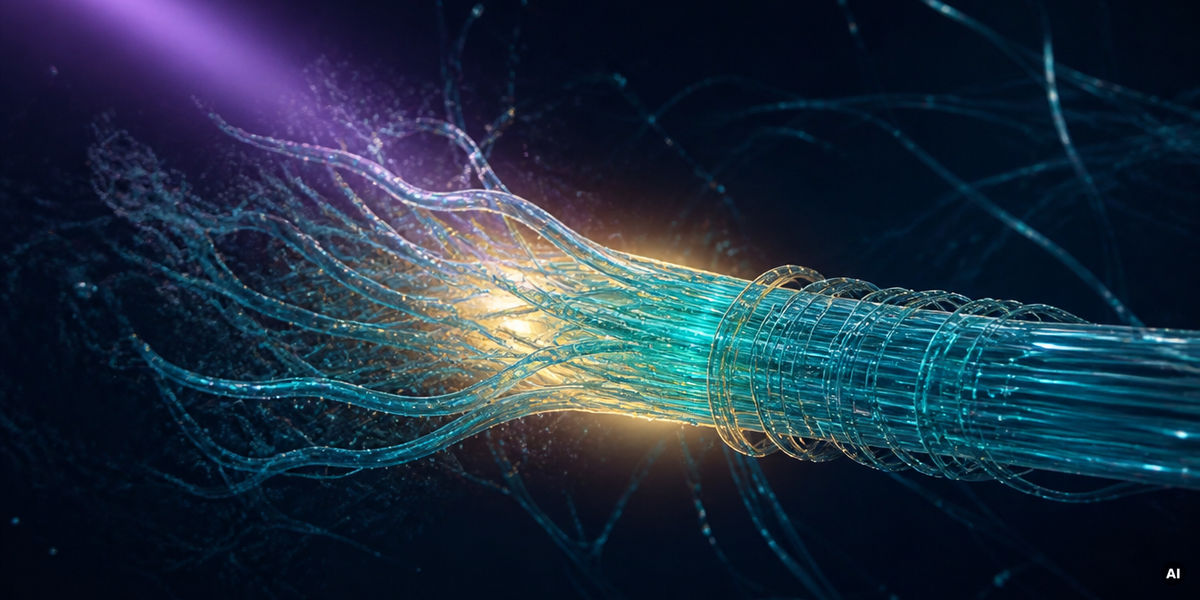
Researchers at the University of Bayreuth, together with colleagues from Freie Universität Berlin and the Leibniz Institute of Polymer Research Dresden, have developed a synthetic fibre system inspired by the cellular cytoskeleton that protects itself through controlled bundling. The findings open up new avenues for smart, switchable materials whose properties can be deliberately altered in response to a specific stimulus.
\--- Why it matters
Living cells accomplish a remarkable feat: they maintain delicate structures such as the cytoskeleton, which are held together only by weak intermolecular interactions, even under adverse conditions. They achieve this through hierarchical organisation and targeted bundling. Individual protein molecules form the smallest building blocks, which assemble into filaments. Multiple filaments are then bundled together and joined by crosslinking proteins, creating more stable structures. Reproducing this principle in synthetic polymers could lead to new resource-efficient materials for applications such as 3D printing, sensing and optoelectronics, as well as biotechnology. \---
For the first time, a research team led by Prof. Dr. Alex Plajer at the University of Bayreuth has recreated a fibre system with hierarchical order and controlled bundling in a fully synthetic aqueous system. The starting point is a zinc-containing planar molecule linked to a temperature-responsive polymer. In dilute aqueous solution, these building blocks spontaneously assemble into nanofibres. Remarkably, water molecules themselves become incorporated as structural components of the nanofibres instead of merely acting as a solvent.
When the temperature is raised above 32°C, the initially independent nanofibres bundle together into micrometre-sized structures. The same bundling process can also be triggered by changes in salt concentration or solvent composition. Reversing the respective stimulus, for example by lowering the temperature or adjusting the salt concentration or solvent composition, causes the bundles to dissociate again. The process is therefore fully reversible.
Crucially, this higher-order organisation protects the otherwise fragile building blocks, just as in the cytoskeleton. While individual nanofibres rapidly disassemble under dilution, acidic conditions, or chemical attack, bundled fibres remain stable. “We were even able to demonstrate selective protection of the fibres. In a mixture containing bundled and unprotected fibres, only the bundle-forming fibres survive, while the others disintegrate. This behaviour resembles the selective compartmentalisation observed in cells, where distinct regions or organelles are formed within the cellular environment,” explains Merlin Stühler, first author of the study and a doctoral researcher in Alex Plajer’s group.
This principle became particularly evident in an unusual experiment. Upon irradiation with UV light, the zinc complex heats itself photothermally and maintains the fibres in their protected, bundled state for as long as energy is supplied by the light source. Once irradiation ceases, the bundles dissociate and the building blocks disintegrate under acidic conditions. “In this way, we have created an analogy to mechanisms used by acid-resistant bacteria, which actively expend energy to maintain their internal balance under hostile conditions,” says Merlin Stühler. “Our system literally survives only while energy is being supplied. It therefore exists in a state far from thermodynamic equilibrium, a defining feature of biological systems.”
The hierarchical bundling not only enhances fibre stability but can also be observed with the naked eye. Upon heating, the fibres form a hydrogel at concentrations around 200 times lower than those required in comparable polymer systems. Cooling reverses the process, returning the gel to a liquid state. Gelation can be triggered by light irradiation, while the gelation temperature can simultaneously be controlled through salt concentration or solvent composition. Even in the hydrogel state, the building blocks remain protected against acid and chemical attack.
“Beyond the fundamental insight that biological organisational principles can be transferred to synthetic systems, we see clear application potential for our material. Its reversible, repeatedly stimulus-responsive gelation at comparatively low material concentrations makes the system attractive for 3D printing, where it could serve as a recyclable, ‘switchable’ printing resin,” concludes Prof. Plajer. The work also provides a novel design strategy for sensing and optoelectronics, owing to the light-responsive photophysical properties of the zinc-containing building block, as well as for the development of more robust and intelligent materials in nanotechnology and biotechnology.
Original publication


Other news from the department science





















Most read news











More news from our other portals



























See the theme worlds for related content
Last viewed contents
Bruker announces strategic collaboration with Atinary Technologies to advance self-driving laboratories

FUST Lab Receives Investment from Asia2G Capital - The Korean deep-tech company plans to use the capital to expand into the U.S., European, and Japanese markets

ACHEMA Middle East: Debut in Saudi Arabia not until 2027 - Messe Frankfurt Saudi Arabia and DECHEMA are responding to regional uncertainties and are also changing the venue
New core-shell design for anodes significantly increases performance of sodium-ion batteries - Researchers coat porous carbon with a filter-like layer that allows sodium ions to pass through while keeping disruptive electrolyte molecules out

New "chemical armor" could unlock the holy grail of solid-state battery technology - A simple one-step coating builds a silicon-indium hybrid shield on lithium metal, quadrupling current density and extending battery cycle life
Scientists unveil mechanism behind greener ammonia production
Siemens to digitalize one of Europe's largest renewable hydrogen projects - Physics-based digital twin and real-time optimization
Collaboration between University of Bristol and Malvern Panalytical - Bringing academia and business together to solve global challenges

Digital lab day 2025 celebrates international success - virtual battery day 2025 follows in November

RE:VOLTAGE and CometHire Win the HTW Startup Challenge 2026 in Berlin - The competition awarded 10,000 euros in prize money in the GreenTech and Impact Entrepreneurship categories
Atomic reshuffle paves way for record-breaking catalysts for hydrogen production - "This opens a new strategy for designing adaptive catalysts for a wide range of applications"
