How chemistry chooses a mirror-image form: the 2026 Nobel Prize in Chemistry for asymmetric synthesis
The Nobel Prize goes to Kagan and Soai for their discovery of homochirality

Advertisement


The Royal Swedish Academy of Sciences has decided to award the Nobel prize in Chemistry 2026 to
- Henri B. Kagan Université Paris-Sud, France
- Kenso Soai Tokyo University of Science, Japan
“for the discovery of non-linear effects and autocatalysis in asymmetric organic synthesis”
They made chemistry choose a mirror image
Some molecules, such as amino acids, exist as two variants that are each other’s mirror image. However, living organisms only contain one of these mirror images. How chemical asymmetry such as this could have emerged was long a mystery to chemists. Henri B. Kagan and Kenso Soai are awarded the Nobel Prize in Chemistry 2026 for discovering a solution to this puzzle.
Life’s chemistry is what chemists call homochiral , after the Greek words for “same” and “hand”. Like hands, all amino acids exist as two mirrored variants, but only one of them is found in the proteins in your cells. The other is rarely found in nature.
For a long time, chemists wondered how homochirality can emerge. When they began to experiment with chemical reactions that can form two mirrored molecules, they always obtained equal proportions of both in their test tubes. However, chemists strived to produce only one of these mirror images, because in the development of molecules that will interact with living beings – such as in pharmaceuticals – only one mirror image will have the desired effect.
The Nobel Prize in Chemistry 2026 recognises discoveries that have enabled chemists to drive chemical reactions that lead to homochirality.
“Henri Kagan and Kenso Soai have provided a solution to a chemical mystery that is over a century old: how homochirality can emerge spontaneously. The chemical reactions they have developed are spectacular,” says Heiner Linke, chair of the Nobel Committee for Chemistry.
Henri Kagan took the first decisive step in 1986, when he discovered a new way of manipulating chemical reactions. This allowed him to create a greater excess of one of the mirror images than had previously been thought possible.
Kenso Soai took the next step. In 1995, a key publication describes how he designed the first ever chemical reaction that had the potential to be homochiral. In 2003, he finally succeeded. He presented a reaction in which only one of the two possible mirror images was formed. Other than life itself, no one had previously achieved this feat.
Thanks to Henri Kagan and Kenso Soai, we now know how homochirality can emerge. Their discoveries have been decisive for chemists who design reactions for the manufacture of pharmaceuticals.


Other news from the department science




















Most read news












More news from our other portals


























See the theme worlds for related content
Topic world Synthesis
Chemical synthesis is at the heart of modern chemistry and enables the targeted production of molecules with specific properties. By combining starting materials in defined reaction conditions, chemists can create a wide range of compounds, from simple molecules to complex active ingredients.
Topic world Synthesis
Chemical synthesis is at the heart of modern chemistry and enables the targeted production of molecules with specific properties. By combining starting materials in defined reaction conditions, chemists can create a wide range of compounds, from simple molecules to complex active ingredients.
Last viewed contents
CHT Germany is Finalist for the “German Sustainability Award Companies 2027” - Jury recognizes the efforts to advance sustainable transformation and CHT's integration of chemical product development with industrial customer processes
21st DuPont Awards for Packaging Innovation winners honoured for achievements in enhanced sustainability and performance

Start-up Entrepreneurs Want to Make Chemical Industry More Sustainable
Oxea receives European Product Leadership Award for its Phthalate-free Plasticizer product range

The 2-D form of tungsten ditelluride is full of surprises
Sophisticated monitoring array to address mystery of uranium plume - Groundwater contamination remains significantly unchanged for 10 years
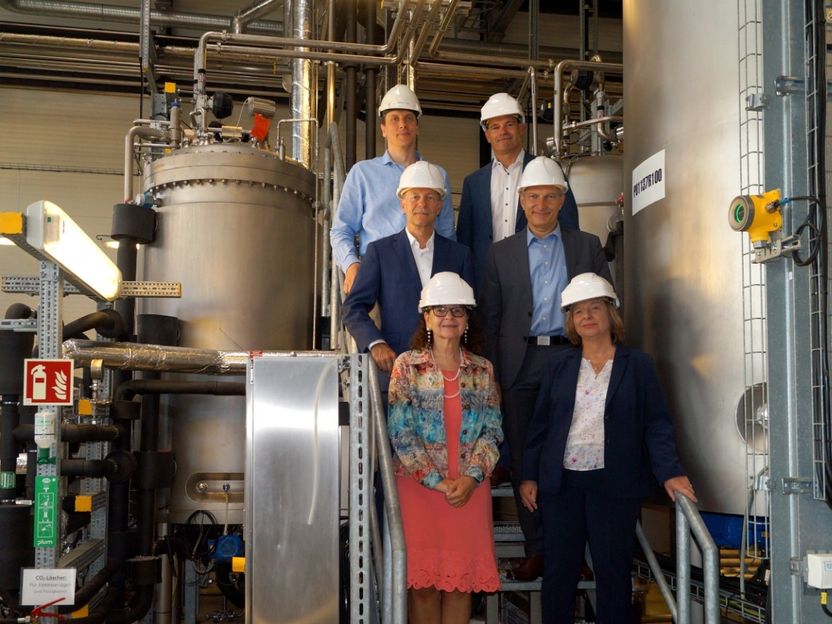
CO₂ recycling powers a new palm oil alternative for the cosmetics industry - The Mibelle Group, LanzaTech, and Fraunhofer IGB have successfully produced a sustainable fat from CO₂ as a replacement for palm oil

Claus Rettig to serve as interim CEO of Evonik - Christian Kullmann on the road to recovery
The Power of light: How light can be used to control processes in synthetic cells

Breakthrough in research on production of 2D crystals with excellent optical properties - Flat crystals showing uniform parameters over the entire surface, including - most valuably - excellent optical properties
Extending the Lifespan of Electrocatalysts
