New biobatteries are inspired by your small intestine
Binghamton University team shows how wastewater can power bacteria fuel cells
Advertisement


When trying to figure out a better design for a bacteria-powered biobattery, Binghamton University researchers found inspiration in nature — specifically, the insides of our small intestines.
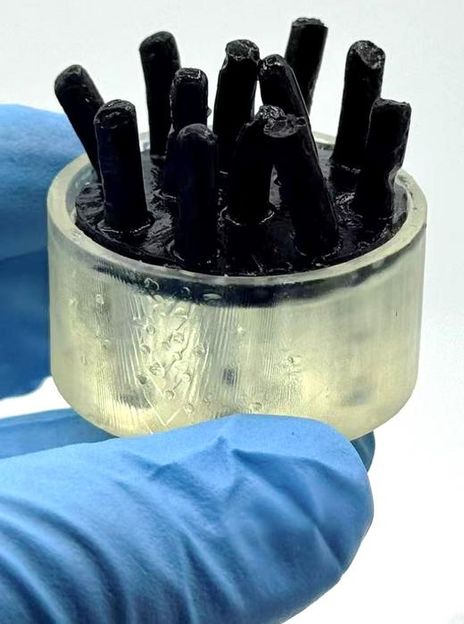
The Binghamton University team manufactured various sizes of villi-inspired biobatteries to see which ones provided optimum electric output.
Ruohan Zhang, Botian Wang, Seokheun Choi, "Intestinal Villi-Inspired Living Biobatteries via Habitat-Engineered Conductive Hydrogel Architectures"
Finger-like protuberances called villi line the digestive tract and are covered with microorganisms that help us to digest our food. Their shape and behavior also prove to be ideal for generating bioenergy using spore-forming bacteria.
Professor Seokheun “Sean” Choi and PhD students Ruohan “Astrid” Zhang and Botian Wang from the Thomas J. Watson College of Engineering and Applied Science’s Department of Electrical and Computer Engineering recently published their findings in the journal Small.

Choi’s previous research has explored a variety of biobattery configurations with paper, fabric, metal, and polymers, and he is trying to integrate them into 3D-printed circuits. He’s even created an ingestible biobattery that remains inert until it activates in the small intestine.
As a pioneer of papertronics, Choi is most interested in using paper as the medium. One limitation he’s discovered among nearly all the materials he’s tried: two-dimensional configurations don’t offer enough surface area for the spore-forming Bacillus subtilis bacteria to thrive. The porous nature of paper offers limited three-dimensional possibilities but can lead to performance issues.
“Porous structures can be easily clogged by biofilm formation, so we had a lot of problems with nutrient delivery, waste buildup or uneven biofilm growth,” said Choi, who leads the Bioelectronics and Microsystems Lab. “What we need is a bioelectrode that mimics living tissue, so that we provide a large surface area and short diffusion distance, efficient mass transport, and at the same time mechanically flexible, stretchable, and scalable.”
For this latest research, the Binghamton team fabricated the villi-inspired structures out of a dormant yet flexible polymer hydrogel commonly used for biomedical applications. They seeded inactive bacteria throughout the villi, which act as the biobattery’s anode. To generate small amounts of electricity, the villi are separated from a modified carbon-cloth cathode by an ion-exchange membrane.
With a constant supply of nutrient medium, the villi device maintained a stable output of about 0.75 volts for at least 14 hours — enough to light small LEDs or power microsensors. One possibility for future use would be self-powered wastewater treatment.
“We can put this biobattery in a waste pipe, because it can easily be integrated with its surroundings,” Choi said. “It can use the waste in the water as a nutrient and generate power, and it can exactly conform to the shape and size of the pipeline.”
As an electrical engineer, Zhang admitted she wasn’t too familiar with the human digestive system before this research, but she and Choi did a lot of reading before deciding to design and build a villi-inspired biobattery.
“I now know how the structure looks and how the bacteria in the gut perform,” she said. “I also studied a lot more about the exact structure of the villi and how the different layers of cells function, so I can integrate them in our work.”
The Binghamton team wants to improve the manufacturing process for the villi-inspired biobatteries by developing a single-step, scalable printing method. The researchers also would like to move closer to how our bodies work, with bacteria in our digestive tract staying mostly near the surface in a mucous layer that coats the villi.
“In this work, we tried to mimic architectural part,” Choi said. “We need to mimic their actual physiological and chemical makeup to truly understand how those bacterial cells can maintain their viability.”
Original publication


Other news from the department science





















Most read news











More news from our other portals



























See the theme worlds for related content
Topic World Battery Technology
The topic world Battery Technology combines relevant knowledge in a unique way. Here you will find everything about suppliers and their products, webinars, white papers, catalogs and brochures.

Topic World Battery Technology
The topic world Battery Technology combines relevant knowledge in a unique way. Here you will find everything about suppliers and their products, webinars, white papers, catalogs and brochures.
Last viewed contents
“See you at the DISCO₂!”: Carbon Dioxide as a Valuable Resource for Industry - The Federal Ministry of Federal Affairs, Transport, and Telecommunications (BMFTR) is providing over 24 million euros in funding for the DISCO₂ research initiative on industrial CO₂ utilization

FUST Lab Receives Investment from Asia2G Capital - The Korean deep-tech company plans to use the capital to expand into the U.S., European, and Japanese markets

ACHEMA Middle East: Debut in Saudi Arabia not until 2027 - Messe Frankfurt Saudi Arabia and DECHEMA are responding to regional uncertainties and are also changing the venue
New core-shell design for anodes significantly increases performance of sodium-ion batteries - Researchers coat porous carbon with a filter-like layer that allows sodium ions to pass through while keeping disruptive electrolyte molecules out

New "chemical armor" could unlock the holy grail of solid-state battery technology - A simple one-step coating builds a silicon-indium hybrid shield on lithium metal, quadrupling current density and extending battery cycle life
Scientists unveil mechanism behind greener ammonia production
Siemens to digitalize one of Europe's largest renewable hydrogen projects - Physics-based digital twin and real-time optimization
Collaboration between University of Bristol and Malvern Panalytical - Bringing academia and business together to solve global challenges

Digital lab day 2025 celebrates international success - virtual battery day 2025 follows in November
RE:VOLTAGE and CometHire Win the HTW Startup Challenge 2026 in Berlin - The competition awarded 10,000 euros in prize money in the GreenTech and Impact Entrepreneurship categories
Atomic reshuffle paves way for record-breaking catalysts for hydrogen production - "This opens a new strategy for designing adaptive catalysts for a wide range of applications"
