Increases Evonik’s global hydrogen peroxide capacity by approx. 30 percent
Evonik’s new hydrogen peroxide plant officially opened in Jilin
Advertisement


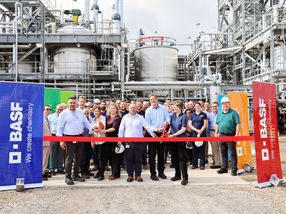
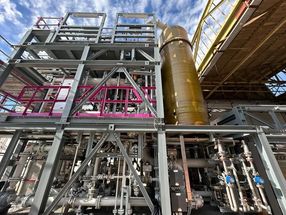
Evonik Industries formally commenced operations at a new hydrogen peroxide plant in Jilin (China). The new production plant has an annual capacity of 230,000 metric tons. Evonik has invested over one hundred million euros in the site, thereby raising its current global capacity for hydrogen-peroxide production to more than 900,000 metric tons per annum.
"This investment further consolidates our market leadership for hydrogen peroxide and sees us resolutely pursuing our growth strategy in Asia," said Dr. Klaus Engel, Chairman of the Executive Board of Evonik Industries, at the official opening ceremony in Jilin. The event was also attended by high-ranking representatives from politics and the business community.
Evonik will supply H2O2 from Jilin straight to the neighboring propylene oxide plant run by Jishen Chemical Industry Co., Ltd., which has likewise been newly erected. A long-term supply agreement was signed for this purpose. Jishen will use the hydrogen peroxide to manufacture propylene oxide on the basis of the HPPO process. Propylene oxide is used predominantly to make the polyurethane intermediates that are used in the manufacture of products such as upholstery for car seats and furniture or insulation material for the construction and refrigeration industry.
"We are registering a great deal of demand around the world for our efficient HPPO process", says Gregor Hetzke, Head of the Advanced Intermediates Business Unit at Evonik. "The Jilin plant represents another milestone on the way to establishing hydrogen peroxide as an eco-friendly oxidant for the process of chemical synthesis. The project is also proof of how we use new technologies to systematically drive forward our growth."
Evonik developed the HPPO process together with ThyssenKrupp Uhde GmbH. The new plant in Jilin is the second of its kind. Evonik, ThyssenKrupp Uhde, and a Korean chemicals company as the licensee were the first companies worldwide to use the HPPO process on an industrial scale back in 2008 in Ulsan (Korea).
To date, hydrogen peroxide has been used mainly as a bleaching agent by the textile and pulp industry. The HPPO process now allows this eco-friendly oxidant to also be employed in the direct chemical synthesis of propylene oxide. The benefits of the new method are that it requires much lower investment costs, has high production efficiency, and has excellent environmental compatibility.



Other news from the department manufacturing

















Most read news











More news from our other portals



























Last viewed contents

Researchers turn coffee and plastic waste into climate solution - “What begins with a Starbucks coffee cup and a discarded plastic water bottle can become a powerful tool in the fight against climate change...”

Team develops bioprocess for converting plant materials into valuable chemicals

Wonder material graphene claims yet another superlative
Magnets trump metallics - Magnetic fields can block conductivity of carbon nanotubes

Cellphone converts into powerful chemical detector - With only $50 worth of components, an ordinary cellphone transforms into a sophisticated scientific instrument, capable of identifying chemicals, drugs, and pathogens
Dual-function organic molecule may advance display technologies and medical imaging - Researchers overcome a long-standing molecular design challenge by realizing efficient light emission and photon absorption in the same compound.

Cylib selected as Strategic Project under EU Critical Raw Materials Act - cylib is building a facility in Dormagen designed to process up to 140,000 EV batteries per year
Advanced X-ray technique unveils fast solid-gas chemical reaction pathways
BASF invests in alkoxylate capacity expansion
PerkinElmer Acquires C&A Service Solutions Ltd.
Efficient indium oxide catalysts designed for CO2 hydrogenation to methanol - Promising way to directly convert CO2 into methanol for industrial applications