Electrical conductivity in doped organic semiconductors deciphered
Advertisement


organic semiconductors enable the fabrication of large-scale printed and mechanically flexible electronic applications, and have already successfully established themselves on the market for displays in the form of organic light-emitting diodes (OLEDs). In order to break into further market segments, however, improvements in performance are still needed. Doping is the answer. In semiconductor technology, doping refers to the targeted introduction of impurities (also called dopants) into the semiconductor material of an integrated circuit. These dopants function as intentional "disturbances" in the semiconductor that can be used to specifically control the behaviour of the charge carriers and thus the electrical conductivity of the original material. Even the smallest amounts of these can have a very strong influence on electrical conductivity. Molecular doping is an integral part of the majority of commercial organic electronics applications. Until now, however, an insufficient fundamental physical understanding of the transport mechanisms of charges in doped organic semiconductors has prevented a further increase in conductivity to match the best inorganic semiconductors such as silicon.
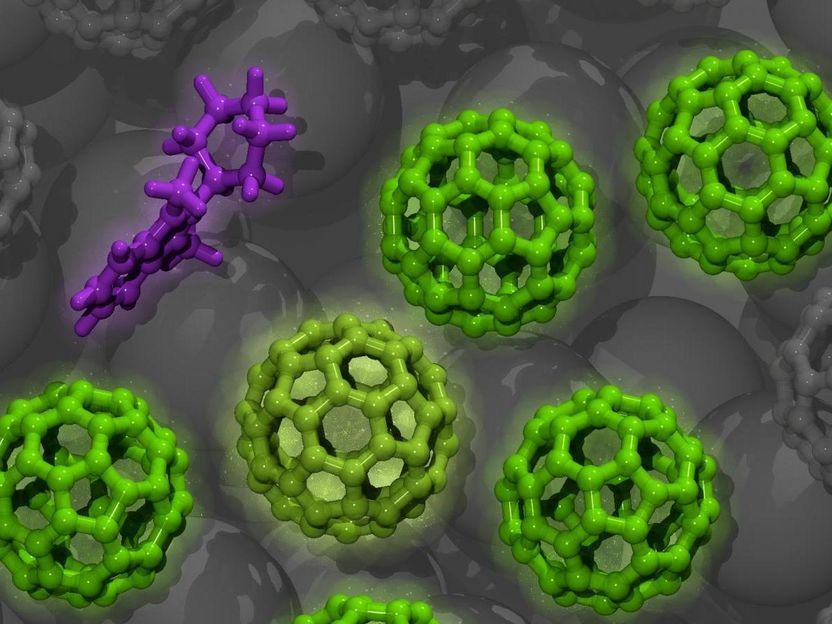
Illustration of an organic semiconductor layer (green molecules) with dopant molecule (purple).
Sebastian Hutsch, Frank Ortmann
Researchers from the Dresden Integrated Center for Applied Physics and Photonic Materials (IAPP) and the Center for Advancing Electronics Dresden (cfaed) at TU Dresden, in cooperation with Stanford University and the Institute for Molecular Science in Okazaki, have now identified key parameters that influence electrical conductivity in doped organic conductors. The combination of experimental investigations and simulations has revealed that introducing dopant molecules into organic semiconductors creates complexes of two oppositely charged molecules. The properties of these complexes like the Coulomb attraction and the density of the complexes significantly determine the energy barriers for the transport of charge carriers and thus the level of electrical conductivity. The identification of important molecular parameters constitutes an important foundation for the development of new materials with even higher conductivity.
While the experimental work and a part of the simulations were conducted at the IAPP, the Computational Nanoelectronics Group at the cfaed under the leadership of Dr. Frank Ortmann verified the theoretical explanations for the observations by means of simulations at the molecular level. In doing so, a comprehensive foundation for new applications for organic semiconductor technology has been created.
Original publication
Martin Schwarze, Christopher Gaul, Reinhard Scholz, Fabio Bussolotti, Andreas Hofacker, Karl Sebastian Schellhammer, Bernhard Nell, Benjamin D. Naab, Zhenan Bao, Donato Spoltore, Koen Vandewal, Johannes Widmer, Satoshi Kera, Nobuo Ueno, Frank Ortmann & Karl Leo; "Molecular parameters responsible for thermally activated transport in doped organic semiconductors"; Nature Materials; 2019


Other news from the department science





















Most read news












More news from our other portals

























Last viewed contents

Molecular highway for electrons in organic light-emitting diodes - New material concept potentially allows efficient blue OLEDs with strongly simplified structure

Returning rare earth element production to the United States - ReElement Technologies licenses Purdue critical mineral refining tech and will begin production in late 2024
It’s not getting rougher! Smoothing the way for copper wires - Kiel Physicists discover anomalous deposition of copper
PerkinElmer and VWR International join forces to create combined service solution

Flexing the power of a conductive polymer - A new material holds promise for the next generation of organic electronics
Max-Planck-Institut für Struktur und Dynamik der Materie - Hamburg, Germany
Fast and energy-saving synthesis method for new electrocatalysts - Water electrolysis and the associated hydrogen production could become more energy-efficient in the future

Modified microwave oven cooks up next-gen semiconductors - The breakthrough could change the geometry of transistors used in microchips
Light-induced shape shifting of MXenes - Femtosecond light creates switchable nano-waves in MXenes and moves the materials’ atoms at a record-breaking speed
A touch of gold and silver - For the first time, it is possible to produce crystalline layers of precious metals that consist of a single atomic layer and which are semiconducting
Nanoparticle supersoap creates 'bijel' with potential as sculptable fluid
