Preventing lead spread
Advertisement


While lead pipes were banned decades ago, they still supply millions of American households daily with drinking water amid risks of corrosion and leaching that can cause developmental and neurological effects in young children.
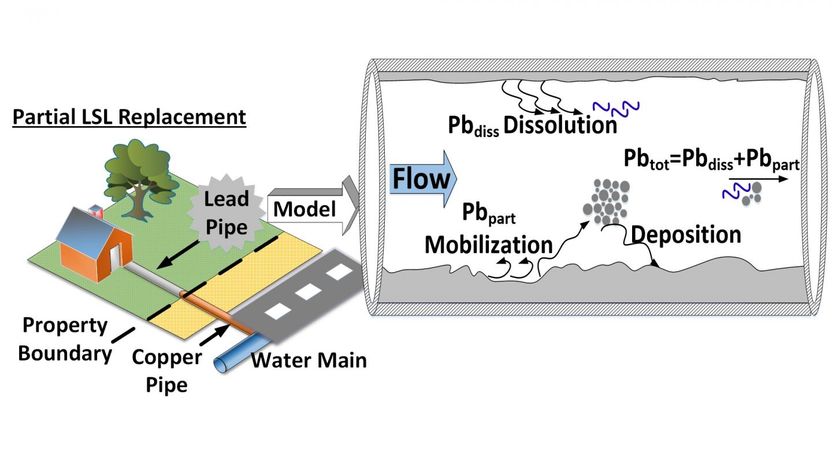
This diagram shows the new model at work: By taking into account a number of factors, including water-use patterns and water chemistry, engineers can predict where lead particles will dislodge and end up in the drinking-water supply during a partial lead service line (LSL) replacement.
Courtesy: Biswas Lab
One common abatement: Dig up old lead lines and replace a portion of them with another metal, such as copper. However, this technique can dislodge lead particulates and release them into the water supply. Furthermore, partially replacing the lead pipe connection instead of entirely exchanging it is problematic.
A team of engineers at Washington University in St. Louis has developed a new way to model and track where lead particles might be transported during the partial-replacement process, in an effort to keep the water supply safer.
"We all know lead is not safe, it needs to go," said Assistant Vice Chancellor of International Programs Pratim Biswas, the Lucy and Stanley Lopata Professor and the chair of Energy, Environmental and Chemical Engineering at the School of Engineering & Applied Science. "This is the first comprehensive model that works as a tool to help drinking-water utility companies and others to predict the outcome of an action. If they have the necessary information of a potential action, they can run this model and it can advise them on how best to proceed with a pipe replacement to ensure there are no adverse effects."
In the research Biswas and graduate research assistant Ahmed A. Abokifa present their approach, which predicts how far lead particles and dissolved species might travel after they've been disturbed. Utilizing water-quality modeling they had previously developed for the Environmental Protection Agency, Biswas and his team built a new computational model to predict lead particulate release, taking into account factors such as pipe age and dimensions, water-use patterns, water chemistry and previous pipe disturbances.
After running a number of simulations testing their predictions, Biswas and his team are ready to make their model widely available to utility companies and even consumers. Biswas said the companies can input their individual system's information and receive recommendations so partial-pipe replacement can proceed without compromising water quality. Abokifa and Biswas have developed several other drinking-water distribution system models to accurately predict disinfectant concentrations in the pipe network, especially dead-end systems.
"We'll work to make these accurate models readily available, so utilities can download and use them," he added. "The predictions of the model will guide them on best practices to ensure the safety of the public at large."
Original publication


Other news from the department science




















Most read news












More news from our other portals


























Last viewed contents
Evonik commissions production plant of PVC plasticizers
How the age of plastic is affecting our hormones - Influence of the chemical substances bisphenol A, F and S on hormone synthesis and the hormone balance of the adrenal gland
LLC SIBUR selects INEOS Technologies as a licensor for 1.5 million tonnes of polyethylene capacity.
Neutrons for the quantum technologies of the future: breakthrough results on layered perovskites
Nuclear detector: New materials hold promise for better detection of nuclear weapons
Artificial intelligence evaluates chemical spectra in minutes - Researchers from the University of Jena, Helmholtz-Zentrum Berlin, and Zakodium develop AI system for chemical structure analysis

Claus Rettig to serve as interim CEO of Evonik - Christian Kullmann on the road to recovery
Scientists discover molecular ‘reshuffle’ and crack an 80-year-old conundrum - “Our findings open the door to new asymmetric transformations based on mechanistic pathways that chemists previously dismissed as inaccessible”
Rigaku opens Rigaku Technology Center Taiwan - Advancing regional growth through engineering and collaboration in Taiwan and beyond
Surface analysis of catalyst particles in aqueous solutions - The results are relevant for the development of efficient photoelectrodes for the production of green hydrogen

Linking superconductivity and structure