My watch list
my.chemeurope.com  
Login  

Rapid procedure for the exploration of chemical compound space unites quantum chemistry with artificial intelligence
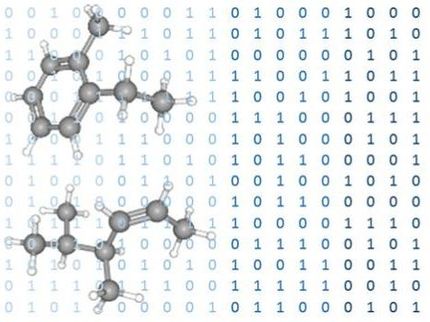
16-02-2012: By combining quantum chemistry with artificial intelligence (Machine Learning), researchers at the Institute for Pure and Applied Mathematics at the University of California, Los Angeles achieved a scientific breakthrough expected to aid in exploring chemical compound space, i.e. the virtual space populated by all possible chemical compounds.



The interdisciplinary team from the Technische Universität Berlin (Germany), the Fritz-Haber Institute of the Max-Planck Society (Germany), and the Argonne Leadership Computing Facility (United States) dramatically increased the speed of calculating energies of small molecules with quantum chemical accuracy. Quantum chemical methods permit scientists to calculate molecular properties on a computer from first principles (i.e. without having to conduct any experiments) — they are necessary for many chemical applications such as catalysis, or the discovery of novel materials. Previously, such calculations demanded intensive computational resources.

Machine Learning, on the other hand, generates predictive models based on examples. While common in daily life, such as in Google's internet search engines or Amazon's book suggestions, it is also used in scientific domains, such as genetic research or brain computer interfaces. When applied to quantum chemistry, thousands of quantum chemical reference energies have been calculated in order to "learn" a molecular model. The resulting Machine permits the prediction of molecular properties with comparable accuracy within milliseconds, instead of hours. Such speed-up paves the way for highly accurate calculations of unprecedentedly many molecules.

Original publication:
Matthias Rupp, Alexandre Tkatschenko, Klaus-Robert Müller, and O. Anatole von Lilienfeld; Fast and Accurate Modeling of Molecular Atomization Energies with Machine Learning; Physical Review Letters 108, 058301 (2012)

Contact / Request information

Request further information free of charge:

Watchlist

This is where you can add this news to your personal favourites

Additional Information

Facts, background information, dossiers
More about TU Berlin
Contact
Technische Universität Berlin
Straße des 17. Juni 135
10623 Berlin
Germany
Phone
+4930314-0
Fax
+4930314-23222
More about Fritz-Haber-Institut
Contact
Fritz-Haber-Institut der Max-Planck-Gesellschaft
Faradayweg 4-6
14195 Berlin
Germany
Phone
+4930841330
Fax
+493084133155
  • News

    X-ray laser reveals chemical reaction

    What happens when a chemical bond is broken? That question was recently answered with the help of a so-called free electron x-ray laser, which makes it possible to follow in real time how bindings in a molecule are changed and broken. The study, published in Science, found, among other thin ... more

    Cheap and Cheerful: Iron to Replace Palladium

    Precious metals are expensive and in demand, not just for jewellery or as a financial investment, but also in industry. Here, valuable metals are used, among other things, as catalysts in chemical reactions. For example, palladium is crucial in a decisive step in the production of polyethyl ... more

    Defects make catalysts perfect

    There is now one less mystery in chemical production plants. For many decades industry has been producing methanol on a large scale from a mixture of carbon dioxide and carbon monoxide, as well as hydrogen. An international team, including chemists from the Fritz Haber Institute of the Max ... more

More about Argonne National Laboratory
Contact
Argonne National Laboratory
9700 S. Cass Avenue
60439
Phone
+1630252-2000
Your browser is not current. Microsoft Internet Explorer 6.0 does not support some functions on Chemie.DE