My watch list
my.chemeurope.com  
Login  

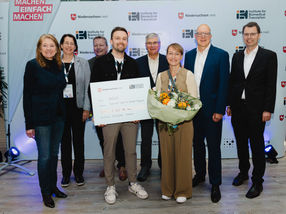
14-05-2012: A team of students from the University of Manchester, UK,  has been awarded an international sustainability prize by the Institution of Chemical Engineers (IChemE) in recognition of a university design project  based on turning corn waste into succinic acid.

The seven-strong team that clinched the inaugural McNab-Lacey Student Design prize was made up of final-year students Liam Booth, Maryam Ojetola, Sarah Bickerton, Richard Gowers, Sophie Wilkinson, Vanessa Suniggi and Andrew Harrison, all of whom have now graduated from Manchester. They were mentored through their project by chemical engineering professor Colin Webb. The prize is open to final-year chemical engineering students from IChemE accredited universities across the globe, rewarding the project that best contributes to a sustainable world.

Their winning project involved designing a process for producing succinic acid from corn waste using the microorganisim Actinobacillicus succinogenes. Malcolm Wilkinson, chair of the IChemE Sustainability Special Interest Group and head of the judging panel, says that the team had “clearly taken the idea of sustainability right through the project, from the initial concept to the final design.”

When asked what they had taken from the project the team explained that it had given them an appreciation of how “incredibly iterative” the design process is, and spoke of how hard – and rewarding – it is to work with a team under incredibly stressful conditions.

“If you couldn’t adapt,” they said, “you couldn’t get through it.”

Less than half of the teams vying for the award came from UK universities, with two entries coming in from Malaysia and a much-commended effort from Singapore Polytechnic clinching second place.

IChemE CEO David Brown says that he was impressed with the winning project: “ This project is a great example of how chemical engineers are leading the transition to a low carbon economy and are helping to tackle the impact of climate change. Encouraging chemical engineering students to think about this and sustainable ways of working is key to ensuring they take a similar mindset into their professional careers.”

Contact / Request information

Request further information free of charge:

Watchlist

This is where you can add this news to your personal favourites

Facts, background information, dossiers
More about IChemE
Contact
Institution of Chemical Engineers (IChemE)
Davis Building, 165-189 Railway Terrace
CV21 3HQ Rugby
United Kingdom
Phone
+4401788578214
Fax
+4401788560833
  • News

    KBR named as new Gold Corporate Partner

    KBR has been named as Institution of Chemical Engineers (IChemE’s) newest Gold Corporate Partner. IChemE Chief Executive Officer David Brown formally presented Barry Weightman, KBR Discipline Manager, Process Engineering, with the partner certificate at KBR’s Greenford office in London, U.K ... more

    IChemE welcomes UK fracking go-ahead

    IChemE is backing a UK government decision to lift an embargo on hydraulic fracturing – better known as fracking – after creating new regulations that it says will reduce the chance of causing earthquakes. The technique, which involves injecting thousands of tons of water into gas-bearing r ... more

    Kletz bows out at Hazards

    Chemical engineers and process safety experts paid tribute to industry guru Trevor Kletz at IChemE’s (Institution of Chemical Engineers) Hazards conference this week. Kletz, who turned 90 last month, has announced his retirement following a celebrated career as industry safety advisor, lect ... more
More about University of Manchester
Contact
University of Manchester
Oxford Road
M13 9PL Manchester
United Kingdom
Phone
+44 161 306 6000
  • News

    What determines the stability of proteins?

    With mathematical methods and computer simulations, Humboldt Fellow Richard Henchman (University of Manchester) is exploring the factors of protein stability – Research stay at the Heidelberg Institute for Theoretical Studies (HITS), supported by the Alexander von Humboldt foundation. Since ... more

    Forensic electrochemistry: sensing “molecule of murder” atropine

    A disposable and cost effective electrochemical sensor that can detect atropine in a drink has been made by scientists from the UK and Brazil. Atropine is a plant-derived drug that can be used in the treatment of Parkinson’s disease and exposure to nerve agents. However, it is also used as ... more

    Spectroscopy on a two pence coin

    Surface enhanced Raman spectroscopy (SERS) has been carried out on British two pence coins to detect several drugs of abuse, including MDMA. SERS relies on a roughened metal surface, often silver, to give rise to strong spectral signals of the substance being analysed. By galvanising the co ... more

Your browser is not current. Microsoft Internet Explorer 6.0 does not support some functions on Chemie.DE