Luminescent nano-architectures of gallium arsenide
Advertisement


A team at the HZB has succeeded in growing nanocrystals of gallium arsenide on tiny columns of silicon and germanium. This enables extremely efficient optoelectronic components for important frequency ranges to be realised on silicon chips.

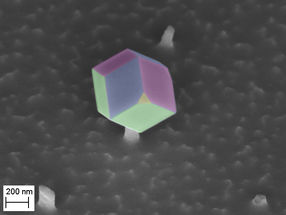
The GaAs nanocrystal has been deposited on top of a silicon germanium needle, as shown by this SEM-image. The rhombic facets have been colored artificially.
S. Schmitt/HZB
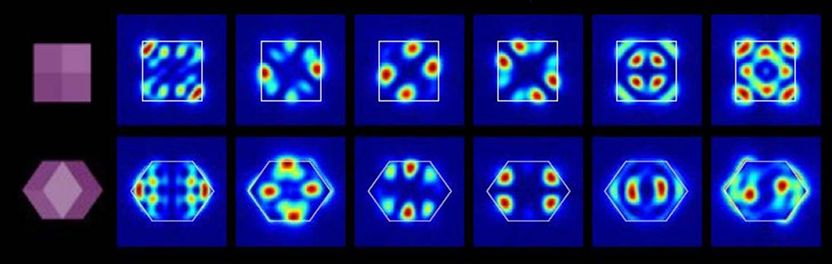
Intensity distribution of the six optical modes in the rhombic-dodecahedron is shown along two rectangular cross sectional planes.
HZB
Gallium arsenide semiconductors have better optoelectronic properties compared to silicon. Those properties can be controlled and altered by specific nanostructures. Dr. Sebastian Schmitt, Prof. Silke Christiansen and their collaborators have succeeded to obtain such a nanostructure on a silicon wafer covered with a thin, surprisingly crystalline layer of germanium. Colleagues from Australia had produced the high-quality wafer and sent it to HZB. The thin film of germanium facilitates the growth of gallium arsenide crystals because the lattice constants of germanium and gallium arsenide are almost identical.
They etched deep trenches in these wafers at intervals of a few micrometers until only a series of fine silicon columns topped with germanium remained on the substrate. Gallium arsenide was then deposited using metal organic vapor phase epitaxy (MOVPE). In this way, both gallium and arsenic atoms were systematically deposited on each germanium-capped silicon tower, forming a tiny, almost-perfect crystal. “The germanium acts like a crystallisation nucleus”, explains Schmitt who is the author of the study published in Advanced Optical Materials.
The nano-architecture looks spectacular under the electron microscope. At first glance, it seems as if you can see a cube on the tip of each silicon needle. At second glance, it becomes apparent that it is actually a rhombic dodecahedron – with each of the twelve surfaces an identical rhombus.
This nano-structure exhibits unusually high optical emission after excitation with a laser, especially in the near-infrared region. “As the GaAs crystals grow, germanium atoms also become incorporated into the crystal lattice”, explains Schmitt. This incorporation of germanium leads to additional discrete energy levels for charge carriers that emit light when falling back to their original levels. The light is then amplified by means of optical resonances in the highly symmetrical nanocrystal, and the frequency of these resonances can be controlled by size and geometry of the crystals. A large number of these so-called photonic resonances could be detected in the experiment that also agree well with numerical calculations.
“Because the optical and electronic properties of semiconductors can be strongly modified by nanostructuring, such nano-architectures are well suited for developing novel sensors, light-emitting diodes, and solar cells”, says Schmitt.
Original publication
"Germanium template assisted integration of gallium arsenide nanocrystals on silicon: a versatile platform for modern optoelectronic materials"; S. W. Schmitt, G. Sarau, C. Speich,G. H. Döhler, Z. Liu, X. Hao, S. Rechberger, C. Dieker, E. Spiecker, W. Prost, F. J. Tegude, G. Conibeer, M. A. Green and S. H. Christiansen; Advanced Optical Materials; 2018.


Other news from the department science





















Most read news












More news from our other portals

























Last viewed contents

Climate pioneers cooperate to produce solar fuels - INERATEC joins forces with Synhelion

Micro- and nanoplastics in the body are passed on during cell division - That plastic may increase metastasis of tumors
Search for new semiconductors heats up with gallium oxide
Smoltek Hydrogen and Heraeus Precious Metals advance next-generation ultra-low iridium electrolysis technology

Chemistry without detours: Researchers introduce a two-step process for producing phosphorus-containing chemicals - This promising innovation not only contributes to environmental protection but also saves significant time and costs

Evidence stacks up for poisonous books containing toxic dyes

Adhesives from waste wood, biofuel from straw - EU research project on the potential of agroforestry waste as environmentally friendly raw materials completed
Computational trick enables better understanding of exotic state of matter - New process relevant for fusion and materials research

Pushing boundaries: Detecting the anomalous Hall effect without magnetization in a new class of materials - The first experimental evidence for the anomalous Hall effect emerging in a collinear antiferromagnet with non-Fermi liquid behavior

Unveiling how water and ions impact chemical reactivities at solid-aqueous interfaces

Chemistry meets biology: controlling artificial cell membranes through catalysis - Researchers develop an artificial metalloenzyme-based platform that enables programmable control of artificial membrane behavior