Don't Give the Slightest Chance to Toxic Elements in Medicinal Products
New high-accuracy reference solutions for the SI-traceable measurement
Advertisement


lead, cadmium, mercury, and arsenic do not belong in medicinal products. International requirements for the quality of medicines have therefore become more stringent and introduced new control requirements. Hence, it makes sense to use high-accuracy reference solutions with defined contents of these four elements to be able to make the measurements traceable to the International System of Units (SI). Such reference solutions have now been produced in a joint project of the European Directorate for the Quality of Medicines and HealthCare (EDQM), the Joint Research Center (JRC) Geel, the German Federal Institute for Materials Research and Testing (BAM) and the Physikalisch-Technische Bundesanstalt (PTB).
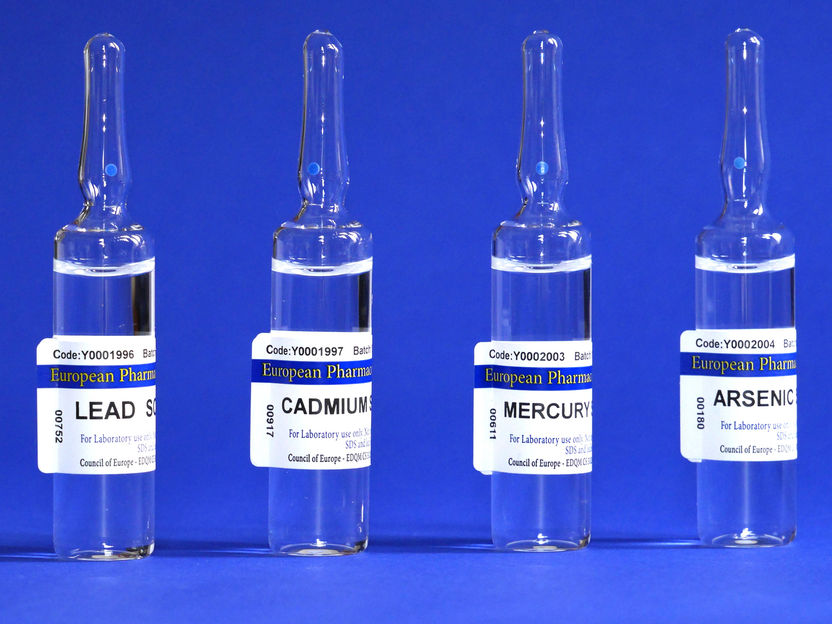
Since January 2018, the jointly developed reference solutions for lead, cadmium, mercury, and arsenic with SI-traceable element content are in the EDQM product portfolio.
PTB
The protection of public health is very high on the agenda of regulators worldwide. For this reason, it is expedient to apply the best methods available when it comes to examining medicinal products for possible contaminations. In this case, the best means are elaborately prepared reference solutions with a defined content of toxic elements that are applied for calibrating the analytical instruments used. This way the measurements become traceable to the SI and they fulfill the specifications of the internationally harmonized quality guideline ICH Q3D, which has also been adopted by the European Medicines Agency (EMA/CHMP/ICH/353369/2013).
For the currently 38 member states of the European Pharmacopoeia (Ph. Eur.), inclusion of the guideline into the Ph. Eur. has rendered it legally binding. Since June 2016, the comparable measurements have to be applied for new medicines, and as of December 2017, this applies also to already authorized products. In this two-year period, high-accuracy reference solutions for four particularly toxic inorganic contaminants, namely lead, cadmium, mercury, and arsenic were produced within the framework of this European cooperation. In January 2018, the solutions have been included in the portfolio of the EDQM, and are now commercially available.
“The preparation of such high-accuracy monoelemental reference solutions requires years of experience,” stated Dr. Anita Röthke, chemist at PTB. “BAM and PTB have been active in this field for two decades and can therefore prepare and characterize these solutions at an especially high accuracy level.” When characterizing the mass fraction of lead in the solution by means of ICP OES (optical emission spectrometry with inductively coupled plasma), PTB was, for example, able to achieve measurement uncertainties one hundred times smaller than usually obtained in routine measurements.
Currently, there are discussions on continuing the successful collaboration efforts with the objective of developing further reference solutions.


Other news from the department science





















Most read news












More news from our other portals

























Last viewed contents

Bodo Möller Chemie Group enters exclusive acquisition talks with Rocktin - Strengthen adhesives distribution in Asia
Researchers develop procedure to interpret x-ray emission spectra of liquid water - Study helping to advance the understanding of the structure of water

How can life emerge in a world of minerals? - The European Research Council (ERC) has awarded an ERC Synergy Grant to the project “The role of silica at the dawn of life on our planet” (PROTOS)

New reactor could save millions when making ingredients for plastics and rubber from natural gas - With oil production dropping, a process using natural gas is needed to avert a shortage of a workhorse chemical used for automotive parts, cleaning products and more
Manganese could make luminescent materials and the conversion of sunlight more sustainable
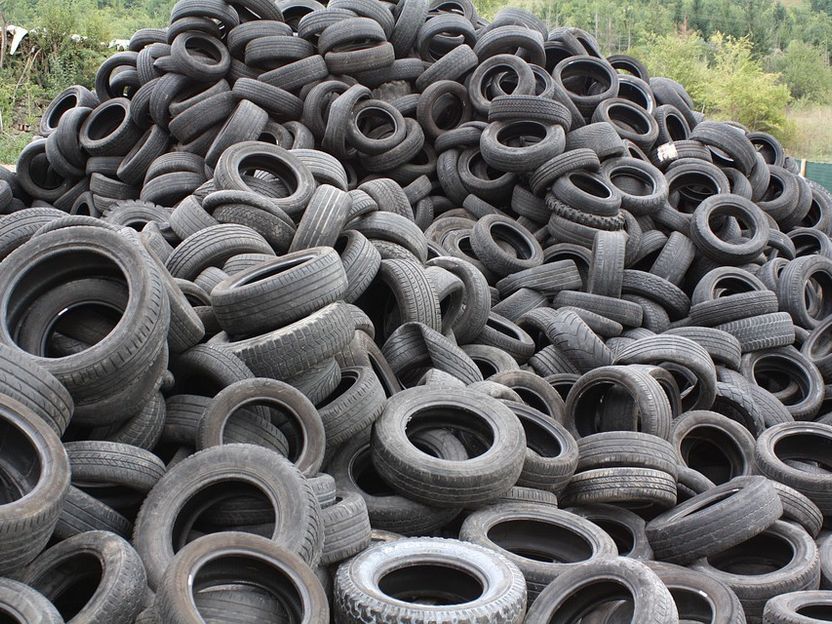
Fibers from old tires can improve fire resistance of concrete

Consortium develops evolutionary concept for recycling of end-of-life polyurethane mattress foams - Ecomaison, Covestro, Secondly and Federal Eco Foam launch research project

Controversial Mass Products: Ceresana Analyzes the Global Market for Plasticizers
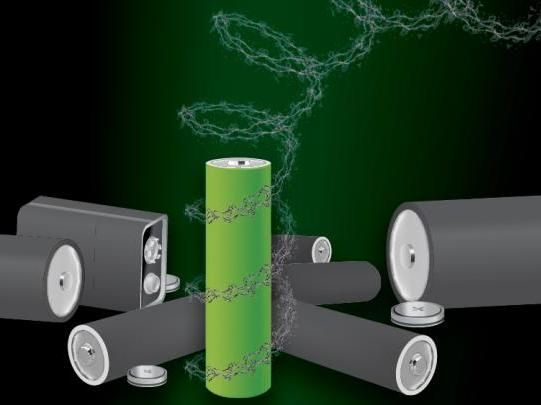
New metal-free, recyclable polypeptide battery that degrades on demand - Breakthrough could lead to battery production moving away from cobalt
Shedding light on mechanisms of electrochemical energy storage - UV-visible spectroscopy gives researchers a tool to study battery materials - a breakthrough that could speed the design of higher performing energy storage devices

Researchers discover new ultra strong material for microchip sensors - A material that doesn't just rival the strength of diamonds and graphene, but boasts a yield strength 10 times greater than Kevlar
