Characterizing and designing lubricants on the computer
Computational models based on molecular structure properties
Advertisement


Lubricated shafts, bearings and gears only run 'like clockwork' when the components slide on a perfect lubricating film, generating as little friction, wear and energy loss as possible. To achieve this, engineers need to know the behavior of the lubricant film in the so-called tribo-contact, which is difficult to measure experimentally. In order to ascertain such behavior, the Fraunhofer IWM, MicroTribology Center μTC makes lubricant properties calculable using atomistic methods and has recently published exciting findings on one of the central parameters, the pressure dependence of lubricant viscosity, in the scientific journal Physical Review Letters.
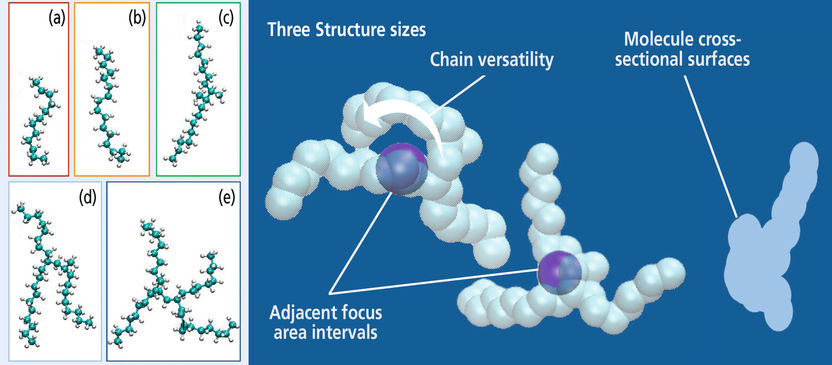
Alkane molecules whose viscosity have been calculated via molecular dynamics simulation at high pressure and high temperature conditions (left) as well as the required molecular structure properties.
© Fraunhofer IWM
In order to develop a new lubricant or to improve upon an existing one, it is important to precisely understand its behavior: pressure, temperature, shear rate and viscosity are important parameters. 'It’s very difficult to measure the lubricant film experimentally because the conditions required to do so can rarely be set in a controlled manner', explains Dr. Kerstin Falk, member of the Multiscale Modeling and Tribosimulation group at the Fraunhofer Institute for Mechanics of Materials IWM in Freiburg. 'In some areas, for example, such extreme loads occur that pressure in the Giga-Pascal range is generated locally', says the expert in tribology, the science of friction, lubrication and wear. Simulations can help where experiments are difficult: up to now, predictions for lubricant behavior at high pressure have mostly been obtained by extrapolating the results of experiments in a normal pressure range. Unfortunately, this approach fails at the extremely high pressures that occur locally in lubricated frictional contacts.
Precise calculations of viscosity at high pressure
Using atomistic molecular dynamics simulations, the physicist can predict lubricant properties such as viscosity under controlled, arbitrarily adjustable pressure and temperature conditions. 'We have been very successful in calculating the viscosity for various model lubricants at pressures of up to 700 Mega-Pascals', says Dr. Kerstin Falk. 'Our model lubricants consisted of simple linear or branched alkanes', she continues. Alkanes or paraffins are very stable chains of carbon and hydrogen which are the basic components of many common lubricants and fuels.
Lubricants characterized by their molecular properties
But Falk's real goal was to obtain a more practical prediction model than had been previously possible. It should allow for viscosity value calculations for certain conditions in the tribo gap without having to carry out complex molecular dynamics simulations. For this purpose, Dr. Kerstin Falk and her colleagues Dr. Daniele Savio and Prof. Michael Moseler used atomistic simulations which, almost like a 'virtual super magnifier', provide insights into the microscopic structure and dynamics of the lubricant molecules. In this way, the team found out which three molecular properties of a lubricant significantly determine its viscosity: the molecular cross-sectional areas, the chain flexibility and the distance between the individual molecules. With these properties identified, the viscosity of a lubricant can easily and accurately be calculated under a wide variety of conditions. 'Additionally, using this simulation method, we can also find the right molecules for certain tribological stresses', says Dr. Falk. 'And in combination with additional quantum chemical simulations of the lubricant interaction with component surfaces, we can suggest a suitable lubricant for a given application to our clients', adds Prof. Michael Moseler.
In the future, these new results will also serve as a basis for investigating lubricant behavior at very high speeds and thus high shear rates. Also examined will be the ways in which lubricants behave in very narrow friction gaps which are only a few molecule diameters wide. Dr. Kerstin Falk and her colleagues can also characterize other lubricants with the new method - for example, water-based lubricants for environmentally compatible applications.
Original publication


Other news from the department science




















These products might interest you


Most read news












More news from our other portals

























Last viewed contents
‘Smart plastic’ material is step forward toward soft, flexible robotics and electronics - A new plastic-like material can be manipulated to be soft and stretchy or hard and rigid with only the application of a catalyst and visible light
Exotic vibrations in new materials - New insights show universal applicability of carbyne as a sensor
BASF increases price for Vitamin B2

First controllable nanoscale gas-liquid interface fabricated

Biodiesel made from discarded cardboard boxes - Development of a microorganism that doubles the yield of biodiesel precursor production using genetic scissors and based on the principles of evolution

Breakthrough for efficient and high-speed spintronic devices - New soft X-ray source could be used for many applications in physics, chemistry, and biology

Keep safe and cool in the pool - Novel chip sensor quickly and continuously does all the work of a chemistry laboratory

“Dictionaries” make fluorescence-based data for integrative structure models and their dynamics accessible - 3D structures of biomolecules

PSL - Powder Systems Limited - Liverpool, United Kingdom
Significant progress achieved in chemical liquid analysis - ISFET-based pH sensor-control successfully miniaturized and optimized for easy use

From research to spinoff - PSI Founder Fellowship supports two spin-off projects: AI platform and solid-state batteries