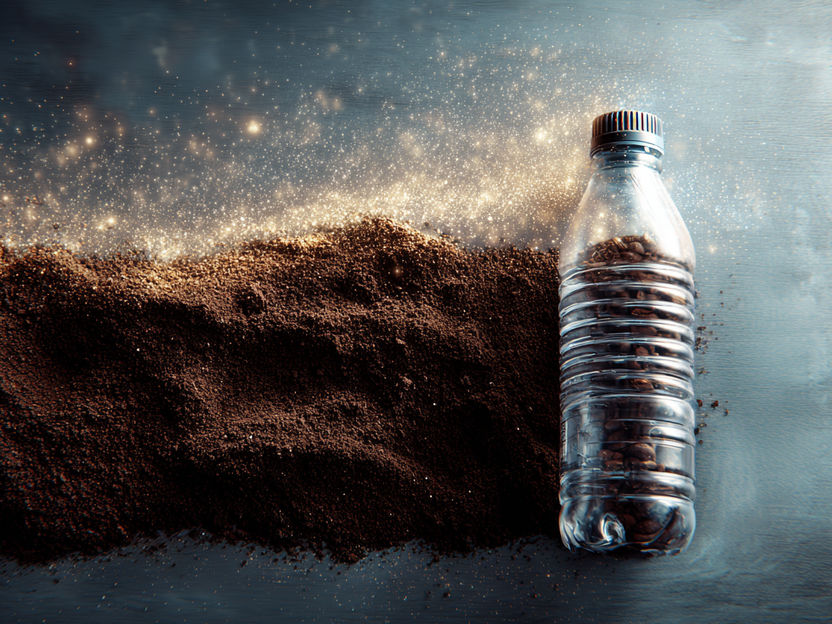
Waste Becomes Recyclable Material
New Process Turns Urine and Ash into Sustainable Raw Materials
Advertisement


How can waste be put to good use instead of being disposed of? A research team at Saarland University has developed an innovative approach that can convert locally available waste materials—urine and ash—into valuable raw materials. The goal of the new process is to make clever use of these two waste materials to provide nitrogen, phosphorus, calcium, and magnesium—the basis for many fertilizers that are currently in high demand. The research findings have now been published in the journal *Bioengineering*.
Ash and urine are considered unwanted waste products. They are produced in enormous quantities and also cause massive environmental problems. For example, urine from intensive livestock farming contributes significantly to the contamination of soil and groundwater with nitrogen and phosphorus compounds, and wood ash must be disposed of in landfills. At the same time, both urine and ash contain valuable chemical components, including nitrogen, phosphorus, calcium, and magnesium. These elements are among the most important raw materials for agriculture and industry.
Researchers led by Claus Jacob, professor of bioorganic chemistry at Saarland University, have now developed the so-called “urine-ash process.” It combines simple biological and chemical processes that can be used to convert the two waste products into valuable materials. “The goal is to produce ‘green’ ammonia and calcium phosphate—both in-demand products with numerous potential applications,” explains Claus Jacob. Green ammonia, for example, can serve as a climate-friendly energy source or as a raw material for fertilizers, while calcium phosphate is widely used in agriculture, medicine, and materials science, among other fields.
In addition to recovering valuable raw materials, the research team is also investigating the practical implementation of the process. This includes issues related to the collection, transport, and processing of the feedstocks, as well as the potential for industrial-scale application of the process.
“In the long term, the process could make an important contribution to the bioeconomy and a sustainable circular economy in our region as well: It would make sensible use of regional waste streams, reduce the environmental impact caused by these materials to date, and at the same time decrease the demand for energy-intensive ‘gray’ ammonia, thereby curbing the environmentally harmful mining of phosphate deposits,” says Professor Claus Jacob. In this way, the project demonstrates how previously unused and unwanted waste materials can be transformed into valuable resources—an important step toward a more sustainable and resource-efficient regional circular economy.
Note: This article has been translated using a computer system without human intervention. LUMITOS offers these automatic translations to present a wider range of current news. Since this article has been translated with automatic translation, it is possible that it contains errors in vocabulary, syntax or grammar. The original article in German can be found here.
Original publication


Other news from the department science




















Most read news












More news from our other portals


























Last viewed contents

RUDN University chemist created a catalyst from orange peel for organic compounds production

Charged “molecular beasts” the basis for new compounds - Researchers use “aggressive” fragments of molecular ions for chemical synthesis
Sustainable raw material supply: New FlashPhos process converts sewage sludge into phosphorus for industrial use

Adhesives from waste wood, biofuel from straw - EU research project on the potential of agroforestry waste as environmentally friendly raw materials completed
Solar cells for the Internet of Things - Seed capital and (more) customers for Empa spin-off
HZB Sets New World Record for CIGS Perovskite Tandem Solar Cells - "We are confident that CIGS-perovskite tandem cells can achieve much higher efficiencies..."
Catalyst selectivity as a “balancing act” - The study suggests a shift in how chemists should think about heterogeneous catalysis
EcoBean: Brewing sustainable chemicals from coffee grounds - Reducing the environmental impact of the chemical and coffee industry: OHAUS as partner
The chameleon effect: Sustainable sensors and displays - An elastic material that changes color, conducts electricity, can be 3D printed and is also biodegradable?

Intertek Group plc - London, United Kingdom