The broken mirror: Can parity violation in molecules finally be measured?
Scientists propose a promising way to detect parity violation in molecules for the first time
Advertisement


Scientists have long tried to experimentally demonstrate a certain symmetry property of the weak interaction - parity violation - in molecules. So far, this has not been possible. A new interdisciplinary effort led by a research group at the at the PRISMA+ Cluster of Excellence at Johannes Gutenberg University Mainz (JGU) and the Helmholtz Institute Mainz (HIM) has now shown a realistic path to demonstrating this phenomenon. The approach includes aspects of nuclear, elementary particle, atomic and molecular physics as well as nuclear magnetic resonance (NMR). "Molecular parity nonconservation in nuclear spin couplings" is published in the current issue of the journal Physical Review Research.

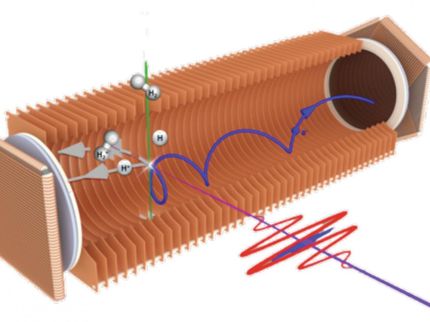
Schematic illustration of parity violation in a molecule containing two nuclear spins
©: Dr. John W. Blanchard
Symmetries are omnipresent – in space as well as in the world of molecules, atoms and elementary particles. The four fundamental forces (electromagnetism, gravity, and the strong and weak nuclear forces) also obey certain, perhaps seemingly abstract, symmetries. From the Big Bang to the present day, existing symmetries were repeatedly broken. Symmetry and symmetry breaking are necessarily reflected in the physical processes and states that we can observe.
One of these symmetries is the mirror symmetry (symmetry with regard to reflection in space) – if it is broken, the researchers speak of parity violation. According to current knowledge, the weak interaction is the only one among the four fundamental forces that does not appear mirror-symmetrical: Only in processes that are subject to this interaction do parity violations occur. "Since the weak interaction plays almost no role in our everyday experience – gravity and electromagnetism dominate here – the phenomenon of parity violation contradicts our normal idea and is therefore difficult to grasp," says Dr. John Blanchard, lead author of the study. "Parity violation in the weak interaction was therefore only theoretically predicted in the 1950s and was discovered shortly afterwards in certain nuclear and elementary particle decays. Parity-violating processes have never been detected in molecules, although theoretical calculations predict that they should be there. Definitive evidence of such subtle effects is, so to speak, a holy grail of precision-measurement physics."
Many attempts have been made to experimentally observe the effects of parity violation in molecules. One example is the interaction of the spins of different atomic nuclei in a molecule. In turn, these can in principle be detected and analyzed using nuclear magnetic resonance methods (NMR). While the team of scientists has already developed a promising approach to chiral molecules in a previous work, their current publication focuses on simple molecules that consist of as few as two atoms. First of all, they identify a special NMR measurement variable (a specific spin-spin coupling) on the basis of which the parity violation is shown and carry out complex theoretical analyses to calculate the expected effect within the molecule. These calculations were carried out in close collaboration with the co-author of the study, Prof. Mikhail G. Kozlov from the Nuclear Physics Institute in St. Petersburg, Russia, with whom the Mainz group has been working very successfully for many years.
Building on this, the scientists propose a special experiment that should be sensitive enough to detect the calculated signals: "The so-called ZULF (zero to ultra-low field) NMR method is an exotic technique that we were already using for dark matter successfully," explains Prof. Dr. Dmitry Budker, also an author of the study. "It offers a system in which nuclear spins interact with each other more than with an external magnetic field. In this way, it enables the direct measurement of antisymmetric spin-spin couplings, which are cut off in conventional high-field NMR experiments."
"Our results show an elegant way to quantitatively investigate the weak interaction in molecules and atomic nuclei," concludes Dr. Blanchard. "The results of our feasibility study are very promising – we hope to soon have experimental verification of molecular parity nonconservation."
Original publication


Other news from the department science





















Most read news












More news from our other portals

























Last viewed contents

Novel chemical design makes hard crystals stretchy - Researchers hope to use chemical structure to target and trap impurities in water
Cobalt-copper tandem successfully converts carbon dioxide to ethanol - Sustainability in the focus of chemical research

Atoms in the sunbath for a sustainable future - Dr. Shanmugapriya Periyannan has been named "MSCA Fellow of the Month"
An electronic rainbow – perovskite spectrometer by inkjet printing

Returning rare earth element production to the United States - ReElement Technologies licenses Purdue critical mineral refining tech and will begin production in late 2024
It’s not getting rougher! Smoothing the way for copper wires - Kiel Physicists discover anomalous deposition of copper
PerkinElmer and VWR International join forces to create combined service solution

Flexing the power of a conductive polymer - A new material holds promise for the next generation of organic electronics
Max-Planck-Institut für Struktur und Dynamik der Materie - Hamburg, Germany

Fast and energy-saving synthesis method for new electrocatalysts - Water electrolysis and the associated hydrogen production could become more energy-efficient in the future

Modified microwave oven cooks up next-gen semiconductors - The breakthrough could change the geometry of transistors used in microchips