Light-induced shape shifting of MXenes
Femtosecond light creates switchable nano-waves in MXenes and moves the materials’ atoms at a record-breaking speed
Advertisement


Ultrafast laser spectroscopy allows to observe the motion of atoms at their natural time scales in the range of femtoseconds, the millionth of a billionth of a second. electron microscopy, on the other hand, provides atomic spatial resolution. By combining electrons and photons in one instrument, the group of Professor Peter Baum at the University of Konstanz has developed some of the fastest electron microscopes for obtaining detailed insight into materials and their dynamics at ultimate resolutions in both space and time.
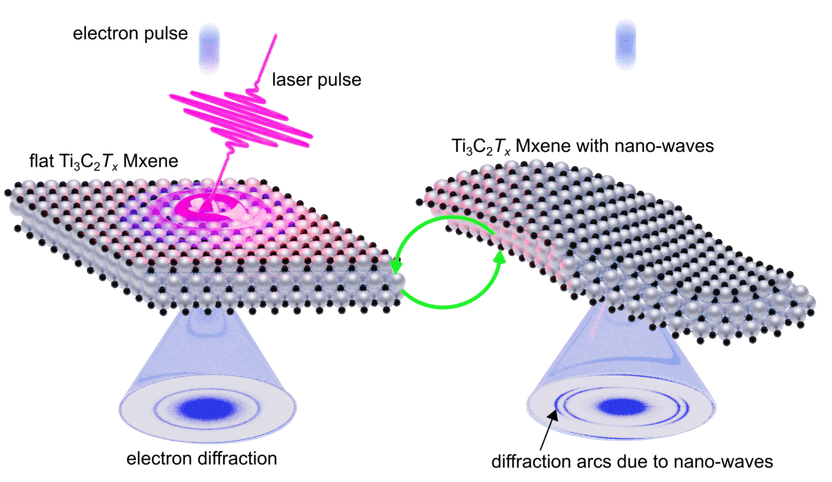
Ultrafast electron diffraction reveals photo-switchable nanoripples in MXene nanosheet.
Mikhail Volkov
In their recent publication in ACS NANO, scientists from the Baum lab have applied this technique together with colleagues from ETH Zurich to study novel materials – two-dimensional molecularly defined sheets called MXenes – and made a surprising discovery. Using laser pulses, MXenes can be switched repeatedly between a flat and a rippled shape, opening up a wide spectrum of possible applications.
MXenes: novel two-dimensional materials
MXenes are two-dimensional sheets of transition metal carbides or nitrides in the form of few-atom-thick single layers. “MXenes are comparable to a molecule in one spatial dimension and to an extended solid in the other two”, Dr Mikhail Volkov, first author of the recent study, describes the structure of MXenes. MXenes are synthesized by "peeling off" the thin layers of material from a precursor material – a process called exfoliation.
In contrast to most other single-layer materials, MXenes can be easily produced in large quantity, thanks to the discovery of a scalable and irreversible chemical exfoliation method. The chemical and physical properties of MXenes can be widely tuned by the choice of the transition metal, leading to widespread applications of MXenes in sensing, energy storage, light harvesting, and antibacterial action.
Nano-waves in MXenes formed by fast light
In their study, primary investigators Dr Mikhail Volkov from the University of Konstanz and Dr Elena Willinger from ETH Zurich have found a new way to enhance the properties of MXenes by shining fast light pulses on them. Using ultrafast electron microscopy with atomic spatial resolution, they recorded a movie of MXenes interacting with femtosecond laser pulses, showing that the laser energy transfers to the atomic lattice in a record-breaking time of merely 230 femtoseconds.
Unexpectedly, the scientists also found that femtosecond laser light can be used to switch back and forth between the originally flat surface structure of the MXene and a nano-wave form of the material – a hill-and-valley “nano-landscape” with a periodicity that is more than fifty times finer than the laser wavelength. “We can control the nano-wave’s orientation with the polarization of the laser, which means the material has an optical memory on the nanoscale. Moreover, if the laser strikes again, the nano-waved MXene turns back into a plane and remains flat during illumination. The extremely small size of the nano-waves and the fast lattice reaction are also quite surprising, and a phenomenon called plasmon-phonon coupling is likely involved”, explains Volkov.
Nano-waves boosting material performance
“Nano-structuring in the form of waves also increases the surface-to-volume ratio of the materials, making them chemically more reactive. In addition, it enhances the local electro-magnetic fields, improving the coupling with light – a valuable property for sensing applications,” says Volkov. The scientists therefore expect the discovered nano-waved MXenes to show improved energy storage capacity and enhanced catalytic or antibiotic activity. “Finally, the possibility to switch the structure of MXenes between plane and wavy ‘on demand’ via a laser pulse opens up intriguing ways to use the materials in active plasmonic, chemical and electric devices”, Volkov concludes.
Original publication


Other news from the department science





















Most read news












More news from our other portals

























Last viewed contents
A touch of gold and silver - For the first time, it is possible to produce crystalline layers of precious metals that consist of a single atomic layer and which are semiconducting
Nanoparticle supersoap creates 'bijel' with potential as sculptable fluid

Inspired by nature: Scientists have developed a nanopore-microchip

Reinforcement of structures with Memory Steel
Ultra-thin lenses that make infrared light visible - Researchers have achieved this using a special metal-oxide lens material called lithium niobate and through nanoscale pattern, stamped into the material

Team develops bioprocess for converting plant materials into valuable chemicals

Wonder material graphene claims yet another superlative
Magnets trump metallics - Magnetic fields can block conductivity of carbon nanotubes

Cellphone converts into powerful chemical detector - With only $50 worth of components, an ordinary cellphone transforms into a sophisticated scientific instrument, capable of identifying chemicals, drugs, and pathogens
Dual-function organic molecule may advance display technologies and medical imaging - Researchers overcome a long-standing molecular design challenge by realizing efficient light emission and photon absorption in the same compound.

Cylib selected as Strategic Project under EU Critical Raw Materials Act - cylib is building a facility in Dormagen designed to process up to 140,000 EV batteries per year