Scientists use copper nanowires to combat the spread of diseases
Advertisement


An ancient metal used for its microbial properties is the basis for a materials-based solution to disinfection. A team of scientists from Ames National Laboratory, Iowa State University, and University at Buffalo developed an antimicrobial spray that deposits a layer of copper nanowires onto high-touch surfaces in public spaces. The spray contains copper nanowires (CuNWs) or copper-zinc nanowires (CuZnNWs) and can form an antimicrobial coating on a variety of surfaces. This research was initiated by the COVID-19 pandemic, but the findings have wider-reaching applications.
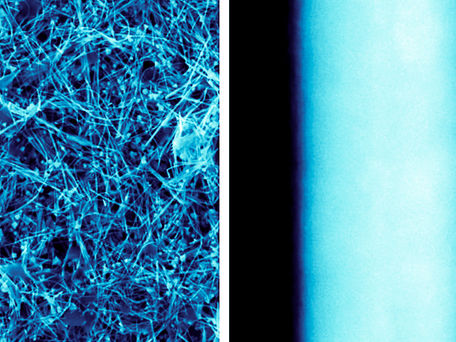
Left: Scanning electron microscopy image of the CuNW network on a copper-sprayed surface. Right: Up-close image of CuNW nanowire, which is about 60 nm in diameter, approximately 100x smaller than a human hair.
U.S. Department of Energy Ames National Laboratory
People have taken advantage of copper’s antimicrobial properties since 2400 B.C. to treat and prevent infections and diseases. It has been proven effective for inactivating viruses, bacteria, fungi, and yeasts when they are directly in contact with the metal. According to Jun Cui, a scientist at Ames Lab and one of the lead researchers on the project, “copper ion can penetrate the membrane of a virus and then insert itself into the RNA chain, and completely disable the virus from duplicating itself.”
Amidst the pandemic, “The DOE asked researchers, what can you do to help to mitigate this COVID situation?” Cui said. Ames Lab is known for work in materials science, not a field that often intersects with disease research. However, Cui’s team came up with the idea to apply copper’s antimicrobial properties to help reduce the spread of COVID.

Cui explained their idea came from a separate project they were working on, which is a copper ink designed for printing copper nanowires used in flexible electronic devices. “So the thinking is, this is ink, and I can dilute it with water or even ethanol, and then just spray it. Whatever the surface, I spray it once and coat it with a very light layer of a copper nanowire,” he said.
First the surface needs to be cleaned and disinfected, then the reformulated copper ink solution can be applied. The ideal coating should be thin enough to be transparent. The ink can be diluted with water or alcohol to make it sprayable, and it works on plastic, glass, and stainless-steel surfaces.
The team tested two types of copper ink, CuNW and CuZnNW. Compared to a plain copper disk, both inks were just as effective at disabling the virus. However, it took 40 minutes for the copper disk to disable the virus, whereas it took the copper inks only 20 minutes. The nanowires worked faster because of their greater surface area.
In a comparison between the two ink coatings, the CuNW inactivated the virus more quickly than CuZnNW during the first 10 minutes. However, CuZnNW had a more steady and sustainable release of copper ions, compared to CuNW, which makes the coating effective for a longer amount of time. Ultimately the team concluded that the CuZnNW was the best option for a sprayable copper nanowire coating for antimicrobial purposes.
Cui said that this work was important, not just because of the pandemic, but since these nanowires can protect against many different microbes, “there’s the chance that we can have a lasting impact to human society.”


Other news from the department science





















Most read news












More news from our other portals

























Last viewed contents
Ytterbium thin-disk lasers pave the way for sensitive detection of atmospheric pollutants - The laser's capacity to generate high-power, stable pulses in the SWIR range is a game-changer for field-resolved spectroscopy and femtosecond fieldoscopy
Shedding light on mechanisms of electrochemical energy storage - UV-visible spectroscopy gives researchers a tool to study battery materials - a breakthrough that could speed the design of higher performing energy storage devices

Researchers discover new ultra strong material for microchip sensors - A material that doesn't just rival the strength of diamonds and graphene, but boasts a yield strength 10 times greater than Kevlar

Brown chemists report promising advance in fuel-cell technology

Climate pioneers cooperate to produce solar fuels - INERATEC joins forces with Synhelion

Micro- and nanoplastics in the body are passed on during cell division - That plastic may increase metastasis of tumors
Search for new semiconductors heats up with gallium oxide
Smoltek Hydrogen and Heraeus Precious Metals advance next-generation ultra-low iridium electrolysis technology

Chemistry without detours: Researchers introduce a two-step process for producing phosphorus-containing chemicals - This promising innovation not only contributes to environmental protection but also saves significant time and costs

Evidence stacks up for poisonous books containing toxic dyes

Adhesives from waste wood, biofuel from straw - EU research project on the potential of agroforestry waste as environmentally friendly raw materials completed