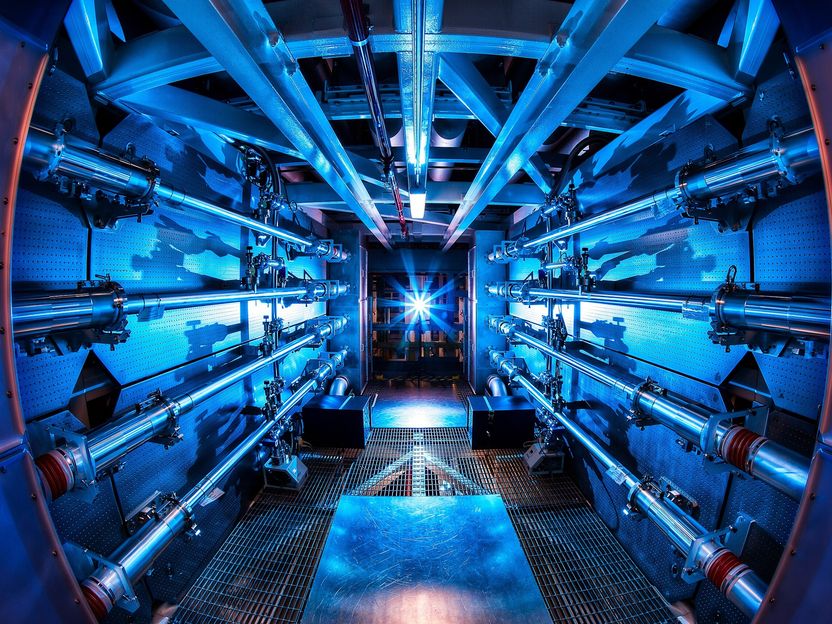
Researchers are improving technology to generate high harmonics in nanostructured metasurfaces
Advertisement


Natural and artificial crystals can change the spectral colour of light – known as the nonlinear optical effect. Colour conversion is used for numerous applications, including nonlinear microscopy for biological structures and material examinations, LED light sources and lasers, in optical communications, and in photonics and its resulting technologies such as quantum computing. Researchers from Paderborn University have now found a way to improve the physical process underlying the phenomenon. The results have been published in the specialist journal ‘Light: Science & Applications’.
Symbolic photo
Paderborn University, Besim Mazhiqi
‘The process is based on the anharmonic potential of crystal atoms and often prompts a precise multiplication of the light frequency, known as generating “higher harmonics” – similar to the overtones heard when the string on a musical instrument vibrates’, Paderborn physicist Professor Cedrik Meier explains. Although the effect occurs naturally in many crystals, it is often extremely weak. Given this, there have been various approaches to increasing the effect, for example by combining different materials and their structures on a micro and nano scale. Paderborn University has conducted intensive, successful research in this area in recent decades.
One focal point of this research into photonics is metamaterials, and in particular metasurfaces. This involves structured elements being applied in the nanometre range to a thin substrate, which then interacts with incoming light and for example produces optical resonances. With a longer duration and greater focus, the light can generate higher harmonics more efficiently.
An interdisciplinary collaboration sees the research groups run by Professor Cedrik Meier (Nanophotonics & Nanomaterials), Professor Thomas Zentgraf (Ultrafast Nanophotonics) and Professor Jens Förstner (Theoretical Electrical Engineering) at Paderborn University working together as part of the ‘Tailored Nonlinear Photonics’ Collaborative Research Center/Transregio 142 to develop an innovative approach to generating higher harmonics more efficiently. By using specifically proportioned applications of microscopically small elliptical cylinders made of silicon, they can take advantage of the ‘Fano’ effect – a particular physical mechanism where multiple resonances intensify each other.
The researchers initially used digital simulation to determine the ideal geometric parameters and investigated the underlying physics. They then created nanostructures using state-of-the-art lithography processes, and conducted optical examinations. They were able to prove through both theory and experimentation that this enables third harmonics – i.e. light with triple the frequency of the incoming light – to be generated much more efficiently than with previous known structures.
Original publication


Other news from the department science





















Most read news












More news from our other portals

























Last viewed contents
Lithium-sulphur pouch cells investigated at BESSY II - Degradation processes examined
Shedding light on mechanisms of electrochemical energy storage - UV-visible spectroscopy gives researchers a tool to study battery materials - a breakthrough that could speed the design of higher performing energy storage devices
Researchers discover new ultra strong material for microchip sensors - A material that doesn't just rival the strength of diamonds and graphene, but boasts a yield strength 10 times greater than Kevlar

Brown chemists report promising advance in fuel-cell technology

Climate pioneers cooperate to produce solar fuels - INERATEC joins forces with Synhelion

Micro- and nanoplastics in the body are passed on during cell division - That plastic may increase metastasis of tumors
Search for new semiconductors heats up with gallium oxide
Smoltek Hydrogen and Heraeus Precious Metals advance next-generation ultra-low iridium electrolysis technology

Chemistry without detours: Researchers introduce a two-step process for producing phosphorus-containing chemicals - This promising innovation not only contributes to environmental protection but also saves significant time and costs

Evidence stacks up for poisonous books containing toxic dyes

Adhesives from waste wood, biofuel from straw - EU research project on the potential of agroforestry waste as environmentally friendly raw materials completed