Brown chemists report promising advance in fuel-cell technology
Advertisement


Creating catalysts that can operate efficiently and last a long time is a big barrier to taking fuel-cell technology from the lab bench to the assembly line. The precious metal platinum has been the choice for many researchers, but platinum has two major downsides: It is expensive, and it breaks down over time in fuel-cell reactions.

The multimetallic nanoparticle created by Brown University chemists for fuel-cell reactions uses a palladium core and an iron-platinum shell.
Shouheng Sun Laboratory, Brown University
In a new study, chemists at Brown University report a promising advance. They have created a unique core and shell nanoparticle that uses far less platinum yet performs more efficiently and lasts longer than commercially available pure-platinum catalysts at the cathode end of fuel-cell reactions.
The chemistry known as oxygen reduction reaction takes place at the fuel cell's cathode, creating water as its only waste, rather than the global-warming carbon dioxide produced by internal combustion systems. The cathode is also where up to 40 percent of a fuel cell's efficiency is lost, so "this is a crucial step in making fuel cells a more competitive technology with internal combustion engines and batteries," said Shouheng Sun, professor of chemistry at Brown and co-author of the paper in the Journal of the American Chemical Society.
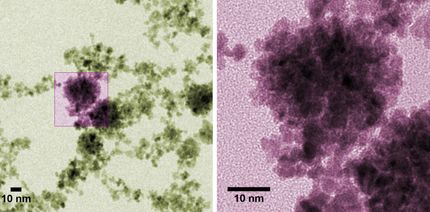
The research team, which includes Brown graduate student and co-author Vismadeb Mazumder and researchers from Oak Ridge National Laboratory in Tennessee, created a five-nanometer palladium (Pd) core and encircled it with a shell consisting of iron and platinum (FePt). The trick, Mazumder said, was in molding a shell that would retain its shape and require the smallest amount of platinum to pull off an efficient reaction. The team created the iron-platinum shell by decomposing iron pentacarbonyl [Fe(CO)5] and reducing platinum acetylacetonate [Pt(acac)2], a technique Sun first reported in a 2000 Science paper. The result was a shell that uses only 30 percent platinum, although the researchers say they expect they will be able to make thinner shells and use even less platinum.
"If we don't use iron pentacarbonyl, then the platinum doesn't form on the (palladium) core," Mazumder said.
The researchers demonstrated for the first time that they could consistently produce the unique core-shell structures. In laboratory tests, the palladium/iron-platinum nanoparticles generated 12 times more current than commercially available pure-platinum catalysts at the same catalyst weight. The output also remained consistent over 10,000 cycles, at least ten times longer than commercially available platinum models that begin to deteriorate after 1,000 cycles.
The team created iron-platinum shells that varied in width from one to three nanometers. In lab tests, the group found the one-nanometer shells performed best.
"This is a very good demonstration that catalysts with a core and a shell can be made readily in half-gram quantities in the lab, they're active, and they last," Mazumder said. "The next step is to scale them up for commercial use, and we are confident we'll be able to do that."
Mazumder and Sun are studying why the palladium core increases the catalytic abilities of iron platinum, although they think it has something to do with the transfer of electrons between the core and shell metals. To that end, they are trying to use a chemically more active metal than palladium as the core to confirm the transfer of electrons in the core-shell arrangement and its importance to the catalyst's function.


Other news from the department science





















Most read news












More news from our other portals

























See the theme worlds for related content
Topic World Battery Technology
The topic world Battery Technology combines relevant knowledge in a unique way. Here you will find everything about suppliers and their products, webinars, white papers, catalogs and brochures.

Topic World Battery Technology
The topic world Battery Technology combines relevant knowledge in a unique way. Here you will find everything about suppliers and their products, webinars, white papers, catalogs and brochures.
Last viewed contents

Climate pioneers cooperate to produce solar fuels - INERATEC joins forces with Synhelion

Micro- and nanoplastics in the body are passed on during cell division - That plastic may increase metastasis of tumors

Search for new semiconductors heats up with gallium oxide
Smoltek Hydrogen and Heraeus Precious Metals advance next-generation ultra-low iridium electrolysis technology
Chemistry without detours: Researchers introduce a two-step process for producing phosphorus-containing chemicals - This promising innovation not only contributes to environmental protection but also saves significant time and costs

Evidence stacks up for poisonous books containing toxic dyes

Adhesives from waste wood, biofuel from straw - EU research project on the potential of agroforestry waste as environmentally friendly raw materials completed
Computational trick enables better understanding of exotic state of matter - New process relevant for fusion and materials research
Pushing boundaries: Detecting the anomalous Hall effect without magnetization in a new class of materials - The first experimental evidence for the anomalous Hall effect emerging in a collinear antiferromagnet with non-Fermi liquid behavior
Unveiling how water and ions impact chemical reactivities at solid-aqueous interfaces
Chemistry meets biology: controlling artificial cell membranes through catalysis - Researchers develop an artificial metalloenzyme-based platform that enables programmable control of artificial membrane behavior