A spintronic view of the effect of chiral molecules
Researchers verified the chiral-induced spin selectivity effect, i.e., the influence of chiral molecules on spin, using spintronic analytical techniques

Advertisement


The role of electrons and their negative charge in electric current is well established. Electrons also exhibit other intrinsic properties that are associated, for example, with considerable potential for enhancing data storage devices: the electron's spin or magnetic moment. To date, however, the selection of specific spins has been challenging. It has been difficult to single out only those electrons with an up-direction of spin, for example. One way of doing this would be to pass a current through a ferromagnet, such as iron. This would result in the generation of a current in which the spin polarization aligns with the direction of the magnetic field.
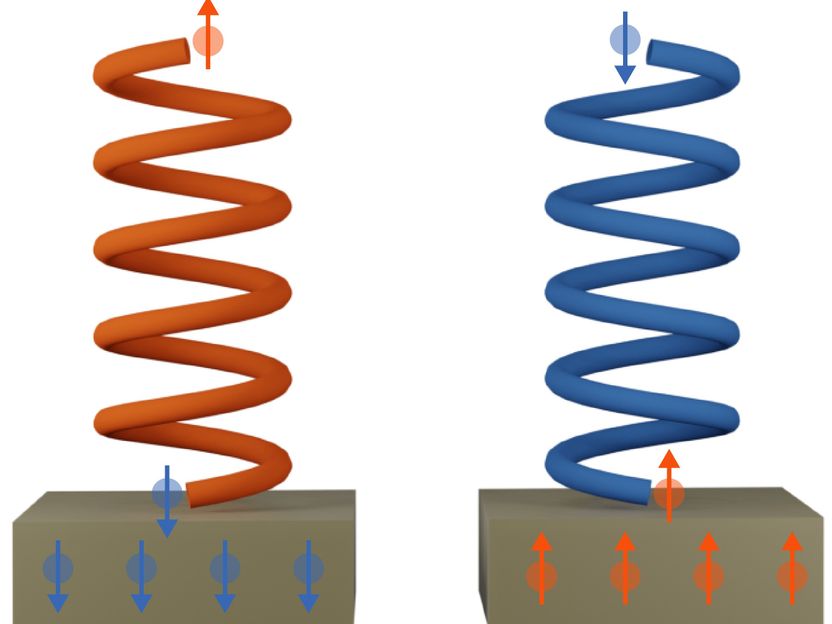
Filtering spin with a helix
©: Angela Wittmann
The alternative option of inducing a current in chiral molecules, i.e., molecules that have no superimposable mirror images, such as helix structures, has been discussed over the past decade. The result is spin polarization of approximately 60 to 70 percent, a level similar to that achieved in ferromagnetic materials. However, this approach remains a subject of ongoing debate and research.
A system of a thin film of gold and chiral molecules
Researchers at Johannes Gutenberg University Mainz (JGU) have recently been able to confirm the existence of this so-called chiral-induced spin selectivity (CISS) effect. "Our group investigated the influence of chiral molecules using spintronic methods," emphasized Professor Angela Wittmann of the JGU Institute of Physics. "We did not pass the charge current directly through the chiral molecules themselves. Instead, we created a hybrid system that consisted of a thin film of gold with chiral molecules on it. Although the major part of the current flows through the gold film, the presence of the chiral molecules alters the state of the gold."
The researchers were interested in how the spin current was converted to a charge current. In a film consisting of pure gold, some three percent of the spin current is converted to charge, irrespective of whether the spin of the electrons is oriented up or down. In the hybridized system of a gold layer with chiral molecules, however, the result is quite different. If the molecules on the surface of the gold are right-handed, currents with electron spin-up are converted much more efficiently to charge than those with spin-down. The outcome is exactly the opposite if molecules on the gold surface are left-handed. The extent to which a spin current is converted into a charge current thus depends on the chirality of the molecules on the gold surface. "Moreover, the effect is vectorial," explained Wittmann. If the helix structure of a chiral molecule is directed upwards, this effect occurs only if the spin is more or less in the same direction or completely counter to this." On the other hand, if the direction of spin is not aligned with the direction in which the helix structure is arranged, the effect does not occur. Consequently, the direction of the spin and the helix axes must either correspond or be exactly counter to each other.
"Our results are an important contribution to the acceptance of the spin selectivity effect and thus the influence of chiral molecules on spins," concluded Wittmann.
Original publication


Other news from the department science





















Most read news












More news from our other portals

























Last viewed contents

Evidence stacks up for poisonous books containing toxic dyes

Adhesives from waste wood, biofuel from straw - EU research project on the potential of agroforestry waste as environmentally friendly raw materials completed
Computational trick enables better understanding of exotic state of matter - New process relevant for fusion and materials research
Pushing boundaries: Detecting the anomalous Hall effect without magnetization in a new class of materials - The first experimental evidence for the anomalous Hall effect emerging in a collinear antiferromagnet with non-Fermi liquid behavior
Unveiling how water and ions impact chemical reactivities at solid-aqueous interfaces
Chemistry meets biology: controlling artificial cell membranes through catalysis - Researchers develop an artificial metalloenzyme-based platform that enables programmable control of artificial membrane behavior
'Hot' oxygen atoms on titanium dioxide motivated by more than just temperature - PNNL scientists find unexpected chemical behavior on catalyst surface

New method measures the 3D position of individual atoms - The method developed at the Universities of Bonn and Bristol uses an ingenious physical principle

Grand opening of new laboratory world - Training and testing facilities on over 1,500 m2

Fine particles from aircraft exhaust become more harmful over time

A sustainable path for energy-demanding photochemistry - Novel strategy for the generation of highly energetic UV light
