Tracking forever chemicals across food web shows not all isomers are distributed equally
Advertisement


When University at Buffalo chemists analyzed samples of water, fish, and bird eggs, they weren’t surprised to find plenty of per- and polyfluoroalkyl substances (PFAS). After all, these “forever chemicals” turn up nearly everywhere in the environment.
But they were intrigued that one of the most hazardous PFAS — perfluorooctanesulfonic acid (PFOS), once used in nonstick pans and firefighting foam — appeared in slightly different structural forms, known as isomers, depending on the sample.
More than half of the PFOS detected in wastewater and supermarket fish were branched isomers, which are spherical and compact and dissolve more easily in water. Yet in the egg yolk of fish-eating birds, PFOS was nearly 90% linear, an elongated form that tends to bind to proteins and remain in tissues longer.
“Taken together, these results suggest that as PFOS moves across the food web — from water to fish to birds — its linear isomers become more prevalent than branched isomers,” says the study’s corresponding author, Diana Aga, PhD, director of the UB RENEW Institute and SUNY Distinguished Professor and Henry M. Woodburn Chair in the UB Department of Chemistry.
Isomers of a given compound maintain the same chemical formula, but the unique arrangement of their constituent atoms can cause them to behave very differently. For example, one isomer of methamphetamine is a controlled substance, another is used in over-the-counter nasal inhalers.
And yet U.S. and European regulations still advise simply lumping all isomers together when measuring PFAS.
“Our study is yet another piece of evidence that PFAS isomers can bioaccumulate at different rates and should not be treated as if they were all the same,” Aga says.
Spanning two studies, this work was supported by the U.S. National Science Foundation and Environmental Protection Agency.
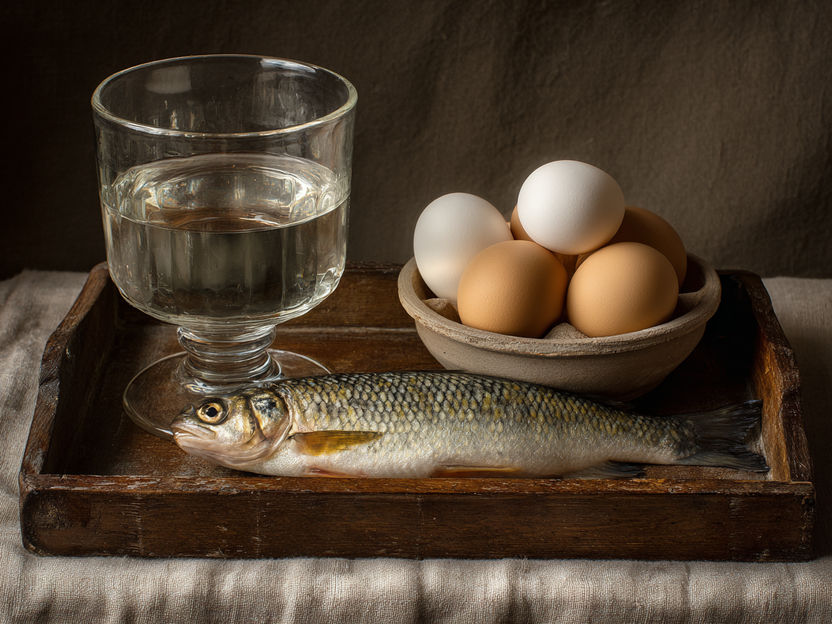
Symbolic image
AI-generated image
Advanced separation techniques help sort isomers
Distinguishing between different isomers of PFAS requires cyclic ion mobility spectrometry. This advanced analytical technique separates isomers based on their shape differences that influence how they move through a tube filled with gas, such as nitrogen.
Say you have two sheets of paper — one flat and one crumpled into a ball — and drop them. They’re made of the same material and weigh the same, yet the crumbled one will hit the ground first.
Similarly, cyclic ion mobility spectrometry distinguishes among isomers of the same molecule based on their drift time, the time it takes for the PFOS isomers to travel through the tube to reach the detector. Branched isomers’ more compact, spherical shapes mean they move faster through the inert gas inside the tube than the elongated linear isomers.
The RENEW Institute's cyclic ion mobility spectrometry instrument, supported by the UB Office of the Senior Vice President for Research, Innovation and Economic Development, analyzed PFAS in seven unfrozen supermarket fish samples. They included both bottom-dwelling benthic fish, such as blue catfish, cod and haddock, and pelagic fish that live in open waters, such as rainbow trout, salmon and tilapia.
Published in the American Chemical Society’s Journal of Agriculture and Food Chemistry , Aga’s results showed that generally, there are more types of branched PFOS isomers in benthic than in pelagic fish. The benthic fish contained two additional types of branched PFOS isomers not detected in pelagic samples.
The combination of both branched and linear isomers led to benthic fish having a significantly higher total PFOS concentration than pelagic fish. The benthic fish species also generally have higher proportions of longer-chain PFAS, such as PFOA and PFNA, which have eight and nine carbons, respectively.
“These results suggest that consumers who frequently eat bottom-dwelling species may have a higher exposure to PFAS,” says Mindula Wijayahena, a PhD student in Aga’s lab and first author of the study.
Isomer mix flips in birds
Aga’s team identified PFOS isomers in wastewater and bird eggs in a separate study published in the Journal of the American Society for Mass Spectrometry .
The wastewater came from a municipal wastewater treatment facility in Erie County, while the egg yolks were collected from abandoned nests near Buffalo Harbor. The eggs were from double-crested cormorants, a North American aquatic bird that eats fish.
In wastewater samples, more than half of the PFOS was branched. But in the double-crested cormorant egg yolks, nearly 90% of PFOS was linear.
“Although we know linear isomers tend to accumulate more in tissue than branched, the reason why the eggs skewed so heavily to linear warrants further investigation,” says PhD student Jenise Paddayuman, the first author of the study. “Still, the results give insight into the environmental fate of PFOS and suggest that linear isomers persist more as PFOS makes its way through the environment.”
Now that chemists have the tools to distinguish PFAS isomers, Aga says it may be time to examine the differences in their toxicological effects, which could support the need to regulate them differently.
“For example, if the evidence continues to show that branched isomers don’t bioaccumulate as much as linear, then perhaps we start designing more molecules to take on the branched structure,” she says. “That’s something we can think about in the future.”
Original publication
Mindula K. Wijayahena, Rawikan Kachangoon, Cheyanne Witmer, Joshua S. Wallace, Jitlada Vichapong, Diana S. Aga; "PFAS Isomers Matter: Distribution Patterns of Linear and Branched PFOS and PFOA in Consumed Fish Revealed by Cyclic Ion Mobility Separation"; Journal of Agricultural and Food Chemistry, Volume 73, 2025-10-6


Other news from the department science





















Most read news











More news from our other portals



























See the theme worlds for related content
Topic World Mass Spectrometry
Mass spectrometry enables us to detect and identify molecules and reveal their structure. Whether in chemistry, biochemistry or forensics - mass spectrometry opens up unexpected insights into the composition of our world. Immerse yourself in the fascinating world of mass spectrometry!

Topic World Mass Spectrometry
Mass spectrometry enables us to detect and identify molecules and reveal their structure. Whether in chemistry, biochemistry or forensics - mass spectrometry opens up unexpected insights into the composition of our world. Immerse yourself in the fascinating world of mass spectrometry!
Last viewed contents

The competitiveness of low-carbon fuels depends on location - New infrastructure could boost European production
Deep tech startup Reduciner introduces novel technology to turn captured carbon into sustainable fuels - Raising 3.6 million euros in its initial funding round, the Finnish startup plans to build its first industrial-scale pilot
Bruker announces strategic collaboration with Atinary Technologies to advance self-driving laboratories

FUST Lab Receives Investment from Asia2G Capital - The Korean deep-tech company plans to use the capital to expand into the U.S., European, and Japanese markets

ACHEMA Middle East: Debut in Saudi Arabia not until 2027 - Messe Frankfurt Saudi Arabia and DECHEMA are responding to regional uncertainties and are also changing the venue
New core-shell design for anodes significantly increases performance of sodium-ion batteries - Researchers coat porous carbon with a filter-like layer that allows sodium ions to pass through while keeping disruptive electrolyte molecules out

New "chemical armor" could unlock the holy grail of solid-state battery technology - A simple one-step coating builds a silicon-indium hybrid shield on lithium metal, quadrupling current density and extending battery cycle life
Scientists unveil mechanism behind greener ammonia production
Siemens to digitalize one of Europe's largest renewable hydrogen projects - Physics-based digital twin and real-time optimization
Collaboration between University of Bristol and Malvern Panalytical - Bringing academia and business together to solve global challenges
Digital lab day 2025 celebrates international success - virtual battery day 2025 follows in November