Not just faster, but smarter: AI that explains its discoveries
Using a grey-box approach, a catalyst was identified in fewer than 50 experiments that outperforms the industry standard for propane dehydrogenation
Advertisement


Self-driving laboratories (SDLs) powered by artificial intelligence (AI) are rapidly accelerating materials discovery, but can they also explain their results? Researchers from the Theory Department of the Fritz Haber Insitute, in collaboration with BASF, and BasCat – UniCat BASF JointLab, show that they can. Their new AI-driven strategy works hand-in-hand with SDLs to identify better catalysts while revealing the chemistry behind their performance. The approach was validated on the industrially crucial conversion of propane into propylene.
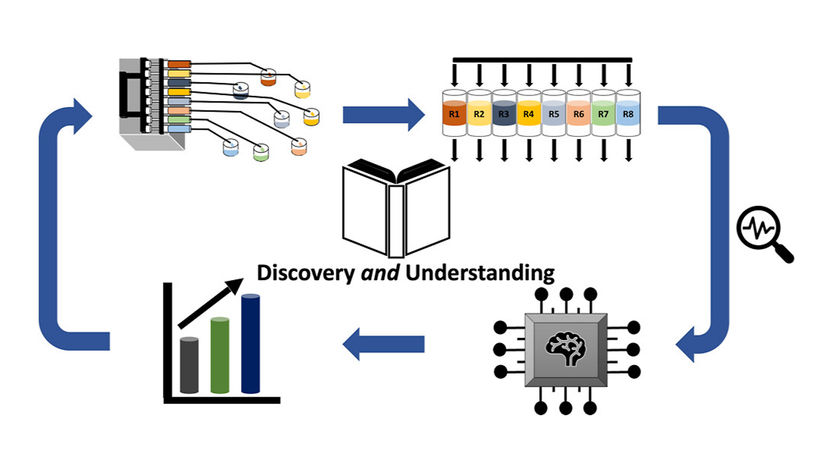
Schematic of the accelerated discovery loop.
© ACS Catal. 2026
An SDL integrates an AI doing the experiment planning with lab automation and robotics. In the race to develop better materials, AI and SDLs are often celebrated for one main reason: speed. These systems can rapidly test and optimize new materials, helping researchers find improved solutions in a fraction of the usual time. But critics have raised important concerns: If AI simply delivers better results without explaining why they work, is this still true scientific progress and how can we control reliability?
A new study published in ACS Catalysis by our Institute’s Theory Department, in collaboration with BASF, and BasCat – UniCat BASF JointLab, shows that speed does not need to compromise understanding. The team developed an advanced AI-driven strategy that not only accelerates catalyst discovery, but also reveals why the identified materials perform better. This approach was successfully demonstrated on a key industrial reaction: the conversion of propane into propylene, an essential building block of the chemical industry and starting material for a wide range of everyday products, including plastics and synthetic fibers.
From “Black-Box” to “Gray-Box” AI
Most current AI-driven discovery approaches focus on identifying a single best material as quickly as possible. In doing so, they often act as “black boxes”, producing answers without explanations. While this can be useful for optimization, it leaves scientists with limited understanding of the underlying chemistry. Here, a different approach was taken: by carefully designing how AI explores possible material combinations, improved performance was achieved while simultaneously providing meaningful insights: a strategy referred to as “gray-box,” making the process more transparent and controllable.
Understanding and Efficiency Combined
Beyond rapidly identifying a catalyst superior to the current industry reference, the approach translated the improved performance into a language understandable to chemists. It highlighted the effect of individual promoters contained in the identified catalyst, and especially synergistic interactions between them that were missed in previous traditional studies. At the same time, the method remained highly efficient: less than 50 experiments were needed to search a design space containing more than 1013 aka 10000000000000 possible promoter combinations.
Overall, the study demonstrates that AI and automation in chemistry do not have to come at the expense of understanding. Thoughtfully designed, these technologies are capable of transforming materials development – moving from simply finding better solutions to truly understanding them. Ultimately, this will position AI as an agentic partner in scientific discovery rather than just an efficient, but barely assessable tool.
Original publication
Charles W. P. Pare, Aybike Terzi, Christian Kunkel, Michael Geske, Raoul Naumann d’Alnoncourt, Christoph Scheurer, Frank Rosowski, Karsten Reuter; "Adaptive Experiment Planning for Inverse Design and Understanding: Synergistic Interactions as Key to Optimized Multi-Promoter Formulations"; ACS Catalysis, 2026-3-19


Other news from the department science





















Most read news











More news from our other portals



























Last viewed contents
Green hydrogen from sunlight and water - without electrolyzers and without electricity - Photreon, a spin-off from KIT, is developing a photoreactor panel that enables direct solar hydrogen production
Digital lab day 2025 celebrates international success - virtual battery day 2025 follows in November

RE:VOLTAGE and CometHire Win the HTW Startup Challenge 2026 in Berlin - The competition awarded 10,000 euros in prize money in the GreenTech and Impact Entrepreneurship categories
Atomic reshuffle paves way for record-breaking catalysts for hydrogen production - "This opens a new strategy for designing adaptive catalysts for a wide range of applications"

Global underground CO₂ storage hits record 43.6 million tonnes - London Register expands reach
Research Breakthrough on the Path to a New Reserve Antibiotic - For the first time, chemists have succeeded in synthesizing the highly potent natural compound neosorangicin A
Endress+Hauser expands its presence in the U.S. - 44 million euros are being invested in the new facility in Greenwood, Indiana
Plastic bottles could find new life in batteries as graphite - Penn State researchers converting PET waste into synthetic graphite that outperforms natural graphite
Turning food waste into carbon captors - Expected to be cheaper than other capture methods

Study shows: Lithium and sodium-ion technologies are more closely linked than assumed - "Switching to a new battery technology does not automatically open the door to new market players"

ETH spin-offs sweep the board at Venture Awards