Energy Transition: Electrify First—Then Use Methanol Instead of Hydrogen for the Rest
Advertisement


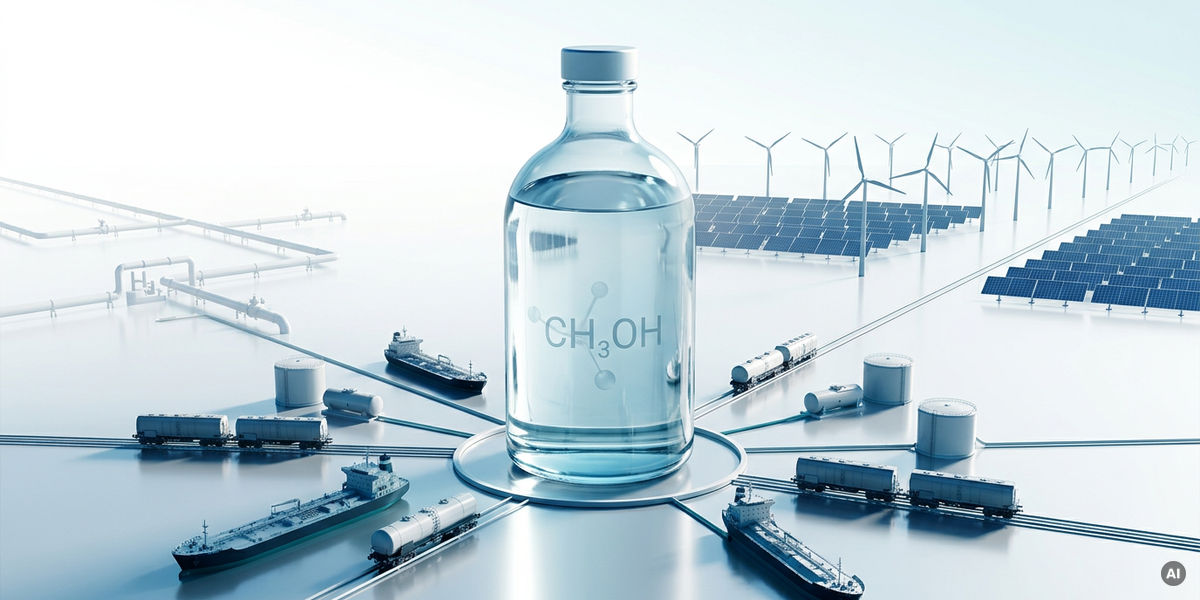
According to a study by the Technical University of Berlin, a climate-neutral energy system in Europe could be based largely on direct electrification. For the few applications that cannot be meaningfully electrified even in the future—such as in shipping, parts of the chemical industry, or to hedge against long periods of low wind and low sunlight—the researchers advocate relying more on methanol rather than hydrogen. According to their calculations, the total system costs would be only slightly higher, while methanol offers significant advantages in terms of transportation, storage, and infrastructure.
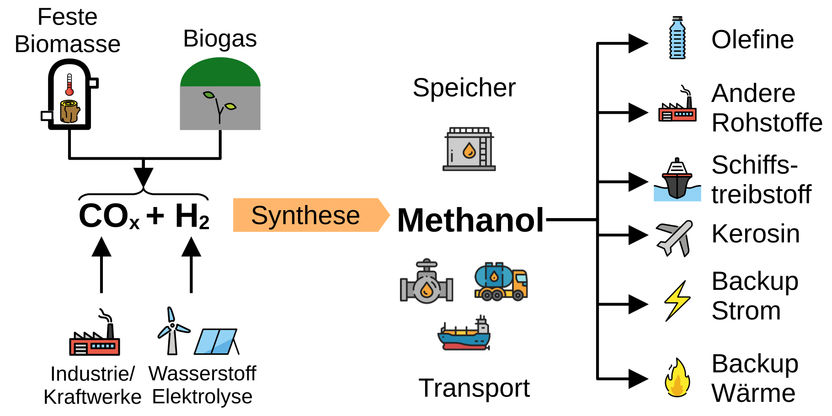
Methanol is produced from biogenic waste materials and renewable hydrogen—a climate-friendly carbon carrier that is easy to transport and store for the remaining applications that cannot be directly electrified.
The study “A minimal methanol backstop for high-electrification scenarios,” published in the journal Joule, examines how Europe can cost-effectively meet its energy needs in a climate-neutral manner. The result: Contrary to what was assumed just a few years ago, significantly more sectors can now be directly electrified—for example, through battery-electric trucks or electric solutions for heat supply.
This eliminates many use cases for hydrogen. Chemical energy carriers are therefore only needed where direct electrification is technically nearly impossible—for example, in international shipping, aviation, parts of the chemical industry, and in backup power plants that secure the electricity supply during prolonged periods of low wind and low sunlight. In these sectors, liquid fuels such as methanol or kerosene with high energy density are needed rather than hydrogen.
Methanol infrastructure can be built more flexibly
“A large hydrogen network is currently being planned in Germany,” says Prof. Dr. Tom Brown, head of the “Digital Transformation in Energy Systems” research group at TU Berlin. “However, it is likely that future demand for hydrogen has been significantly overestimated. Using methanol instead of hydrogen would allow the infrastructure to be adapted much more flexibly to actual demand.” This is because while hydrogen requires long pipelines and underground storage due to its small molecular size and low density, liquid methanol can be transported with comparatively little effort by ship, rail, truck, or through existing oil pipelines, and stored in tanks. According to Tom Brown and his team, this flexibility makes building new infrastructure much easier and reduces the risk of costly misinvestments.
Low additional costs for methanol—but greater flexibility
The model calculations, carried out using the “PyPSA” software developed by Tom Brown’s research group, show that an energy system with a minimal “methanol backup” incurs total system costs that are only about 2.4 percent higher than a scenario that relies on hydrogen or methane for the remaining applications. However, according to the researchers, these minimal additional costs are offset by advantages that the models have so far only been able to partially capture—such as more flexible infrastructure expansion, which can be adapted as developments unfold, and easier storage of the energy carrier. The researchers also view their findings as a contribution to the current energy policy debate. In their view, the expansion of electrification should remain a top priority. Sustainably produced methanol should play an important role in areas where electric solutions reach their technical limits.
Note: This article has been translated using a computer system without human intervention. LUMITOS offers these automatic translations to present a wider range of current news. Since this article has been translated with automatic translation, it is possible that it contains errors in vocabulary, syntax or grammar. The original article in German can be found here.


Other news from the department science





















Most read news











More news from our other portals



























Last viewed contents
HPR-20 OEMS, Online Electrochemical Mass Spectrometer | Hiden Analytical

Global underground CO₂ storage hits record 43.6 million tonnes - London Register expands reach
Research Breakthrough on the Path to a New Reserve Antibiotic - For the first time, chemists have succeeded in synthesizing the highly potent natural compound neosorangicin A

Endress+Hauser expands its presence in the U.S. - 44 million euros are being invested in the new facility in Greenwood, Indiana
Plastic bottles could find new life in batteries as graphite - Penn State researchers converting PET waste into synthetic graphite that outperforms natural graphite
Turning food waste into carbon captors - Expected to be cheaper than other capture methods

Study shows: Lithium and sodium-ion technologies are more closely linked than assumed - "Switching to a new battery technology does not automatically open the door to new market players"

ETH spin-offs sweep the board at Venture Awards
How to generate and steer electrons in liquid water - Surprising results reveal a new aspect of extremely strong electric fields in liquid water
Turning renewable energy into drop-in fuels - Synhelion advances scale-up with large-scale synthetic fuel project in Morocco
30 Million Euros for Catalyst Research Using AI-Controlled Laboratories - ASCEND is leveraging automated learning loops and 3D thin-film catalysts to develop industrially viable drop-in substitutes.
