XPS reveals the surface chemistry of bio-based hybrid materials
Surface analysis supports the development of bio-based materials
Advertisement


Just a few atomic layers at the surface can strongly influence how effectively a material binds pollutants from water or how efficiently a photocatalyst responds to light. Researchers at the Fraunhofer Institute for Applied Polymer Research IAP use X-ray photoelectron spectroscopy (XPS) to investigate the chemical states and interactions at the surfaces and interfaces of bio-based carbon materials and organic-inorganic hybrid materials. Their insights can support the targeted development of functional materials for future industrial applications.
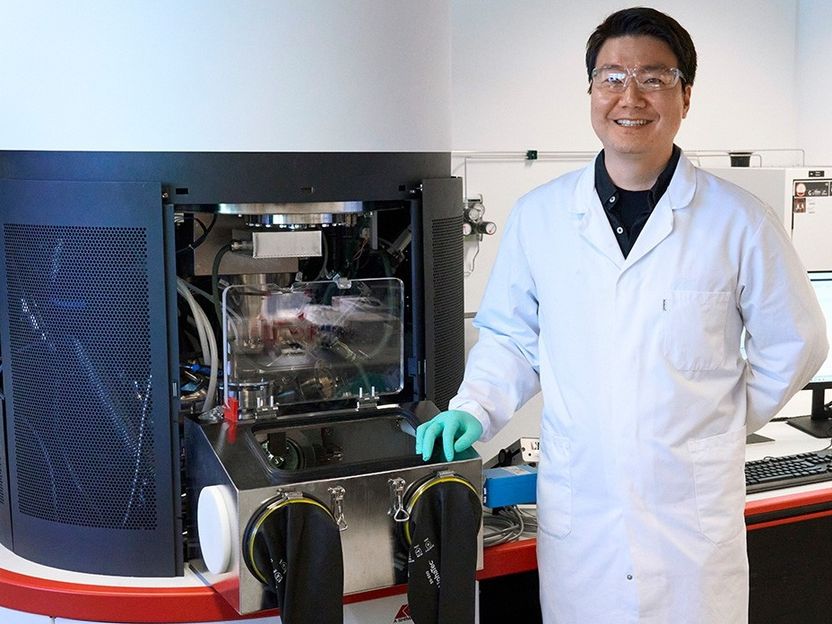
Dr. Jiyong Kim uses XPS to analyze the chemical composition of complex material surfaces at Fraunhofer IAP.
© Fraunhofer IAP / Jadwiga Galties
Bio-based materials and related hybrid systems are being explored for a wide range of applications, including water treatment, catalytic processes, electrochemical devices and functional coatings. They combine natural raw materials with inorganic materials, bringing together the properties of both material classes.
The function, reactivity and stability of bio-based hybrid materials can depend strongly on the chemical environments present at their surfaces and interfaces. Many conventional analytical methods, however, provide only limited access to these processes. For materials development, this means that the causes of differences in performance, aging effects or unexpected material behaviour often remain unclear.
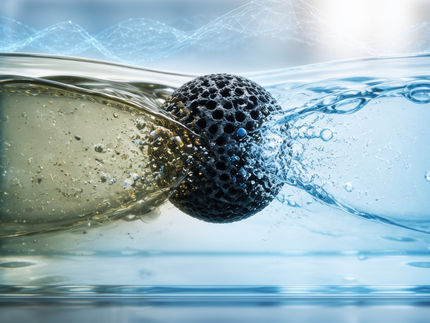
Coffee grounds, orange peels and complex surfaces: what XPS tells about their chemistry
In a series of joint studies led by the Materials Chemistry research group of Professor Andreas Taubert at the University of Potsdam, bio-derived carbon and hybrid materials were developed and evaluated for water-purification applications. Fraunhofer IAP contributed detailed XPS characterization, focusing on surface composition, chemical states and interfacial interactions. Spent coffee and orange peels served as renewable starting materials for producing biochar, which was subsequently combined with clay minerals and metal oxides.
The key question addressed by the XPS analysis was how the formation of these bio-based hybrid materials and their combination with inorganic components changed the chemistry of their surfaces and interfaces. To find answers, Dr. Jiyong Kim, an expert in surface analysis at Fraunhofer IAP, investigated how thermal treatment and hybrid formation changed the surface and interfacial chemistry of the organic-inorganic hybrid materials using XPS). Here, the material surface is irradiated with X-rays, and the energy of the emitted photoelectrons is measured.
“XPS is like an extremely fine surface scanner. It allows us to read the top 1 to 10 nanometers of a material like a chemical map. Another advantage is that the analysis requires only minimal sample preparation and does not require the material to be dissolved or chemically digested,” says Kim.
Biochar: what makes its analysis so challenging
Materials derived from natural raw materials are chemically far more complex than conventional laboratory chemicals. During the thermal treatment of biomass such as coffee grounds or orange peels, for example, numerous reactions take place simultaneously. This produces carbon materials with heterogeneous and sometimes unexpected surface chemistry that cannot be described by a single chemical structure. XPS can differentiate these complex surfaces and draw conclusions about how a material was formed and which properties may be relevant to its subsequent application.
In biochar derived from coffee grounds, XPS showed that thermal treatment reorganized the carbon at the surface. The result was a more carbon-rich, graphite-like structure that nevertheless remained chemically heterogeneous and rich in defect sites. Such surface properties can promote interactions with pharmaceutical compounds, dyes and other organic pollutants, making them particularly relevant for materials used in water purification.
“A detailed understanding of the exact chemistry in a material helps us to very accurately understand not only the material composition but also the individual changes that occur in a material once it is used in an application like water remediation or in an electrochemical device. These changes are often crucial, yet very hard to detect using other methods,” Taubert explains.
XPS provides insights into the chemistry at organic–inorganic interfaces
In bio-based hybrid materials, organic and inorganic components are interconnected at very small length scales. What happens at their interfaces can have a major influence on the material properties that develop later.
“With hybrid materials, it is not enough to know which elements are present. What matters is how the organic and inorganic components interact and whether new chemical environments form at their interfaces. XPS allows us to make these interactions visible,” explains Kim.
In hybrid systems consisting of orange-peel biochar, clay and titanium dioxide, the analyses showed that the organic and inorganic components form chemical bonds at their interfaces during thermal processing, involving titanium, oxygen, carbon and aluminum. In nitrogen-modified photocatalysts, XPS also helped distinguish nitrogen incorporated into titanium-containing inorganic structures from residual nitrogen-containing organic species. Such materials can not only bind pollutants but also use their photocatalytic properties to break them down with the help of light.
Surface analysis supports the development of bio-based materials
Using XPS, Fraunhofer IAP supports companies and research partners in gaining a targeted understanding of the complex surface chemistry of bio-based materials and identifying the causes of differences in performance. This can include analyzing batch-to-batch variations, ageing processes, surface modifications and chemical interactions with pollutants and other molecules. The resulting insights can help guide the systematic optimization of material formulations and manufacturing processes and contribute to the development of robust and reproducible materials for industrial applications. As industrial interest in renewable raw materials continues to grow, these findings also highlight opportunities for further collaborative research on bio-based carbon materials, catalysts, coatings, polymer composites and other materials with complex surfaces and interfaces.


Other news from the department science





















Most read news











More news from our other portals



























See the theme worlds for related content
Topic World Spectroscopy
Investigation with spectroscopy gives us unique insights into the composition and structure of materials. From UV-Vis spectroscopy to infrared and Raman spectroscopy to fluorescence and atomic absorption spectroscopy, spectroscopy offers us a wide range of analytical techniques to precisely characterize substances. Immerse yourself in the fascinating world of spectroscopy!

Topic World Spectroscopy
Investigation with spectroscopy gives us unique insights into the composition and structure of materials. From UV-Vis spectroscopy to infrared and Raman spectroscopy to fluorescence and atomic absorption spectroscopy, spectroscopy offers us a wide range of analytical techniques to precisely characterize substances. Immerse yourself in the fascinating world of spectroscopy!
Last viewed contents

Lignovations Closes Seed Investment to Accelerate Lignin-Based Biomaterial Innovation - A multifunctional alternative to many synthetic chemicals in cosmetics, coatings, packaging, adhesives, and other applications
DECHEMA Research Institute opens new site in Bad Homburg - New impetus for the technologies of tomorrow – Hesse is bolstering its position as a research hub with €1.5 million a year
Batteries, recycling, bio-based adhesives and more: these start-ups aim to rethink electronics - ISC3 announces finalists for the Innovation Challenge 2026 "Sustainable Chemistry & Electronics"
Höchst Industrial Park: Carbon capture pilot plant goes into operation - Project by Infraserv Höchst and GEA
Oxyle: Industrial pilot validates performance basis for full-scale system targeting >99.9% degradation of C3-PFAS - Oxyle successfully validated its PFAS destruction solution on-site at an industrial facility, demonstrating readiness for industrial-scale implementation
New core-shell design for anodes significantly increases performance of sodium-ion batteries - Researchers coat porous carbon with a filter-like layer that allows sodium ions to pass through while keeping disruptive electrolyte molecules out

New "chemical armor" could unlock the holy grail of solid-state battery technology - A simple one-step coating builds a silicon-indium hybrid shield on lithium metal, quadrupling current density and extending battery cycle life
Scientists unveil mechanism behind greener ammonia production
Siemens to digitalize one of Europe's largest renewable hydrogen projects - Physics-based digital twin and real-time optimization
Collaboration between University of Bristol and Malvern Panalytical - Bringing academia and business together to solve global challenges
Digital lab day 2025 celebrates international success - virtual battery day 2025 follows in November