Bridging the gap
Advertisement


Scientists from Spain and Germany have shown electron transfer through extended tetrathiafulvalene bridges in electron donor-acceptor conjugates.
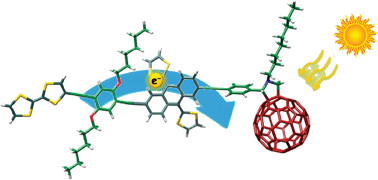
Nazario Martín and colleagues from Universidad Complutense, Madrid and Dirk Guldi and his team from the University of Erlangen have worked together to synthesize donor-acceptor conjugates and have studied their molecular wire characteristics.
Over the years, Martín and Guldi have continued to work together on numerous projects and in particular focusing on synthesizing molecular systems that incorporate a C60 fullerene (electron acceptor), an extended tertrathiafulvalene (exTTF) unit (electron donor) and different conjugated oligomers (bridge).
This new system investigates the use of exTTF as the bridging unit, connecting C60 with TTF (or another exTTF). As a bridge component, the exTTF can mediate charge transfer from one donor unit to the acceptor moiety, by generating separated ion radical pairs with remarkable lifetimes. The charge transfer efficiency was determined by studying the conjugates electrochemical, theoretical and photophysical properties.
Martín explains that this is a ‘challenging area for molecular electronics, an important emerging branch of nano-science. Although the molecular wire behaviour can be addressed in a molecule where the donor and acceptor moieties act as electron reservoirs, the future challenge will be to study the electronic transfer through a single molecule.’ Once different approaches and techniques are developed to allow accurate and reliable studies on single molecules, Martín believes this dream will soon become a reality.
Original publication: Nazario Martín, Dirk Guldi et. al., Chem. Commun. 2009



Other news from the department science