Understanding fuel cell catalysts
Sstudy constitutes a new way of conducting electrocatalyst research
Advertisement


Researchers from the Fritz Haber Institute of the Max Planck Society have unveiled fundamental new insights into the working principles of fuel-cell catalysts. Their study, published in Nature Communications, reveals how multiple steps during the conversion of oxygen (O2) to water (H2O) give rise to the overall catalyst kinetics, and how this is related to changes at the catalyst-solution interface. The study constitutes a profound step forward in our understanding of multi-step electrocatalytic reactions.
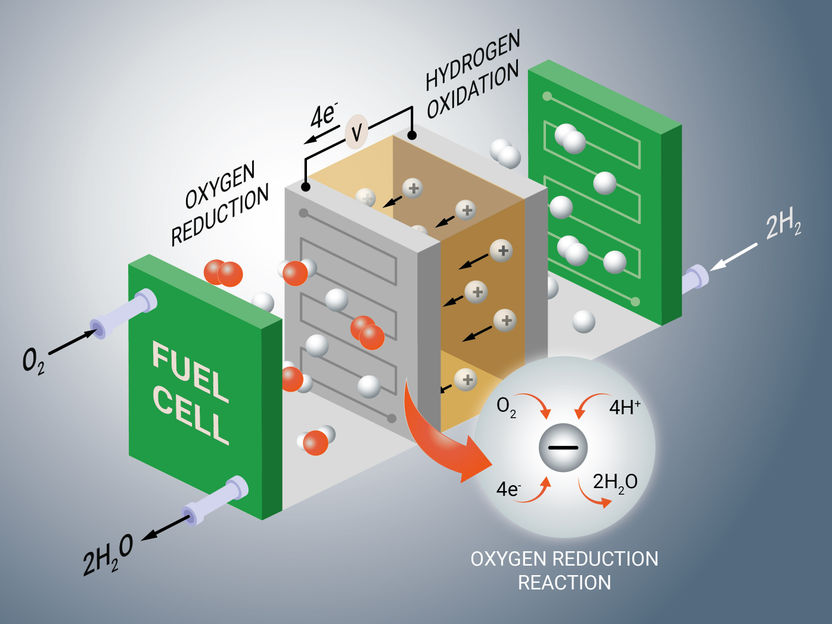
Schematic depiction of a fuel cell and the electrochemical processes studied.
Copyright: © FHI
Introduction to Catalyst Activity
Catalysts are indispensable for our future energy supply. For instance, they are employed in fuel cells that can power heavy-duty and long-range transportation. Continuous advances in catalysts and a deep understanding of fuel-cell electrocatalysts are essential to make this technology more practical for everyday use.
The Department of Interface Science at the Fritz Haber Institute has made significant strides in understanding the working principles of fuel-cell catalysts under industrially relevant conditions. The results are critical for advancing electrochemical technology and providing a foundational understanding of multi-step electrocatalytic reactions.
A Kinetic Cascade
The study, carried out by Dr. Silva and Jody Druce in the group lead by Dr. Öner at the Interface Science Department directed by Prof. Dr. Beatriz Roldán Cuenya investigates how the electrically applied overpotential and O2 pressure change the kinetics of the oxygen reduction reaction (ORR) of four different catalysts in a practically relevant fuel-cell environment. They discovered very rich overpotential-dependent kinetics where the catalyst activity is not limited by one rate-determining step, but different steps over a catalyst-solution interface that itself undergoes changes as a function of the overpotential.
Technical Insights
Dr. Öner explains, “The traditional view in the community is that multi-step reactions can be reduced to one rate-determining intermediate, or in more technical terms, that the degree of rate control of this step is equal to one. However, our findings challenge this view.” The researchers discovered that the rate-limiting steps and their degree of rate control change as a function of the overpotential and pressure. Dr. Öner emphasizes that this study constitutes a new way of conducting electrocatalyst research. “In the past decades, researchers have often applied certain types of analyses and theory with the underlying assumption of a single rate-determining step. Our work breaks with this tradition. We are now providing a kinetic framework to the findings of operando spectroscopy and microscopy that have observed bias dependent structural and chemical changes for decades. One of the most central questions is how the overpotential- and pressure-dependent dynamic, microscopic properties give rise to the ensemble properties that define the activation parameters. As such, our findings set a new agenda for future research.”
Conclusion and Future Directions
Prof. Dr. Beatriz Roldán Cuenya highlights the importance of linking the overpotential- and pressure-dependent chemical and structural changes at the catalyst-solution interphase with the activation parameters. The research not only advances our understanding of the catalyst activity, but also holds promise for improving energy conversion technologies. The team is committed to further exploring these findings in order to bring additional fundamental insight that might impact the fields of energy and chemical conversion and related technologies.
Original publication



Other news from the department science













Most read news









More news from our other portals



























See the theme worlds for related content
Topic World Spectroscopy
Investigation with spectroscopy gives us unique insights into the composition and structure of materials. From UV-Vis spectroscopy to infrared and Raman spectroscopy to fluorescence and atomic absorption spectroscopy, spectroscopy offers us a wide range of analytical techniques to precisely characterize substances. Immerse yourself in the fascinating world of spectroscopy!

Topic World Spectroscopy
Investigation with spectroscopy gives us unique insights into the composition and structure of materials. From UV-Vis spectroscopy to infrared and Raman spectroscopy to fluorescence and atomic absorption spectroscopy, spectroscopy offers us a wide range of analytical techniques to precisely characterize substances. Immerse yourself in the fascinating world of spectroscopy!