A new type of copper from the nuclear reactor
Cu-64 for medical applications
Advertisement


Cu-64 is a copper isotope that is required for medical applications. However, it is very difficult to produce. A new, alternative method has now been found at TU Wien.
The copper isotope Cu-64 plays an important role in medicine: it is used for imaging procedures, but also has potential in cancer therapy. However, it does not occur in nature - it has to be produced artificially, and that is expensive. Until now, nickel atoms have been bombarded with protons. When the nickel nucleus absorbs the proton, nickel becomes copper. However, the Vienna University of Technology has now shown that there is another way: Cu-63 can be turned into Cu-64 by neutron bombardment in a nuclear reactor. This is achieved with a special trick - known as "recoil chemistry".
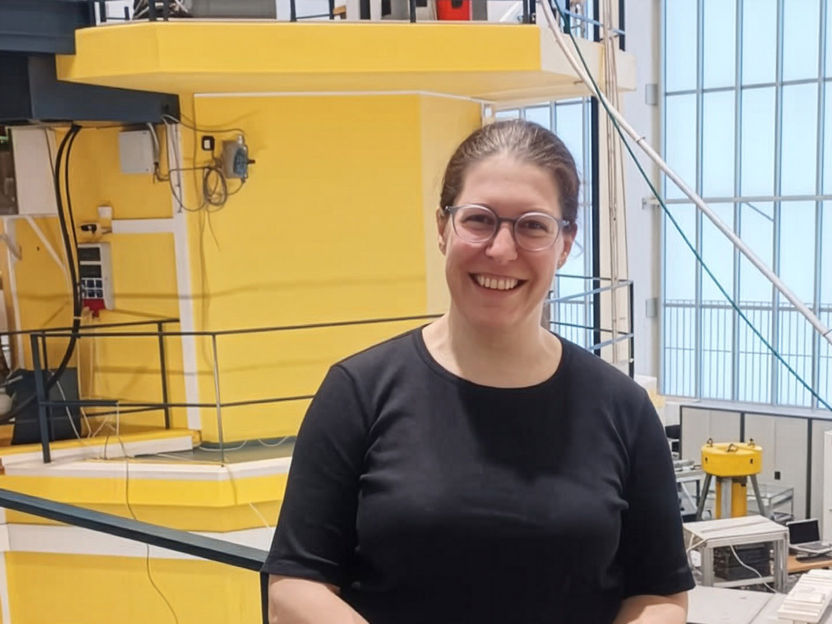
Veronika Rosecker
TU Wien
Nickel becomes copper
Copper atoms have 29 protons - the number of neutrons can vary. The most common copper variant is Cu-63, with 34 neutrons. It is stable. Cu-64, however, copper atoms with an additional neutron, are radioactive and decay with a half-life of just under 13 hours. This makes Cu-64 an interesting isotope for medicine: it is stable enough to be transported to the desired location in the body, but decays quickly enough to keep radiation exposure to the patient as low as possible.
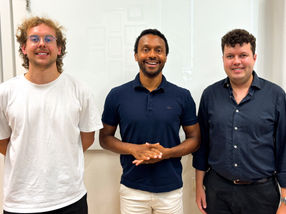
"Until now, Cu-64 has been produced in a cyclotron," explains Veronika Rosecker from TU Wien. "Copper-64 can be produced by using nickel-64 and bombarding it with protons. The proton is absorbed and a neutron is knocked out - that's how nickel-64 becomes copper-64." This method works very well, but is complex - and it requires the availability of a cyclotron and nickel-64, which is also a very rare isotope.
Copper with an additional neutron
The idea of producing Cu-64 not from nickel, but from Cu-63 is therefore an obvious one. To do this, you only need to add a single neutron to the copper atomic nuclei, which can be achieved in a nuclear reactor. However, there is another problem here: "If you bombard copper-63 with neutrons, you produce copper-64 nuclei, but it is almost impossible to separate these atomic nuclei from the normal copper atomic nuclei," explains Martin Pressler. "So you end up with an end product that contains a lot of ordinary copper and only tiny traces of the desired copper-64."
But this problem can now be solved - this is where "recoil chemistry" comes into play. This phenomenon has been known for almost 100 years, but has not yet been used for the production of medically relevant radioisotopes. The copper atoms can be incorporated into molecules before they are bombarded with neutrons. "When the copper-63 atom in the molecule absorbs a neutron and thus becomes copper-64, it initially has a large amount of energy that is emitted as radiation," says Veronika Rosecker. The copper atom emits a photon in the gamma ray range - and as a result it feels a recoil, just like a rocket that emits rocket fuel. This recoil can now cause this atom to be torn out of the molecule.
"This means that we now have a clean separation of copper-63 and copper-64," says Veronika Rosecker. "The copper-63 atoms are bound in the molecules, while the copper-64 atoms are unbound. This means that the two isotopes can be chemically separated from each other without any problems."
The right molecule
Finding the right molecule was crucial to the success of this technique. It must be as stable as possible to withstand the conditions in a nuclear reactor, but still be highly soluble so that the chemical separation works in the end.
"We were able to meet all these requirements with an organometallic complex that is somewhat reminiscent of heme, which is found in our blood," says Martin Pressler. Similar substances had already been investigated before, but were not soluble. The current complex has been chemically modified so that the substance is easily soluble and the desired atoms can be extracted relatively easily after neutron bombardment. The new method can be automated, the molecules can even be reused without loss - and instead of a cyclotron, all you need is a research reactor, such as the one at TU Wien.
Note: This article has been translated using a computer system without human intervention. LUMITOS offers these automatic translations to present a wider range of current news. Since this article has been translated with automatic translation, it is possible that it contains errors in vocabulary, syntax or grammar. The original article in German can be found here.
Original publication


Other news from the department science