Aging processes in sodium-zinc molten salt batteries decoded
Directly observing charge cycles by X-ray
Advertisement


Up to now, it has only been possible to deduce indirectly why high-temperature batteries lose efficiency and durability while in use. For the first time, a team from the Helmholtz-Zentrum Dresden-Rossendorf (HZDR) has now used so-called operando X-ray radiography to look directly into a sodium-zinc molten salt battery at approximately 600 degrees Celsius. The images reveal previously hidden processes and show that, under real operating conditions, the separating layers within the battery can prove problematic. The findings deliver important information for new, simplified cell concepts for large-scale energy storage.
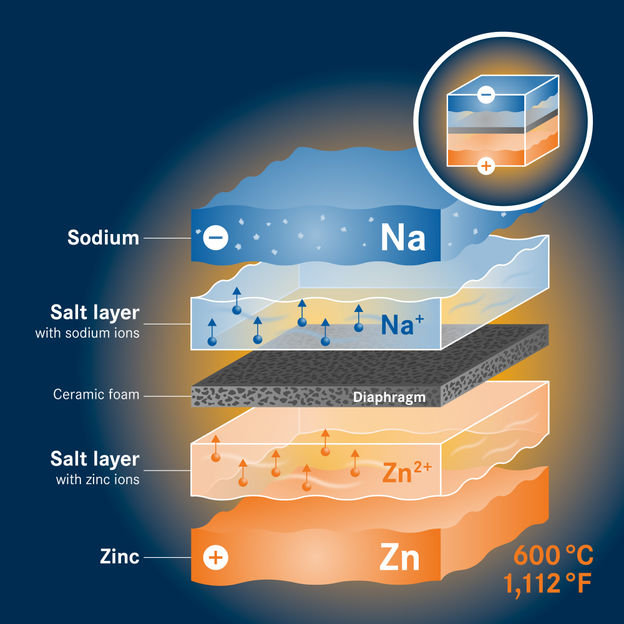
Design of a liquid metal battery - Project Solstice
HZDR / Blaurock
Sodium-zinc molten salt batteries are seen as a very promising option for stationary energy storage. But they age too quickly. “These systems have great potential because sodium and zinc are inexpensive and easily available,” explains Dr. Norbert Weber. As coordinator of the EU project SOLSTICE, the HZDR scientist has been systematically investigating various sodium-zinc storage concepts. “At the same time, we had no clear understanding of why the cells lose so much of their efficiency during use.” One advantage of high-temperature technology is that the metals are liquid at several hundred degrees Celsius and can be transported particularly fast. But it is precisely this dynamic that makes the systems difficult to control.
For a long time, it was only possible to deduce indirectly why sodium-zinc molten salt batteries age prematurely. While classic electrochemical measurements record current and voltage, they do not provide a complete picture of the processes in the cells’ interior. “Our battery is completely liquid. What happens there is highly dynamic,” explains Martins Sarma, lead author of the study. “But we can’t simply open up a battery to look inside while it’s working. And if we let it cool down, the structures change fundamentally.”
Directly observing charge cycles by X-ray
To visualize these processes nonetheless, the team used operando X-ray radiography, an imaging method which enabled them to follow charging and discharging directly under real operating conditions for the first time. It revealed the movements of sodium, zinc and electrolyte that determine the battery’s efficiency and longevity. The images delivered an unexpectedly clear view of a building block that is considered indispensable in many cell concepts: the separator. This is a porous separating layer between the electrodes that prevents direct contact between the sodium and zinc and is thus supposed to prevent unwanted side reactions.
However, the X-rays reveal that during operation, zinc can accumulate in the area of the separator. There, it loses electrical contact with the electrode and is no longer available to continue powering the battery. “It’s a bit like material getting stuck in a sieve,” says Dr. Natalia Shevchenko, who is working on electrochemical energy storage and its analysis at HZDR. “Over time, more and more active zinc is lost – a mechanism that helps explain cell aging.”
The results show one thing above all else: Separators in sodium-zinc molten salt batteries are not a passive component; they significantly influence operation and cell aging. In supplementary experiments excluding a separator, the scientists observed that zinc did not adhere to a solid barrier and get permanently lost. At the same time, however, self-discharge increased because sodium and zinc could come into contact more easily. The comparison clearly demonstrates that separators need to be re-evaluated under high-temperature conditions.
On this basis, the team is now working on dedicated improvements to the cell concept. The aim is to control the transport of substances between the liquid phases better without having to depend on complex or cost-intensive components. In the long term, this should produce robust, simple, economic solutions that facilitate the use of sodium-zinc molten salt batteries in large-scale energy storage outside laboratories, as well.
Original publication
M. Sarma, N. Shevchenko, N. Weber, T. Weier, Operando characterisation of Na-Zn molten salt batteries using X-ray radiography: insights into performance degradation and cell failure, in Energy Storage Materials, 2025.



Other news from the department science
















Most read news









More news from our other portals
























See the theme worlds for related content
Topic World Battery Technology
The topic world Battery Technology combines relevant knowledge in a unique way. Here you will find everything about suppliers and their products, webinars, white papers, catalogs and brochures.

Topic World Battery Technology
The topic world Battery Technology combines relevant knowledge in a unique way. Here you will find everything about suppliers and their products, webinars, white papers, catalogs and brochures.