Electric eel biology inspires powerful gel battery
A unique approach to developing non-toxic batteries for use in medical devices and more
Advertisement


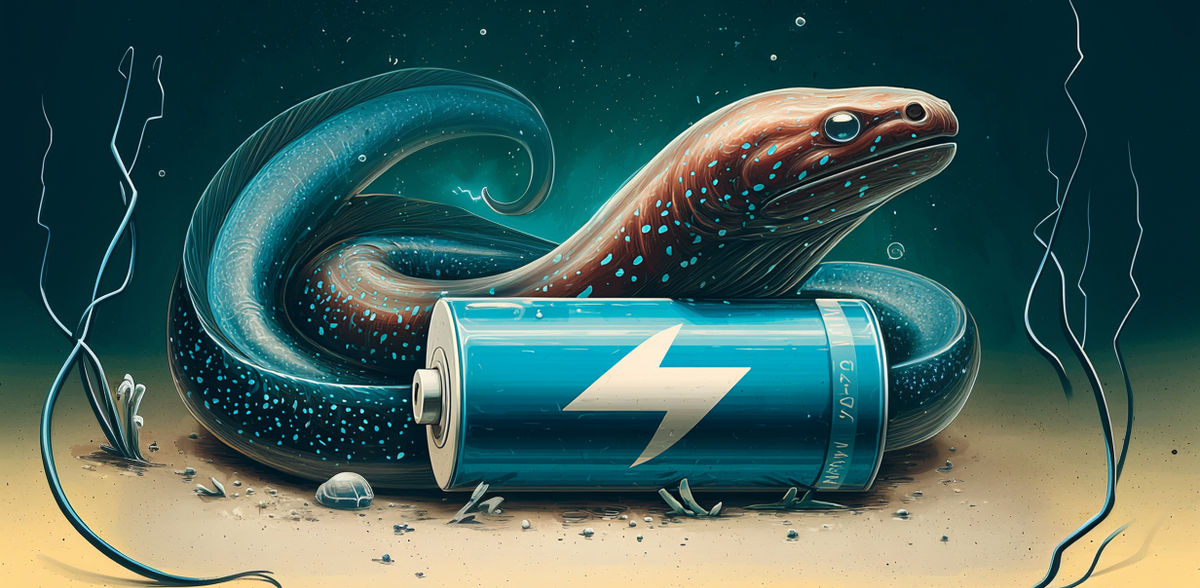
Power sources used in devices found in or around biological tissue must be flexible and non-toxic, while still powerful enough to support demanding technologies such as medical devices or soft robotics. To achieve this balance, researchers at Penn State are taking inspiration from a “shocking” place: electric eels.
The team used a state-of-the-art fabrication method to layer multiple types of hydrogels — a water-rich material capable of conducting electricity — in a specific pattern that mimics the ionic processes electric eels use to generate electrical bursts. Their approach produces power sources with higher power densities than other hydrogel-based designs, while remaining flexible, support-free, environmentally stable and biologically compatible. They published their findings in Advanced Science.
According to Joseph Najem, assistant professor of mechanical engineering and corresponding author on the paper, researchers have looked to the biology of electric fish, such as eels, as inspiration to develop soft power sources previously. However, most existing eel-inspired devices produce limited power and require mechanical support to function. To address these problems, the team adjusted the material chemistry to fabricate very thin hydrogels, which can produce more power without the need of mechanical supports.

“The electrocytes in electric eels are ultra-thin biological cells, capable of generating over 600 volts of electricity in a brief burst,” Najem said. “These cells achieve very high-power densities, meaning they can produce a lot of power from small volumes.”
The team built their power sources from only hydrogel to ensure the batteries remained non-toxic and flexible, even as they became more powerful.
“For biomedical and near-biology applications, we have to make sure that batteries are compatible with their surroundings, flexible, safe and ideally capable of using available resources to recharge,” Najem said. “This motivated us to develop our strong power sources in a hydrogel-based system, which would operate well within biological environments.”
Using spin coating, a technique that deposits ultra-thin layers of material on a rotating surface, the team layered four different hydrogel mixtures, each only 20 micrometers thick — a fraction of the width of a human hair. This thin geometry reduces internal resistance, which is essential for producing high power, while preserving mechanical strength and flexibility, Najem explained.
“In earlier studies, hydrogels typically required external support structures, which made this approach impractical and led to low-power outputs,” said Dor Tillinger, doctoral candidate of mechanical engineering and co-first author on the paper. “We found that using thin hydrogel naturally reduced the internal resistance of the material, which increased the power densities we could output.”
To make their hydrogel thinner, the team had to adjust the chemistry. Wonbae Lee, doctoral candidate in materials science and engineering and co-first author, explained how the team tested several approaches before deciding on the optimal mixture.
“We had to carefully tune the chemical mixture so the hydrogel could spread uniformly during spin coating, remain mechanically stable and be thin enough to maintain low electrical resistance,” Lee said. “Conventional formulations would simply fly off the spinning surface during spin coating. Optimizing the viscosity and mechanical strength of our hydrogel was essential to making this approach work."
The team used instrumentation in Najem’s laboratory and at the Materials Research Institute to collect electrochemical measurements from their power sources, such as discharge rate, power density and conductive potential. Their new power sources showcased power densities around 44 kW/m3 — higher than previously reported hydrogel-based power sources, and capable of efficiently powering complex devices like implanted medical sensors, soft robotics controllers and wearable electronics.
“Additionally, these material optimizations enable operation in extreme environments,” Lee said. “By incorporating the chemical glycerol, the hydrogel power sources remain functional at temperatures as low as 80 degrees Celsius (C), or -112 degrees Fahrenheit (F), without freezing.”
The material also retains water longer than conventional hydrogels. While standard hydrogels can dehydrate within a few minutes and lose conductivity, the new formulation can remain hydrated for days in air, Najem said.
“To our knowledge, this is the first power source entirely contained within a hydrogel solution that requires no external support,” Najem said. “We are not aware of any other hydrogel technology that can achieve these power densities while remaining flexible and environmentally stable.”
According to Tillinger and Lee, future work will focus on further increasing the power density and recharging efficiency of the power sources, while also exploring self-charging capabilities.
Original publication


Other news from the department science










Most read news





More news from our other portals






















See the theme worlds for related content
Topic World Battery Technology
The topic world Battery Technology combines relevant knowledge in a unique way. Here you will find everything about suppliers and their products, webinars, white papers, catalogs and brochures.

Topic World Battery Technology
The topic world Battery Technology combines relevant knowledge in a unique way. Here you will find everything about suppliers and their products, webinars, white papers, catalogs and brochures.