Scientists optimized wastewater use for green hydrogen production through artificial intelligence
Advertisement


Scientists from the Departments of Inorganic Chemistry and Chemical Engineering of the University of Malaga participate in an international collaboration which has optimized, through artificial intelligence, the process of producing bio-hydrogen from wastewater.
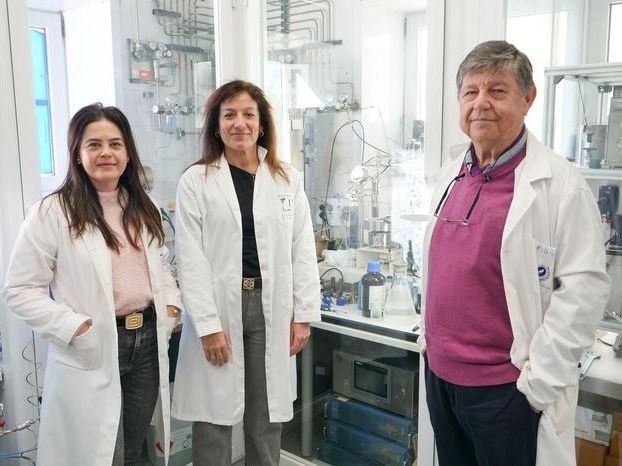
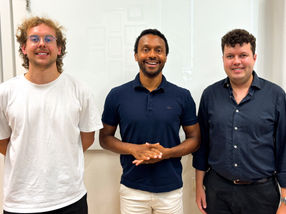
M. Cruz López Escalante, Olga Guerrero Pérez y Enrique Rodríguez Castellón, researchers from the University of Malaga
University of Malaga
It is a consortium involving researchers from countries such as Vietnam, South Korea, India and Taiwan, which, moreover, is financially supported by the company ACOSOL, Fundación Unicaja and the State Research Agency (Spanish Ministry of Science, Innovation and Universities).
“Developing processes for the use and valorization of wastewater is necessary to improve the sustainability of water resources and protect the environment,” says Enrique Rodríguez Castellón, Professor at the Faculty of Sciences, one of the authors of this study, who adds that hydrogen is an "essential raw material in the chemical and metallurgical industries and a key energy vector in decarbonization."
Therefore, as noted in this study, which has been published in the scientific journal Energy, the use of wastewater to produce green hydrogen –considered to be the fuel of the future– is a sustainable process with great potential, since it contributes to saving drinking water, optimizing waste and reducing the use of fossil resources.
A new path
This research has precisely succeeded in optimizing the efficiency of this process, which is carried out through dark fermentation –a method that consists in using anaerobic microorganisms to break down the organic matter present in wastewater to produce bio-hydrogen– although, so far, it has been possible with variables that affect its efficiency and limits in its commercial use.
Therefore, the use of artificial intelligence and machine learning opens a new path to creating predictive models to enhance chemical processes such as dark fermentation. “These models facilitate the identification and learning of patterns, leading to greater accuracy in predictions and system control”, says Rodríguez Castellón.
A novel method
The study of this international consortium has proven that developing predictive models for this process to improve its efficiency is possible, fine-tuning the procedure and saving time and costs.
Moreover, the study describes a novel AI-assisted method that would displace more conventional ones, using real-world test data to build predictive models. In addition, it has been used to optimize energy recovery and minimize organic waste from the process, improving its sustainability.
Original publication
Anh Tuan Hoang, Wei-Hsin Chen, M. Olga Guerrero-Pérez, Enrique-Rodríguez Castellón, María Cruz López-Escalante, Van Nhanh Nguyen, Prabhu Paramasivam, Xuan Phuong Nguyen, Thanh Hai Truong; "Turning waste into energy: Application of machine learning and explainable artificial intelligence for determining key factors in wastewater-to-hydrogen conversion"; Energy, Volume 344


Other news from the department science