Sustainable chemistry: iron replaces precious metals in catalysis
Researchers develop iron(I) source for catalytic reactions - approach aims to make chemical processes more sustainable
Advertisement


Many everyday and industrial products are created with the help of chemical catalysts, such as pharmaceuticals, plastics and coatings. Expensive and limited precious metals are often used for this purpose. Researchers at the Karlsruhe Institute of Technology (KIT) have now presented the first iron compound that is stable in air, makes iron(I) directly usable for catalysis and, unlike previously, does not require strong reducing agents. In an initial test, active iron catalysts were created from this. Results in the Journal of the American Chemical Society.
Catalysts ensure that chemical reactions take place faster or are possible in the first place. In established processes, this task is performed by precious metals such as rhodium, iridium or palladium. They are well suited to many applications, but are expensive and rare. "The focus of our research is on sustainable and environmentally friendly alternatives to precious metal catalysts," explains Dr. Oliver Townrow from the Institute of Nanotechnology at KIT. "Iron is the fourth most common element in the earth's crust and can perform similar tasks to precious metals in certain catalytic reactions."
Stabilizing reactive iron
The work focuses on a modular, pre-activated iron(I) source for catalysis. The Roman numeral here describes the electronic state of the metal. Iron is usually present in chemical compounds as iron(II) or iron(III). However, iron(I) is particularly suitable for certain catalytic reactions because it can accept or release electrons more easily. This enables other reaction pathways.
Until now, there has been no comparably stable starting compound that makes iron(I) directly available for catalytic applications. Researchers therefore often had to generate this form of iron during the reaction using additional substances. Such reducing agents bring iron into the desired reactive form, but can also change other components. "This makes it difficult to control exactly which iron compound is produced in the reaction and how it reacts further," explains Luise Kink, first author of the study and chemistry student at KIT. "With our approach, we can now use this reactive form of iron more reliably."
Producing and testing new iron compounds
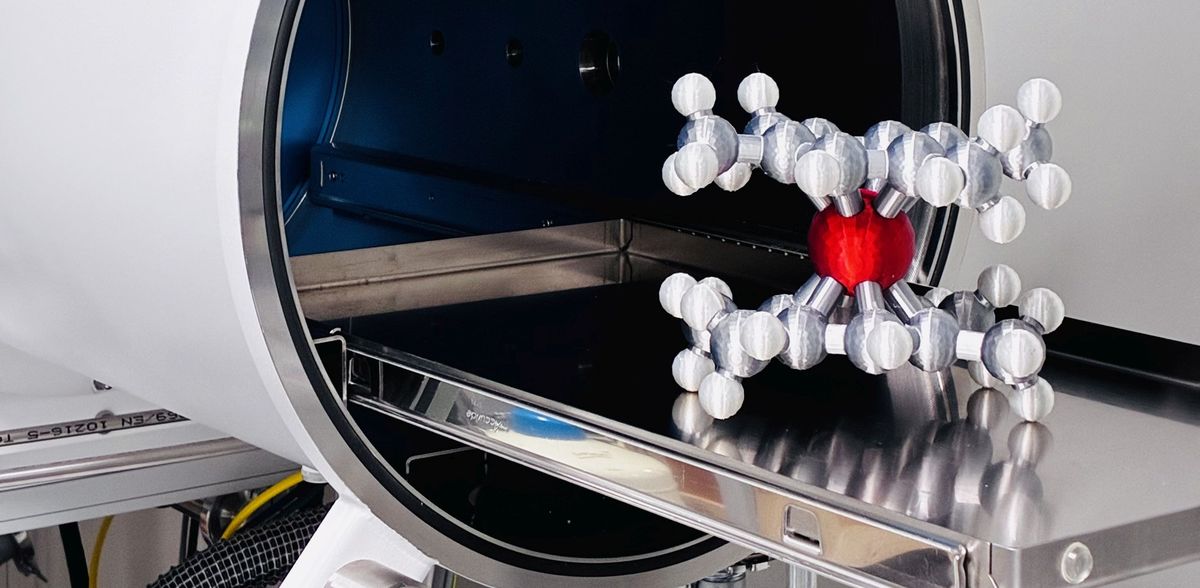
In their experiments, the team initially produced iron(I) as a separate compound outside of the actual catalysis: The iron was placed between two ring-shaped hydrocarbons, called Duren molecules, which stabilize the reactive metal. In this way, the sensitive iron(I) remains sufficiently stable against atmospheric oxygen and moisture to be used in further reactions.
The researchers then specifically replaced the duren with other molecules to produce various iron(I) compounds. They analyzed these using X-ray structure analysis, spectroscopic methods and magnetic measurements, among other things. In an initial catalytic test, they also showed that an active iron catalyst can be formed from the new compound.
Further developing iron catalysts
The new iron(I) compound creates a basis for further applications. Researchers can now test more systematically which variants are suitable for certain catalytic reactions. "Our result shows that we can prepare iron(I) for catalysis better and use it in a more controlled way than before," says Townrow. "In the long term, our approach should help to replace precious metals with iron in industrial applications."
Note: This article has been translated using a computer system without human intervention. LUMITOS offers these automatic translations to present a wider range of current news. Since this article has been translated with automatic translation, it is possible that it contains errors in vocabulary, syntax or grammar. The original article in German can be found here.
Original publication


Other news from the department science