Vacuum pump without motor: Thin films - the stuff new pumps are made of
Research team presents vacuum pump prototype with double film drive - spin-off mateligent brings the technology to industry
Advertisement


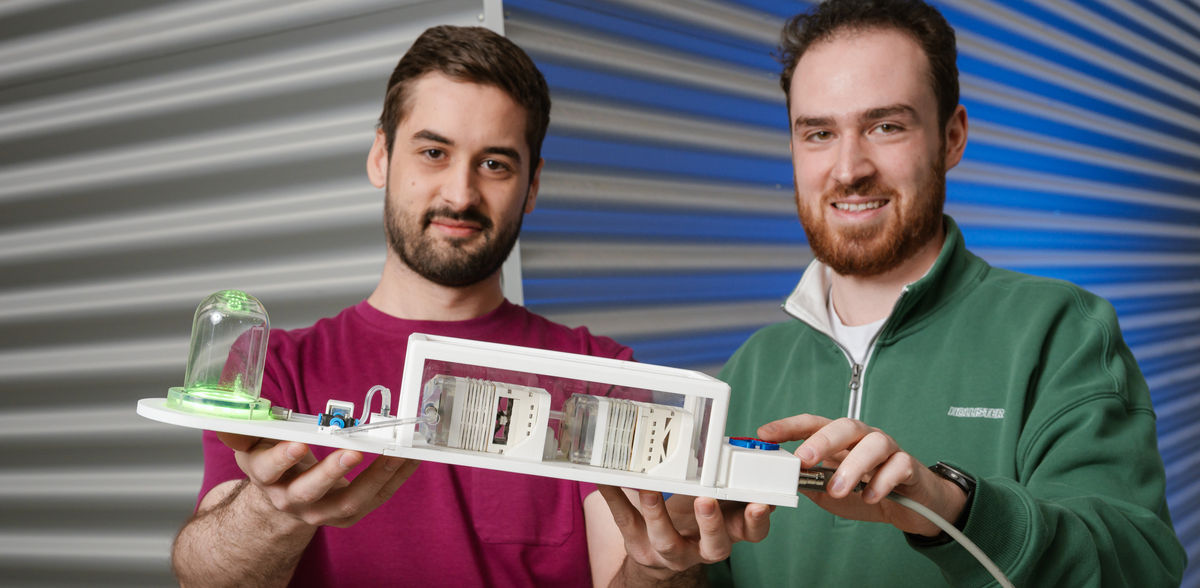
A thin silicone film ensures that pumps do not require motors, compressed air, lubricants or additional sensors. They can be switched as required and accommodated in previously impossible designs. Wherever vacuum is needed in industry and manufacturing, vehicle technology or laboratories and research, the film technology makes lightweight, flat and energy-efficient pumps possible. Professor Paul Motzki's team from Saarland University will be demonstrating the technology at the Hannover Messe.
The plastic film starts to move as soon as the researchers apply an electrical voltage to it. At 50 micrometers, the film is about as thick as a hair. Professor Paul Motzki's team makes it tap vigorously, vibrate, rise and fall slowly in a flowing movement or remain in one position - simply by changing the electrical voltage. What sounds like a nice gimmick is the stuff of which innovative mini-motors are made.
Because the researchers can control the film, it can take on tasks, such as pushing or pulling something. It can perform movements for which technical equipment would otherwise require motors or air compressors, which takes up a lot of space, energy and maintenance. The research team is also installing smart foils in vacuum pumps to draw air or liquid out of a chamber. Vacuum pumps are indispensable in industrial and technical practice and are used everywhere, from packaging machines and robot grippers to medical technology.
Vacuum without compressed air, without a motor
The film technology does not require any heavy components, it is light and compact. "With dielectric elastomers, as the films are called, we can adapt the design of the pumps to the respective requirements. We can also implement shapes that are not technically possible with conventional processes, such as very thin and flat geometries comparable to the shape of a smartphone," says Paul Motzki. The Professor of Smart Material Systems at Saarland University is Managing Director of the Center for Mechatronics and Automation Technology (Zema). The films also pump in small, delicate environments. The technology does not require rare earths or copper and does not need lubricating oil. This makes it suitable for use in clean rooms and sterile environments. "Depending on the operating mode, pumps made of film can also be very energy-efficient," says Paul Motzki. What's more, foil pumps are quiet - an advantage that could significantly reduce background noise in production halls.
More film drives, more power
At this year's Hannover Messe, the research team is using a new prototype to demonstrate how the technology can be scaled up. To this end, the researchers equipped a vacuum pump prototype with a dual drive. While the vacuum pump they showed at the trade fair last year had a drive made of foil in one pump chamber, the new pump now has two drives in two pump chambers. "We can connect the two actuators in the pump chambers either in parallel or in series, thereby increasing the pressure, volume flow and also the performance," explains Paul Motzki.
The two foil actuators can work alternately as opposing forces: While one foil is loaded, the other is unloaded. As a result, the output does not drop and the pump draws a continuous vacuum quickly and cycle-free in a glass bell jar - with more volume flow and pressure behind it. When the two film motors work together, the pump delivers more power. While the single pump managed up to 300 millibar absolute pressure in 2025, it now manages less than 200 millibar. "Of course, we can also connect more films in series or in parallel and thus adapt and increase the performance - depending on the application," says Paul Motzki.
A further step towards use in industry
"The new version of the pump is a further step towards industrial practice," says Paul Motzki. He and his team have been working on film technology in numerous research projects for years. Its functionality is based on an electrically conductive, highly stretchable electrode layer, which is printed on the front and back of the film. When the researchers apply an electrical voltage here, the two printed layers attract each other electrostatically: The film compresses even flatter and expands in width at the same time. "If we change the electrical field, we can control the dielectric elastomer with any frequency and oscillation and make it vibrate or perform infinitely variable slow, fast and powerful lifting movements," explains Motzki. The foil can also hold any desired position. It only consumes electricity when it is in action. The Saarbrücken researchers use the foil like a drive: a mini motor that does not require any additional sensors.
"The films themselves are their own sensor," says Paul Motzki. The dielectric elastomers also provide this function. The measured values of the electrical capacitance change with the slightest movement. Each deformation of the film has its own characteristic sequence of numbers. Using this measured value, the engineers can read exactly how the foil is mechanically deflected, i.e. how it is currently deforming. In a control unit, they use this measurement data to program precise motion sequences using machine learning methods. As a result, the foils draw a vacuum in motorless vacuum pumps, dose liquids as valves or serve as stepless switches. They can also monitor their own function: The measurement data shows if a foreign object is blocking the pump or if the vacuum has not been safely drawn.
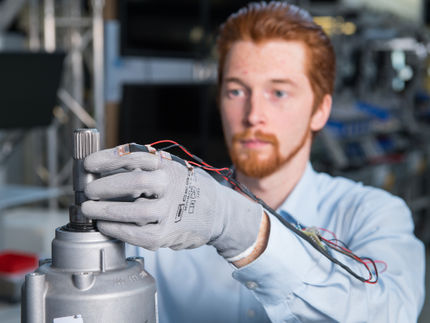
In other projects, Motzki's team uses the films for robot grippers, loudspeakers and also applications such as haptic feedback on smartphone displays or smart textiles: for example, in intelligent work gloves, which act as an interface to the technology and tell it how the hand and fingers are currently moving.
At the Hannover Messe, the research team is looking for partners with whom it can further develop the pump technology for practical use on a mass scale.
The background
Many young scientists are also researching dielectric elastomer technology as part of their master's and doctoral theses. It is the subject of numerous publications in specialist journals and has been funded in several research projects, including by the EU, the German Research Foundation (DFG), the Saarland state government as part of the ERDF projects iSMAT, V-Pro Saar and Multi-Immerse, as well as the Saarland Metal and Electrical Industry Association (ME Saar).
In order to put the results into industrial practice, the researchers have founded the company mateligent GmbH from within the university, which will also be represented at the Saarland stand at the Hannover Messe.
Note: This article has been translated using a computer system without human intervention. LUMITOS offers these automatic translations to present a wider range of current news. Since this article has been translated with automatic translation, it is possible that it contains errors in vocabulary, syntax or grammar. The original article in German can be found here.


Other news from the department science











These products might interest you


Most read news









More news from our other portals























Something is happening in the chemical industry ...
This is what true pioneering spirit looks like: Plenty of innovative start-ups are bringing fresh ideas, lifeblood and entrepreneurial spirit to change tomorrow's world for the better. Immerse yourself in the world of these young companies and take the opportunity to get in touch with the founders.