The structure of water: entropy determines whether ions adhere
Atomic force microscopy and molecular dynamics simulations provide the basis for more precise predictions in battery and membrane research
Advertisement


water molecules do not simply swirl around in disorder, they can form certain preferred structures. This scientific fact is often presented in a completely unscientific way, for example when there is talk of an alleged "water memory" or of "water clusters" as a possible explanation for homeopathy, for example.
All of this has been refuted, but even if water is not a magical store of information, its ability to form structures in the short term can have important consequences. This has now been demonstrated by a study conducted by TU Wien in collaboration with the University of Vienna and the University of Oslo as part of the FWF-funded Cluster of Excellence "MECS": the researchers investigated how easily charged particles can be held on to a surface - a question that is important in many areas, such as research into batteries, fuel cells and biological membranes. New results show: This can only be understood if the structures that water forms on a nanosecond scale are taken into account.
An ion rarely comes alone
"When positively charged ions in an aqueous solution attach themselves to a negatively charged surface, this actually sounds very simple from a physical point of view," says Markus Valtiner from the Institute of Applied Physics at TU Wien. "Opposite electrical charges attract each other, so the particle moves towards the surface. But in reality, things are a little more complicated."
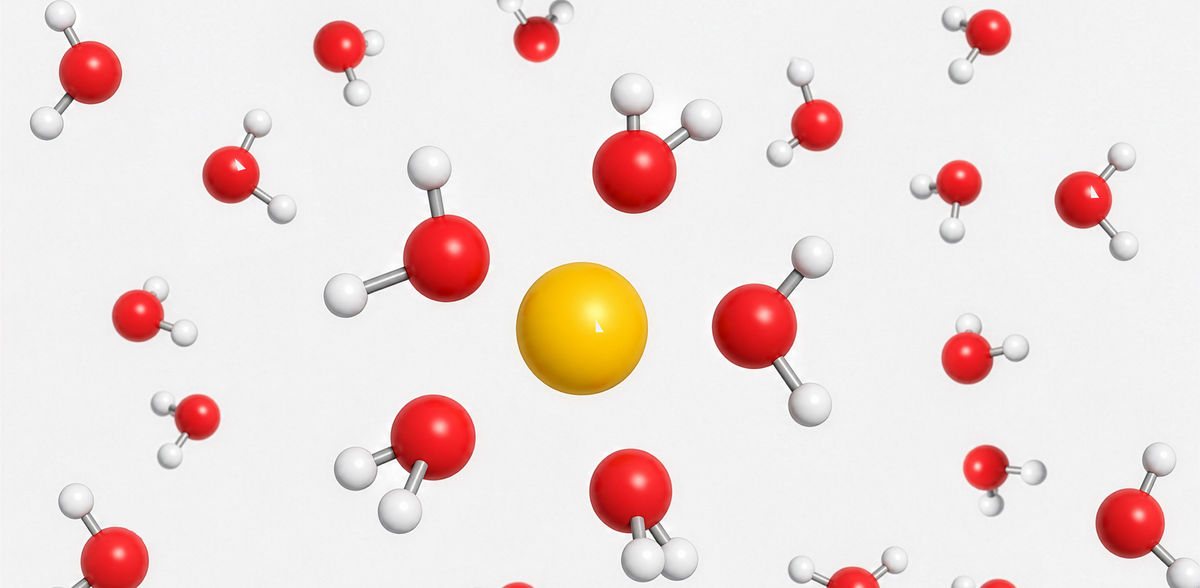
Charged particles do not move alone in water. They are surrounded by water molecules, and these can arrange themselves in different ways. The degree to which this arrangement is pronounced depends on the particle: "Lithium ions, for example, are tiny and can arrange the water around them very strongly. Caesium ions, on the other hand, are large and the effect is much smaller," says Markus Valtiner.
Ordered water - but only for nanoseconds
However, this order should not be thought of as ordered atoms in a crystal. "This order is of a statistical nature," explains Markus Valtiner. "The water molecules vibrate continuously, they move very quickly, they constantly redistribute themselves, form weak bonds and break them again."
This means that the water molecules are not "information stores", as is sometimes incorrectly portrayed, but rather perform a kind of "dance" around the ion, and this dance obeys certain rules. The dance of water around a lithium or calcium ion is - statistically speaking - in a certain sense more orderly than the dance of water around the caesium ion.
When the ions move to the surface, they carry this water-shell dance with them. If the ion then attaches itself, the water around it is forced to structure itself differently than it otherwise would.
"Ions that have a stronger influence on the surrounding water molecules create more order in the water - thermodynamically speaking, this means that they create a state of lower entropy," explains Markus Valtiner. "And the lower the entropy, the less likely it is that such a state will arise by itself. Such ions are therefore less likely to accumulate directly on the surface."
No esoteric "water memory"
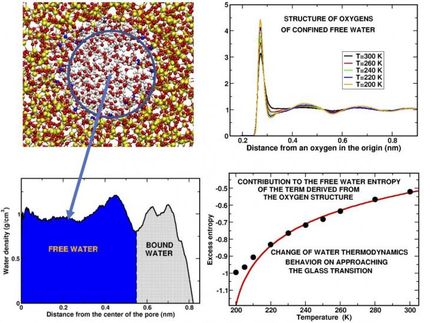
The research team combined high-resolution atomic force microscopy, molecular dynamics simulations and spectroscopic measurements to measure these surface effects. This resulted in a thermodynamic model that can now be used to quantitatively describe the adsorption of particles: For the first time, the different effects are considered together here - electrostatic attraction on the one hand, but also entropy, order probability and interaction with surrounding water molecules.
This means that it is now possible to predict which ions will adhere to a surface and how they will behave there, for example in batteries, electrodes, catalysts or biological membranes. Not only the electrical charges have to be taken into account - but also the statistical order of the water.
"This is not a magical water memory, it has nothing to do with esoteric ideas about water information," emphasizes Markus Valtiner. "It is simply a physically highly interesting dynamic behavior between different ions and the surrounding water molecules - and we have found a quantitative model that can be used to precisely describe this interaction."
Note: This article has been translated using a computer system without human intervention. LUMITOS offers these automatic translations to present a wider range of current news. Since this article has been translated with automatic translation, it is possible that it contains errors in vocabulary, syntax or grammar. The original article in German can be found here.
Original publication


Other news from the department science










Most read news







More news from our other portals


















See the theme worlds for related content
Topic World Battery Technology
The topic world Battery Technology combines relevant knowledge in a unique way. Here you will find everything about suppliers and their products, webinars, white papers, catalogs and brochures.

Topic World Battery Technology
The topic world Battery Technology combines relevant knowledge in a unique way. Here you will find everything about suppliers and their products, webinars, white papers, catalogs and brochures.
Topic World Spectroscopy
Investigation with spectroscopy gives us unique insights into the composition and structure of materials. From UV-Vis spectroscopy to infrared and Raman spectroscopy to fluorescence and atomic absorption spectroscopy, spectroscopy offers us a wide range of analytical techniques to precisely characterize substances. Immerse yourself in the fascinating world of spectroscopy!

Topic World Spectroscopy
Investigation with spectroscopy gives us unique insights into the composition and structure of materials. From UV-Vis spectroscopy to infrared and Raman spectroscopy to fluorescence and atomic absorption spectroscopy, spectroscopy offers us a wide range of analytical techniques to precisely characterize substances. Immerse yourself in the fascinating world of spectroscopy!