Nanoparticles enable new combinations of previously immiscible metals
Advertisement


metals have a wide range of properties. Combining these with each other opens up new perspectives for many future technologies. However, some metals cannot yet be mixed with each other. At the Karlsruhe Institute of Technology (KIT), chemist Professor Claus Feldmann is using metal nanoparticles as a mediator to create new types of alloys. The German Research Foundation (DFG) is funding his project as a Reinhart Koselleck project for highly innovative and risk-taking projects with 750,000 euros over five years.
"Metallic materials are the basis for important components of many future technologies, for example in the fields of energy, electronics, automotive and aerospace," says Professor Oliver Kraft, Vice President Research, Teaching and Academic Affairs at KIT. "With his nanoparticle research, Claus Feldmann is laying the foundations for completely new types of alloys. We are proud of this outstanding scientist and congratulate him on winning the DFG's highest endowed excellence funding for individuals with a Reinhart Koselleck project."
Professor Claus Feldmann, research group leader at the Institute of inorganic chemistry at KIT, is investigating "Nanoparticles as shuttles for alloying immiscible base metals" - the title of his project. This means that nanoparticles serve him as mediators to bring together metals that have not yet been able to be mixed. After all, 80 percent of all known chemical elements are metals. They are characterized by high electrical conductivity, high thermal conductivity, plastic deformability and metallic luster. Apart from this, they have different, sometimes even opposing properties. The fusion of such metals could make new high-performance materials possible in the future.

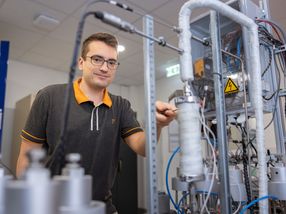
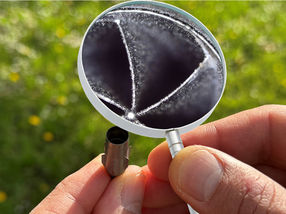
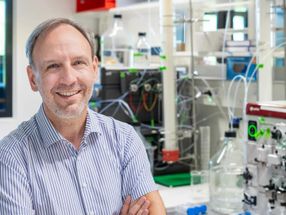
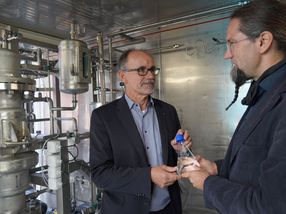
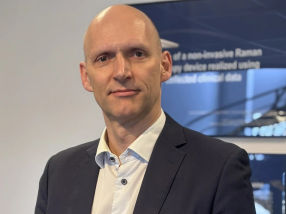
Professor Claus Feldmann uses nanoparticles to bring together metals that previously could not be mixed.
Copyright: Markus Breig, KIT
Speed of reaction outwits nanoparticles
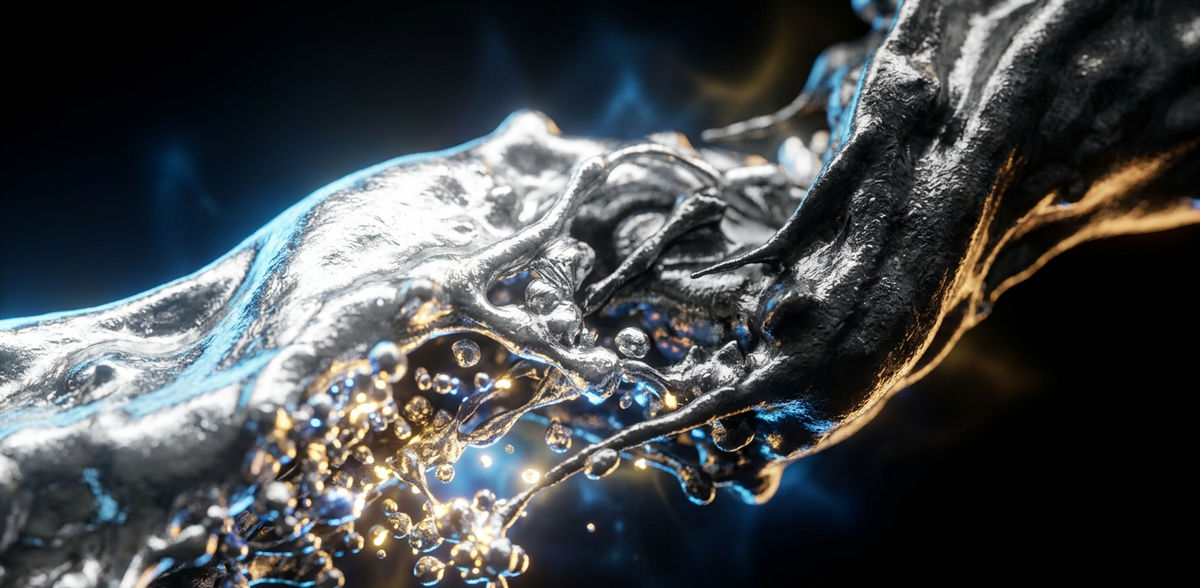
However, some metals are immiscible in the solid phase and do not form thermodynamically stable bimetals. "Light metals, for example, are light, soft and reactive. Hard metals, on the other hand, are hard, have a high melting point and are inert. Combining these properties opens up interesting prospects, but has often not been possible until now," says Feldmann. He and his team use nanoparticles of the metals and are working on kinetically forcing an atomic-statistical distribution of metals in nanoparticles through rapid reduction near room temperature in the liquid phase. "This chemical reaction takes less than a second, so that the nanoparticles have no time at all to separate from each other again," explains Feldmann. "In this way, we ensure that both metals are contained in the mixture to the same extent and are evenly distributed."
Preliminary work with nanoparticles of different metals has already given the research group unique access to previously impossible bimetals. Their properties can differ significantly from those of monometals, for example in terms of reactivity, crystallization and thermal properties.
New bimetals with unusual properties
In addition to the fundamental question of how alloys of previously immiscible base metals can be produced as shuttles using bimetallic nanoparticles, Feldmann is also investigating the possibility of establishing completely new bimetals with unusual properties. This could, for example, drive the further development of metallic glasses, catalysts and high-entropy materials made from five or more elements. The DFG is funding the Reinhart Koselleck project with 750,000 euros over five years. The project starts on June 01, 2026.
Note: This article has been translated using a computer system without human intervention. LUMITOS offers these automatic translations to present a wider range of current news. Since this article has been translated with automatic translation, it is possible that it contains errors in vocabulary, syntax or grammar. The original article in German can be found here.


Other news from the department science