Producing nanoparticles more efficiently by laser
Laser-based nanoparticle production experimentally clarified and new productivity record achieved
Advertisement


nanoparticles are tiny particles that are around a thousand times smaller than the diameter of a human hair. They play a central role in areas such as catalysis in energy technology and biomedical imaging. HM alumnus Dr. Maximilian Spellauge wrote his dissertation at the University of Duisburg-Essen as part of a cooperative doctorate with Munich University of Applied Sciences (HM), in which he systematically investigated the fundamentals of laser-based manufacturing processes. He achieved two groundbreaking results: The maximum achievable power-specific productivity for laser ablation in liquid is 75 milligrams per hour and watt for gold, almost four times higher than the previous record value of 21 mg/h/W. For the splitting of individual microparticles into smaller ones, Spellauge even achieved 720 mg/h/W, almost a whole order of magnitude more.
From the individual pulse to the overall image: systematic investigation under controlled conditions
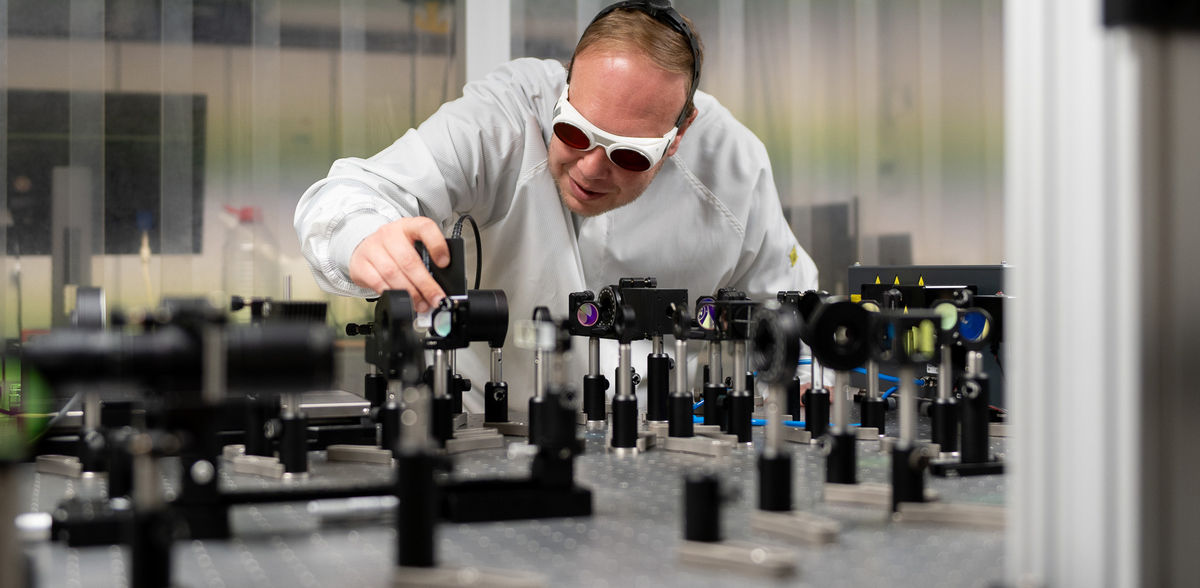
Spellauge carried out targeted single-pulse laser experiments in order to rule out any disruptive influences from bubble formation or particles that had already been generated. The ablation of gold in liquid and the fragmentation of individual gold microparticles in liquid were investigated. Measurements of the transmission and reflection of light provided precise information on the absorbed energy. Using pump-probe microscopy, a method that makes processes visible in the picosecond to millisecond time range, he followed the entire process of laser-matter interaction.
Two paths, one goal: a comparison of the mechanisms of nanoparticle formation
Spellauge demonstrated two formation mechanisms in the ablation of gold in liquid: Evaporated material condenses into very small particles under ten nanometers; the decay of a mechanically dissolved surface layer produces larger particles in the range of several tens of nanometers. The efficiency in liquid is lower by a factor of four compared to ablation in air because some of the ablated material falls back. The most efficient pulse durations in this process are between 10 picoseconds and 1 nanosecond.
Spellauge identified three mechanisms for the fragmentation of individual gold microparticles: firstly, the so-called photothermal phase explosion, in which the particles of the material suddenly change to a gaseous state, the subsequent spallation as gold particles flake off, and pressure focusing. In the latter, the superimposition of pressure waves leads to a local increase in pressure in the particle, which favors its fragmentation into larger pieces. Around two percent of the absorbed energy was converted into a new particle surface, compared to only 0.1 percent when solid bodies were ablated. "The results show that the fragmentation of individual particles is much more energetically efficient than the ablation of a solid in liquid. At the same time, it becomes clear which physical mechanisms determine the particle size - and how we can specifically influence these in the future," says the researcher.
Sustainable nanoparticle production: applications in catalysis and energy technology
The findings offer concrete starting points for process optimization: in the case of ablation in liquid, pulse splitting or extended pulse duration of the laser increase productivity and improve the particle size distribution. In fragmentation, the spatial shaping and splitting of the laser beam also lead to higher productivity and a more targeted adjustment of the particle size distribution. Laser-based processes do not require any chemical additives and comply with the principles of green chemistry. Spellauge sees fields of application primarily in catalysis and sustainable energy technology. Future studies will observe the formation of particles in a time-resolved manner and combine experimental data with numerical simulations.
The dissertation entitled Laser-based Nanoparticle Generation in Liquids: Mechanistic Insights for Advancing Size Control and Process Efficiency was supervised by Maximilian Spellauge at Munich University of Applied Sciences (HM) as a cooperative doctorate by Prof. Dr. Heinz P. Huber (HM), Prof. Dr. Stephan Barcikowski from the University of Duisburg-Essen (UDE) and Dr. Anton Plech from the Karlsruhe Institute of Technology (KIT). The work was carried out in cooperation with the University of Duisburg-Essen (UDE), in particular at the Technical Chemistry and Center of Nanointegration Duisburg-Essen (CENIDE). Dr. Maximilian Spellauge is a postdoc at the HM.
On April 23, 2026, Dr. Maximilian Spellauge received the Oskar von Miller Prize of the Munich University of Applied Sciences for the best doctorate.
Note: This article has been translated using a computer system without human intervention. LUMITOS offers these automatic translations to present a wider range of current news. Since this article has been translated with automatic translation, it is possible that it contains errors in vocabulary, syntax or grammar. The original article in German can be found here.
Original publication


Other news from the department science