New aluminum-ion cell chemistry on the battery test bench
From research to practice and back again: requirements-driven material development
Advertisement


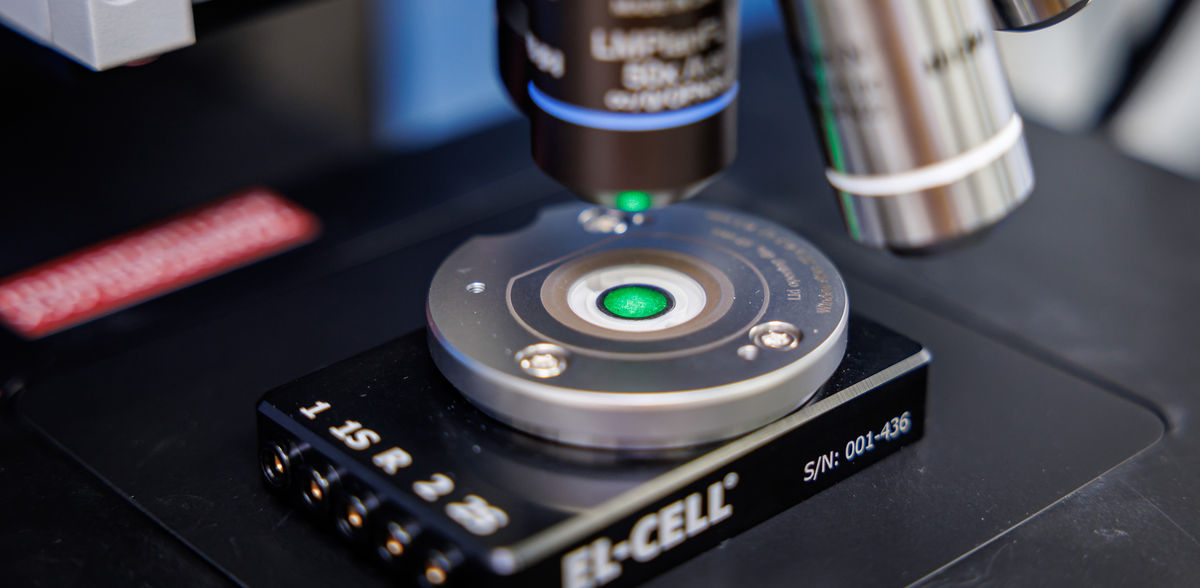
Efficient and environmentally friendly storage technologies such as the lithium-free aluminum-ion battery (AIB) are essential for a secure and climate-neutral energy supply. The SALSA research project (development of application-specific aluminum-ion batteries using innovative passive and active materials) focuses on the validation and further development of the AIB. The potential applications of this new cell chemistry for grid stabilization are being tested in practice in SALSA using standardized battery testing procedures.
The expansion of a sustainable power supply with increasing electrification of transport, industrial processes and building heating requires efficient electricity storage systems. In addition to storing large amounts of energy, for example for day/night or seasonal balancing, it is essential to stabilize the power grid through the highly dynamic smoothing of load peaks. Sensitive areas in industry, commerce and infrastructure benefit in particular from uninterruptible power supplies (UPS). The new aluminum-ion battery is suitable for such low-maintenance stationary applications due to its excellent cycle stability and power density. Compared to the battery technologies currently commercially available, e.g. lithium or lead-based, the AIB is a sustainable alternative: it offers clear advantages in terms of cost, availability of raw materials and environmental balance.
From research to practice and back again: requirements-driven material development
In the INNOBATT project, which was successfully completed in 2025, small-format AIB cells were manufactured in pouch cell format and integrated into a system demonstrator. This important step of demonstrator operation allows conclusions to be drawn about the actual performance of the new cell technology, as only scaling up to battery modules reveals potential improvements for the pouch cells at material level. This results in the overall objective of the follow-up project SALSA: the development of new scalable materials for rechargeable AIBs with a focus on improving power density, energy efficiency and cycle stability. The use of operando analytics provides the necessary basic understanding of the mechanisms. Using standardized battery test procedures, the specific application possibilities of the AIB for a UPS are to be tested in a practical manner. These tests also result in a feedback loop from the application directly back to material development.
The SALSA project can build directly on the findings from previous projects such as INNOBATT. AIB cells or modules with a standard service life are already available at the start of the project. These modules will be tested under application-related load and environmental conditions. Over the course of the project, at least three different development stages of the modules will be put to the test in order to continuously improve the active and passive materials in an iterative process. This enables the active and passive materials to be further developed in parallel with validation. The composition of the consortium with expertise from the fields of material development and surface modification, test cell development as well as battery production and evaluation allows both the further development of AIB cell chemistry through knowledge-based material research and the validation of this technology in concrete application-oriented test procedures.
SALSA project consortium
The SALSA project consortium comprises four industrial partners: HOPPECKE Batterien GmbH & Co KG as consortium leader, EL-CELL GmbH, IoLiTec Ionic Liquids Technologies GmbH and SKW Stickstoffwerke Piesteritz GmbH. On the academic and scientific side, the TU Bergakademie Freiberg (Institute of Inorganic Chemistry), the TU Clausthal (Research Center for Energy Storage Technologies) and the Fraunhofer-Gesellschaft with the institutes Fraunhofer IISB / Fraunhofer THM and Fraunhofer IAP are participating. SALSA is funded by the German Federal Ministry for Economic Affairs and Energy (BMWE) as part of the Electricity Grids and Storage area and runs from 01.08.2025 - 31.07.2028.
Note: This article has been translated using a computer system without human intervention. LUMITOS offers these automatic translations to present a wider range of current news. Since this article has been translated with automatic translation, it is possible that it contains errors in vocabulary, syntax or grammar. The original article in German can be found here.


Other news from the department science








Most read news







More news from our other portals




















See the theme worlds for related content
Topic World Battery Technology
The topic world Battery Technology combines relevant knowledge in a unique way. Here you will find everything about suppliers and their products, webinars, white papers, catalogs and brochures.

Topic World Battery Technology
The topic world Battery Technology combines relevant knowledge in a unique way. Here you will find everything about suppliers and their products, webinars, white papers, catalogs and brochures.