Sustainable and efficient production of ammonia and formic acid
Three-component catalyst developed for pulsed electrolysis
Advertisement


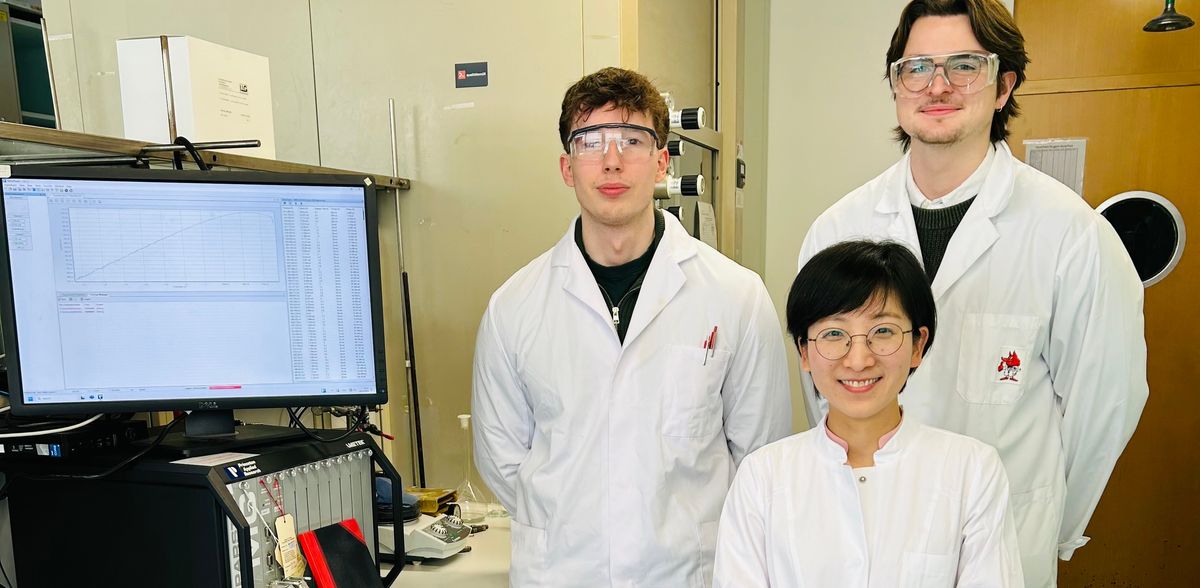
A research team led by Dr. Dandan Gao from the Department of Chemistry at Johannes Gutenberg University Mainz (JGU) has developed a new method for the sustainable production of ammonia and formic acid. Ammonia is indispensable in modern agriculture and, like formic acid, is an important raw material for industry. It is traditionally produced using the Haber-Bosch process, which is extremely energy-intensive and causes considerableCO2 emissions. It is also possible to produce ammonia by electrolysis, i.e. with the help of electricity, but this is still a young field of research. Electrolysis offers a sustainable alternative for production because it can be powered by green electricity. "We have now been able to achieve three key points," says Gao: "Firstly, we have developed a catalyst made of copper, nickel and tungsten that significantly increases the ammonia yield during electrolysis. Secondly, we were able to increase the yield once again by using pulsed instead of static electrolysis. And thirdly, we produce formic acid as a further product within the coupled electrochemical process." The team led by Gao and her colleagues Christean Nickel and David Leander Troglauer published the new method this week in the renowned scientific journal Angewandte Chemie.
Novel catalyst design
The researchers developed the novel so-called three-component tandem electrocatalyst in order to make the usual electrochemical reduction of nitrate to ammonia as efficient as possible. "We chose copper, nickel and tungsten for the following reasons," says Gao: "In order to produce ammonia from nitrate, the oxygen must first be removed from the nitrate - catalyzed by copper. Hydrogen must then be produced, which is where the nickel comes into its own as a catalyst. Now the hydrogen must not escape into the air or react in any other way, but must be selectively bound to the nitrogen: This is the task of the tungsten. Compared to tandem catalysts made of copper and nickel, which were already considered promising, our catalyst achieves an ammonia yield that is more than 50 percent higher," says Gao.
Pulsed instead of static electrolysis
The use of pulsed instead of static electrolysis increases the yield by a further 17 percent. The set-up is identical in both cases. The only difference is the electrical voltage applied to the electrodes. In static electrolysis it is constant, whereas in pulsed electrolysis it constantly alternates between two voltage values.
Additional production of formic acid
In every electrolysis, not only does a reduction reaction take place at the cathode, but also an oxidation reaction at the anode. "Normally, this is a water oxidation that produces oxygen," says Gao. However, oxygen is neither valuable nor in demand by industry. In the new method, the researchers therefore replace water oxidation and instead oxidize glycerol, a waste product of biodiesel production. This produces formic acid, which is used in industry in a variety of ways, for example as a starting material for chemicals and pharmaceuticals. "In this way, we can obtain two valuable products in one go: Ammonia from the cathode and formic acid from the anode," says Gao. "The strategic coupling of the two reactions underlines the potential of the method to sustainably produce value-adding chemicals via energy-efficient coupled electrolysis."
Note: This article has been translated using a computer system without human intervention. LUMITOS offers these automatic translations to present a wider range of current news. Since this article has been translated with automatic translation, it is possible that it contains errors in vocabulary, syntax or grammar. The original article in German can be found here.
Original publication
Christean Nickel, David Leander Troglauer, Chia‐Yu Chang, Tiansheng Bai, Tobias Rios‐Studer, Ingo Lieberwirth, Kevin Sowa, Boris Mashtakov, Bahareh Feizi Mohazzab, Lijie Ci, Deping Li, Xiaohang Lin, Bing Joe Hwang, Rongji Liu, Dandan Gao; "Sustainable Ammonia Electrosynthesis Coupled With Glycerol Valorization via an Adaptive Tri‐Component Catalyst"; Angewandte Chemie International Edition, 2026-2


Other news from the department science