Climate-friendly production of formic acid and hydrogen from the waste product glycerine
New electrolysis process could make an important contribution to the electrification of the chemical industry
Advertisement


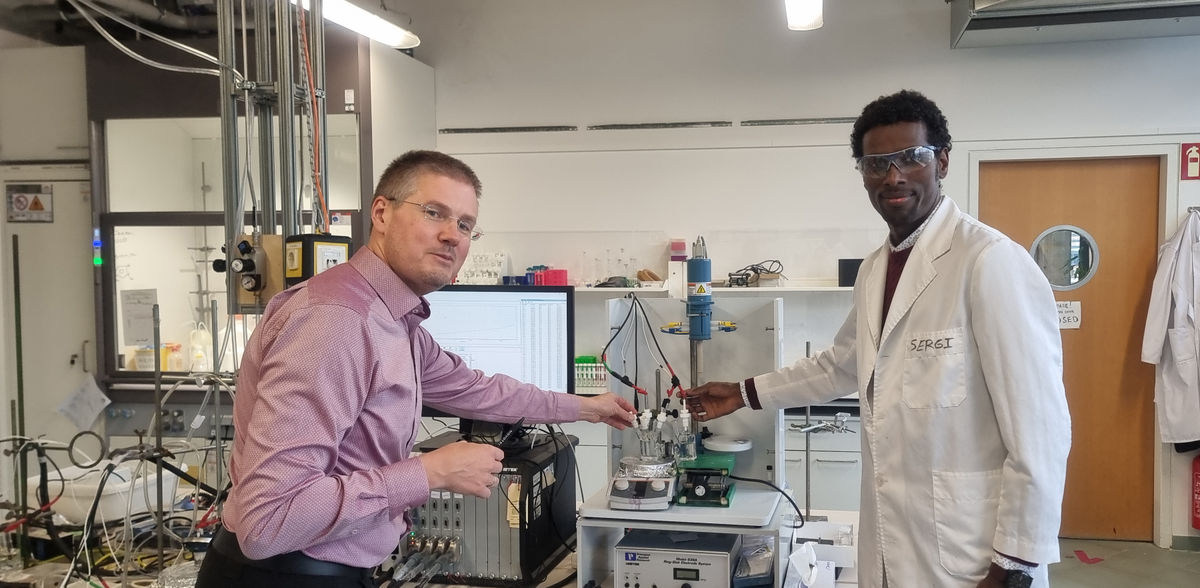
Researchers at Johannes Gutenberg University Mainz (JGU) have developed a method that can be used to produce the raw materials formic acid and hydrogen from the waste product glycerine. Formic acid has many uses in industry, while hydrogen can be used as an energy source for vehicles, for example. The new method also has the advantage that it works with electricity and can therefore be used in a CO2-neutral way. The research team recently published these results in the journal Advanced Energy Materials. "The approach we have developed can make an important contribution to the electrification of the chemical industry, which companies are currently driving forward on a large scale in order to reduce their CO2 emissions," says Prof. Dr. Carsten Streb from the Department of Chemistry at JGU, who led the study. "Processes that previously had to be carried out using large quantities of crude oil or natural gas could then be operated using sustainable electricity."
CO2-neutral production of formic acid
The approach originated from the already familiar hydrogen electrolysis process, in which water is split into hydrogen and oxygen using electricity. In "hybrid electrolysis", the researchers use glycerine as a starting material alongside water, which is produced in huge quantities in biodiesel production, among other things. Formic acid is then produced as a second product instead of oxygen. It is usually produced from crude oil, but this is associated with high CO2 emissions. "The electrochemical production of formic acid from glycerine, on the other hand, is CO2-neutral if it is carried out using green electricity," says Streb. Chemically speaking, the researchers break down glycerine, which has three carbon atoms, into formic acid with just one carbon atom during electrolysis.
New catalyst developed
The researchers have developed a new catalyst for the new method: This involves the two metals copper and palladium being in close proximity at an atomic level. "Not only have we developed the catalyst, but we already have a pretty good understanding of what the material does and how it could be optimized," says Streb. A collaborating team from the National Taiwan University of Science and Technology contributed theoretical and experimental findings.
In further steps, Streb and his team want to investigate how the expensive precious metal palladium in the catalyst can be replaced by cheaper materials. Methanol production is also on the agenda - after all, the demand for methanol is considerably greater than that for formic acid. It could possibly be made possible by adding a second reductive electrolysis process.
Note: This article has been translated using a computer system without human intervention. LUMITOS offers these automatic translations to present a wider range of current news. Since this article has been translated with automatic translation, it is possible that it contains errors in vocabulary, syntax or grammar. The original article in German can be found here.
Original publication
Soressa Abera Chala, Ekemena O. Oseghe, Keseven Lakshmanan, Marcel Langer, Katharina Potemkin, Paul Heim, Rongji Liu, Tobias Rios Studer, Meng‐Che Tsai, Kecheng Cao, Chun‐Chi Chang, Chia‐Yu Chang, Kevin Sowa, Elnaz Ebrahimi, Sarra Rahali, Simon T. Clausing, Sina Sadigh Akbari, Joachim Bansmann, Bing Joe Hwang, Carsten Streb; "Molecular Bottom‐Up Design of Single‐Site Copper‐Palladium Catalysts for Selective Glycerol Electro‐Oxidation"; Advanced Energy Materials, 2026-1-6



Other news from the department science